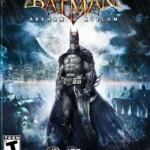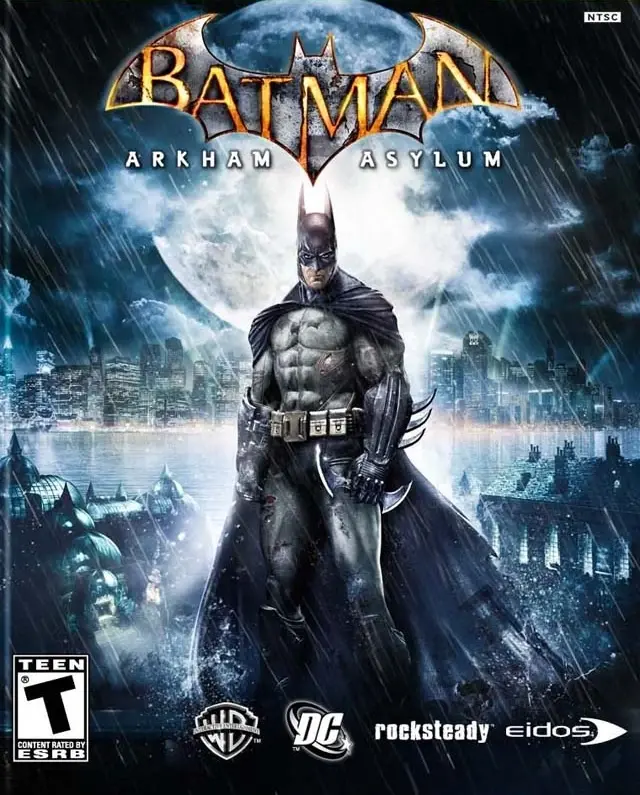
Batman: Arkham Asylum
 92
★ /10
92
★ /10
 Nintendo Switch
 PC
PC PS 3
PS 3 PS4
PS4 Xbox 360
 Xbox One
 ND Games, Warner Bros. Interactive
Where to buy




Batman: Arkham Asylum is a 2009 action-adventure game developed by Rocksteady Studios and published by Eidos Interactive. Released for PlayStation 3 and Xbox 360 on August 25, 2009 (with PC following on September 15), it is the first entry in Rocksteady’s Batman: Arkham trilogy and the game credited with establishing that superhero video games could be taken seriously as creative and commercial products.
It holds Metacritic scores of 92 on PS3 and 91 on Xbox 360 and PC. On release, it set the Guinness World Record for Most Critically Acclaimed Superhero Game. Seventeen years later, the r/patientgamers thread “Batman: Arkham Asylum — A Superhero Classic Worth Playing” sits in its Knowledge Panel as the defining community text: still being discovered, still earning the same verdict.
Technical Specifications
| Attribute | Details |
|---|---|
| Developer | Rocksteady Studios |
| Publisher | Eidos Interactive (original) · Warner Bros. Interactive Entertainment (GOTY and subsequent) |
| Director | Sefton Hill |
| Writer | Paul Dini |
| Composer | Nick Arundel |
| Engine | Unreal Engine 3 |
| Original Platforms | PS3 · Xbox 360 (Aug 25, 2009) · PC (Sep 15, 2009) |
| Remaster | Return to Arkham: Arkham Asylum (PS4, Xbox One · Oct 18, 2016) |
| Switch | October 13, 2023 (Batman: Arkham Trilogy) |
| Genre | Action-adventure, Stealth |
The Night at Arkham: Setting
Arkham Asylum opens where every version of this story begins: Batman delivers the Joker to Arkham Asylum. The Joker has been captured, is processed through intake under heavy guard, and is led through the facility by Batman personally — because Batman suspects a trap and refuses to let Joker out of his sight.
The trap is the Joker’s escape. He has arranged it. Within minutes of the opening, the Joker has taken the asylum, released its inmates, and sealed the island. Batman is trapped inside Arkham with every major criminal he has ever imprisoned.
The game does not leave Arkham’s grounds. There is no Gotham City to fly over. There is no open world. The entire experience takes place within the psychiatric hospital, its attached facilities, the surrounding island grounds, and the Batcave accessed through underground passages. This constraint — unusual for a game that would go on to define an open-world franchise — is a design decision that produces a game unlike its sequels in atmosphere, pacing, and focus.
Paul Dini, Kevin Conroy, Mark Hamill
The game’s creative pedigree is its most significant advantage over any comparable title of its era. Paul Dini, who wrote Batman: The Animated Series and created the character of Harley Quinn alongside Bruce Timm, wrote the story and much of the dialogue. Kevin Conroy, who voiced Batman in the animated series and its successors, voices Batman here. Mark Hamill, who voiced the Joker for the same run of animated media, voices the Joker.
This is not a gaming adaptation of a film property or a separate creative team working with familiar names. It is, in a meaningful sense, a continuation of the creative project that began with the animated series in 1992 — brought forward into three dimensions with the production values that 2009 could provide. The dialogue, character dynamics, and underlying mythology of the game carry the accumulated weight of nearly two decades of Conroy and Hamill performing these roles together, and the result is a Batman and Joker who feel more authentic than any film or game adaptation had previously managed.
FreeFlow Combat
FreeFlow Combat — Rocksteady’s name for the system they designed — is the game’s most significant contribution to the action game genre, and one of the most widely imitated systems of the subsequent decade.
The system works on a principle of maintained momentum: Batman’s attacks flow between multiple enemies in sequence, with counter prompts (indicated by a flash icon above an about-to-attack enemy) that require a timed button press to interrupt and redirect. Successfully maintaining a counter-to-attack-to-counter chain builds a multiplier that scales damage and experience output. Taking a hit — being struck by an attack that was not countered — breaks the chain.
The critical design insight is that the system rewards the appearance and feeling of mastery. A skilled player chaining counters and attacks across six enemies while gadgets extend the reach of the combo looks and feels spectacular without requiring the arcade precision of fighting games. The combat is inclusive at the beginner level and expressive at the expert level.
Every subsequent Rocksteady game used FreeFlow as a base. Games from other studios — Sleeping Dogs (2012), Middle-Earth: Shadow of Mordor (2014), Marvel’s Spider-Man (2018), and dozens of others — implemented variations on the same system. The combat design of Batman: Arkham Asylum is the most replicated design concept in the action-adventure genre of the 2010s.
Predator: The Stealth System
Alongside the combat, Arkham Asylum established the Predator encounter type that would define the series and influence numerous successors: a large room containing armed guards who will shoot Batman on sight, requiring him to systematically eliminate threats without direct engagement.
Batman perches on gargoyles above the room. He can drop silently onto single guards. He can hang upside-down from gargoyles and knock guards unconscious. He can detonate explosive gel on a wall to create a passage or a distraction. He can use a bat swarm to disorient groups. Each elimination causes surviving guards to become more alert, communicate their fears to each other (which Batman can hear through the environment or with Detective Vision), and adopt more defensive postures.
The Predator system tests a different intelligence from combat — patience, sequencing, environmental reading, and the use of the full gadget toolkit. It makes Batman’s tactical intelligence, not his physical ability, the operative factor. The combination of FreeFlow and Predator gives the game two distinct modes of gameplay that alternate in a rhythm calibrated to Rocksteady’s intended experience of being Batman.
The Metroidvania Structure
Arkham Asylum‘s map is a single large interconnected space. Early in the game, certain areas are inaccessible — barred by security doors requiring administrative keys, blocked by overgrown vines, sealed by mechanisms requiring specific tools. As Batman progresses through the main story and acquires new gadgets — the Batclaw, the line launcher, explosive gel, the cryptographic sequencer — previously locked areas become accessible.
The game explicitly rewards exploration: Riddler trophies, interview recordings, and character biographies are placed throughout areas that require returning later with new capabilities. The map is designed to be re-read multiple times as Batman’s toolkit expands, with each new tool opening a different spatial logic.
This structure — a contained interconnected environment that unfolds in proportion to the player’s capabilities — makes Arkham Asylum function more like Metroid or Castlevania: Symphony of the Night than like an open-world action game. The sequel’s expansion to an open city sacrificed this quality for scale; it is the primary reason some players consider Asylum the superior game.
Scarecrow’s Nightmare Sections
Three times in the game, Batman is exposed to Scarecrow‘s fear toxin, and the game transforms.
The dream sequences send Batman back to the night his parents were murdered — the alley, the gunshots, the pearls — rendered in a warped, half-real nightmare version that grows increasingly large and disorienting with each encounter. They break the game’s visual and mechanical conventions completely: familiar UI elements are distorted, familiar patterns fail to behave as expected, and the world behaves according to Scarecrow’s logic rather than the game’s.
The first encounter is brief and disorienting. The second is a genuine setpiece with its own internal logic and escalating horror. The third expands to a scale that matches any of the game’s major boss encounters. Between the three, Scarecrow is never fought directly — the challenge is navigating and surviving the nightmare rather than defeating an enemy. The encounters are the most tonally distinctive material in the franchise.
The most cited specific moment: during the first Scarecrow encounter, a fake “game crash” — a blue screen and Windows-style error message — appears on screen before the game resumes. First-time players experience a few seconds of genuine uncertainty about whether the game has failed before the sequence continues. It is a cheap trick that works exactly as intended and only works once.
The Villain Encounters
The asylum’s population provides the game’s combat variety. Bane, enhanced with Titan, provides the game’s closest thing to an arena boss with an explicit exploit-the-environment mechanic. Killer Croc occupies the sewers in a prolonged stealth sequence that imposes real danger — Croc can kill Batman in one encounter if provoked, requiring pure avoidance. Poison Ivy commands plant-based arena combat. Harley Quinn manages a series of armed encounters. The Joker himself appears as the final boss in a form the game’s story earns rather than imposes.
Detective Vision
Detective Vision — activated by holding a trigger — overlays the environment with an X-ray-like blue filter that reveals structural weaknesses in walls (destructible for access), shows enemy silhouettes through solid surfaces, and highlights environmental hazards. It became the subject of the franchise’s most persistent criticism: the mode is so useful that experienced players spend most of the game with it active, reducing the detailed visual design of the environment to a blue X-ray readout.
Arkham City and Arkham Knight adjusted the system to provide less information and penalise over-reliance more explicitly. Arkham Asylum‘s version is the most generous iteration and produces the most uninhibited visual experience of Arkham Island’s architecture.
Legacy: What Arkham Asylum Started
Before Arkham Asylum, the dominant template for licensed superhero games was the movie tie-in: rushed, shallow games built to arrive alongside a film release and be forgotten immediately after. Batman Begins (2005), Superman Returns (2006), and Spider-Man 3 (2007) represent the category.
Arkham Asylum made several things possible that were not previously demonstrated:
That a Batman game could be built around Batman’s specific capabilities — detective skills, stealth, gadgets, tactical intelligence — rather than adapting a generic action-game framework.
That superhero games could attract serious critical attention and be evaluated on the same basis as other action games.
That the investment required for AAA-quality creative work — high production values, experienced writers, returning cast — produced proportionally better results in the licensed genre.
The FreeFlow combat system’s proliferation into dozens of other games over the following decade represents the most concrete measure of the game’s influence. The model of superhero game that it established — intimate or open-world, character-authentic, mechanically thoughtful — describes almost every major superhero game released in the 2010s and 2020s.
Asylum vs. City
The debate about whether Arkham Asylum or Arkham City is the superior game is the franchise’s most persistent internal argument. TheGamer’s article in the current SERP titled “Arkham Asylum Best Batman Game” represents the Asylum position.
The City position is stronger on aggregate metrics: higher Metacritic, larger scope, more elaborate villain roster, the Joker’s death as a narrative achievement, Mr. Freeze as the best boss fight. The Asylum position rests on design philosophy: the contained Metroidvania structure is perfectly judged for a single session of intensive play; the Scarecrow sections are uniquely artistically ambitious; the absence of scope for scope’s own sake makes every moment accountable. The “best” question has no resolution, which is itself evidence that both games are doing something right.
Reception and Availability
Batman: Arkham Asylum holds Metacritic scores of 92 (PS3), 91 (Xbox 360), and 91 (PC), making it among the most critically successful games of its generation. The Game of the Year Edition — available on Steam, GOG, and Epic Games Store — includes all DLC (primarily challenge maps). The Return to Arkham remaster (Virtuos, 2016) is the current version on PS4/PS5 and Xbox One/Series storefronts. The game is available on Nintendo Switch as part of the Batman: Arkham Trilogy (October 2023).
Physical PS3 and Xbox 360 copies remain available through Amazon and eBay at low cost for players who want the original unmodified version.