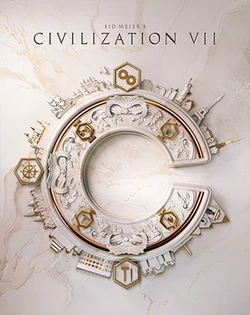
Civilization VII
 79
★ /10
79
★ /10
 iOS (iPhone/iPad),
  Nintendo Switch,
  Nintendo Switch 2,
  PC,
PC,  PS4,
PS4,  PS5,
PS5,  Xbox One,
  Xbox Series X/S
 Firaxis Games
 2K Games
Where to buy




Sid Meier’s Civilization VII (commonly abbreviated as Civ 7) is a turn-based strategy 4X video game developed by Firaxis Games and published by 2K. Officially announced at Summer Game Fest on June 7, 2024, the game launched worldwide on February 11, 2025, across Microsoft Windows, macOS, Linux, PlayStation 4, PlayStation 5, Xbox One, Xbox Series X/S, and the Nintendo Switch. It subsequently expanded to the Nintendo Switch 2 as a launch title on June 5, 2025, a virtual reality (VR) version for Meta Quest, and a mobile/Apple Arcade release on February 5, 2026.
Civilization VII represents the most structurally experimental and polarizing entry in the three-decade history of the franchise. At launch, the title attempted to reinvent the classic 4X loop by fracturing historical campaigns across three distinct “Ages” and decoupling historical Leaders from specific nations.
While critically praised for its graphical fidelity and streamlined logistics, this forced civilization-switching mechanic alienated core strategy purists, resulting in a steep drop in active player metrics throughout 2025.
In response, Firaxis deployed the massive, free Patch 1.4.0 “Test of Time” Update on May 19, 2026—a fundamental mechanical overhaul that restored traditional single-civilization continuity while completely redesigning the game’s victory and progression tracks.
Technical Specifications
| Attribute | Details |
| Developer | Firaxis Games |
| Publisher | 2K Games |
| Distributor | Take-Two Interactive |
| Lead Designer | Matt Owens (Design Lead) |
| Composer | Christopher Tin |
| Engine | Proprietary Firaxis 3D Engine (Updated with advanced HDR lighting in 2026) |
| Platform(s) | Windows, macOS, Linux, PS4, PS5, Xbox One, Xbox Series X/S, Nintendo Switch, Nintendo Switch 2, Meta Quest 3/3S, iOS |
| Release Date | February 11, 2025 |
| Genre(s) | Turn-based strategy, 4X |
| Mode(s) | Single-player, Multiplayer (Cross-play supported) |
Core Gameplay: The Age Architecture
The foundational gameplay matrix of Civilization VII centers around history being built in layers. Rather than playing a continuous, uninterrupted 500-turn match on a single map, a standard campaign is partitioned across three distinct historical eras:
$$\text{Campaign Structure} = \text{Antiquity Age} \longrightarrow \text{Exploration Age} \longrightarrow \text{Modern Age}$$
Each individual Age acts as its own self-contained mini-campaign, complete with era-appropriate resource configurations, independent military unit categories, localized map expansions, and unique Independent Powers.
Decoupled Leaders
For the first time in franchise history, Civilization VII completely separates a player’s choice of Leader from their chosen Civilization. Players can combine any historical figure with any empire to mix and match strategic bonuses—such as leading the Roman Empire as Benjamin Franklin or guiding Ancient Egypt under the militaristic traits of Tecumseh.
Leaders possess unique attributes that earn permanent experience points across multiple gameplay sessions, allowing players to unlock cosmetic profiles and customized starting perks.
Rivers and Regiments
Combat and movement systems received significant quality-of-life adjustments. Navigable Rivers act as natural aquatic highways, allowing specialized naval vessels and standard military units to rapidly sail deep into continent interiors.
To combat the tedious “carpet of doom” unit management of older entries, players utilize Commanders. Multiple military units can pack and latch onto a singular Commander, moving across tiles as a single cohesive regiment before unpacking dynamically to engage in tactical combat grids.
Launch Polarization & Identity Crisis (2025)
Upon its early 2025 launch, Civilization VII sparked massive debate within the strategy community. The primary catalyst for friction was the game’s mandatory Civilization Evolution system.
The Humankind Comparison
At launch, players were strictly forbidden from keeping their initial civilization when transitioning between Ages. Upon completing the Antiquity Age, a player was forced to select a completely different civilization for the Exploration Age based on historical paths or unlocks (e.g., transforming Rome into Norman England or Spain).
This design drew immediate, heavy comparisons to Amplitude Studios’ 4X title Humankind. Strategy purists found the mechanic highly immersion-breaking, noting that abandoning your carefully cultivated cultural identity every 150 turns stripped away the classic “fantasy” of building an empire to stand the test of time.
Player-Base Erosion
While mainstream gaming publications handed out highly favorable scores—praising the complex district-chaining and highly tactical city planning—user reviews on Steam plummeted to a “Mixed” 51% approval rating.
The mechanical friction had a severe impact on player retention. After hitting a launch-week peak of over 80,000 concurrent users on Steam, active player metrics steadily cratered. By April and May 2025, both Civilization V (2010) and Civilization VI (2016) regularly surpassed Civilization VII in daily active user registries, forcing Take-Two Interactive’s leadership to publicly classify the title’s early sales velocity as “slow”.
The 2026 Mechanical Overhaul: “Test of Time”
Recognizing that the core audience felt the game’s mechanics were over-gated and flattened, Firaxis utilized their Firaxis Feature Workshop community test beds to orchestrate an extensive structural rewrite of the application. This culminated in the rollout of Update 1.4.0 (The “Test of Time” Update) on May 19, 2026, which permanently introduced three major gameplay pillars.
1. Time-Tested Civilizations
The update grants players the optionality to remain as a single, uniform civilization across all three Ages. If a player starts as Rome or Greece, they can choose to reject the evolution pool during the Age Transition screen, retaining their original name, regional architecture, and palace aesthetics into the modern era.
To balance this track against civ-switching players, Firaxis integrated a Syncretism and Affirmation node into the unique Civics tree:
- Syncretism: Permits a Time-Tested civilization to adopt a single piece of infrastructure or a specific Unique Unit from a neighboring civilization currently sitting in its “Apex Age”.
- Affirmation: Allows the player to entirely skip external adaptation to fundamentally double down on their native cultural bonuses.
2. Sandbox-Driven Triumphs
The rigid, highly repetitive “Legacy Paths” system—which forced players to execute matching, predictable milestone behaviors every game to advance—was entirely deleted. It was replaced by a highly flexible Triumphs System. Triumphs pop up as dynamic, optional objectives categorized across six attributes: Militaristic, Cultural, Scientific, Economic, Diplomatic, and Expansionist. Completing Minor Triumphs grants instant utility resources, while Major Triumphs award powerful Dedications that define your empire’s bonuses heading into the next Age.
3. Overhauled Victory Score Thresholds
The path to achieving an ultimate victory was completely decoupled from static end-game grinds. The game calculates continuous dominance loops across Military, Economy, Culture, and Science from Turn 1.
Crucially, players can now win the entire match as early as the Exploration Age. If an empire establishes a massive, multi-fold numerical scoring gap over the second-place civilization, the engine will trigger a global threshold victory condition. The score thresholds are dynamically lowered by the Modern Age to prevent late-game stagnation.
Audio and Aesthetics
Civilization VII maintains the franchise’s premium standard for artistic and auditory presentation. Renowned composer Christopher Tin returned to helm the musical score, earning multiple nominations at the 2026 Game Audio Network Guild Awards for “Best Main Theme” and “Music of the Year”. The game’s soundscape updates dynamically; as your cities seamlessly expand from localized settlements into multi-district, high-density metropolis grids, the ambient soundtrack morphs to blend cultural instruments reflecting your empire’s historical layout.
The visual presentation was further upgraded alongside the May 2026 Test of Time update, implementing a full HDR texture and Sun Setting overhaul. This lighting change significantly sharpened environmental shadows, brought out deep unit color contrasts, and removed the heavy visual clutter that players complained blurred the map tiles together at launch.
Current Status (Late May 2026)
As of late May 2026, Civilization VII is operating under its post-Test of Time stabilization era, witnessing a massive resurgence of active concurrent players returning to test the single-civ campaign tracks.
To celebrate the update, Firaxis distributed a high-profile Alexander the Great leader DLC completely free of charge to all owners of the base game, running alongside automated cross-play multiplayer matchmaking setups across Steam, console systems, and mobile platforms. With nested tooltips successfully implemented and future DLC expansion packs scheduled through late 2026, the game has effectively reclaimed its footing as a premiere, deeply strategic 4X benchmark.