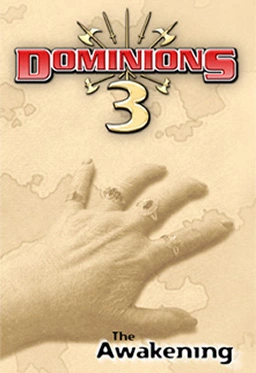
Dominions 3: The Awakening
 82
★ /10
82
★ /10
 PC
PC
Where to buy

Dominions 3: The Awakening (commonly abbreviated as Dominions 3) is a critically acclaimed turn-based fantasy grand strategy 4X video game developed and published by the independent Swedish studio Illwinter Game Design (with Shrapnel Games handling initial physical retail printing). Released on September 29, 2006, for Microsoft Windows, Mac OS X, and Linux, the title represents the grand structural and commercial breakthrough of the franchise, universally hailed by strategy historians as one of the deep, mythologically accurate wargames ever coded.
While the first two games in the series established a dedicated cult following through raw abstraction and intense pre-battle scripting, Dominions 3 completely revolutionized the scope of the universe.
By organizing its sprawling geopolitical landscape into three distinct historical eras, expanding the roster to encompass over 60 asymmetric nations and 1,500 unique unit chassis, implementing a high-stakes economy for legendary one-of-a-kind artifacts, and introducing a deep engine for Blood Magic sacrifices, the title earned iconic status. It is famously accompanied by a legendary, beautifully detailed 300-page printed reference manual.
Technical Specifications
| Attribute | Details |
| Developer | Illwinter Game Design |
| Publisher | Illwinter Game Design (Legacy Retail: Shrapnel Games) |
| Designers | Johan Karlsson, Kristoffer Osterman |
| Composers | Erik Ask Uppmark, Anna Rynefors |
| Engine | Proprietary 2D Sprite Matrix Visual Engine |
| Platform(s) | Microsoft Windows, Mac OS X, Linux |
| Release Date | • Original Launch: September 29, 2006 • Steam Deployment: September 10, 2013 |
| Genre(s) | Turn-based strategy, 4X Fantasy Grand Strategy, Wargame |
| Mode(s) | Single-player, Multiplayer (Simultaneous hotseat, Play-by-Email, TCP/IP) |
The Chronological Schism: The Three Eras of Magic and Steel
The definitive gameplay masterstroke introduced in Dominions 3 is the implementation of the Three Eras System. Rather than treating the game’s massive roster of nations as static templates competing in a vacuum, matches are legally locked into one of three distinct historical epochs. Choosing an era completely shifts map-wide population densities, resource generation curves, magic site frequencies, and technological baselines:
1. The Early Age (EA) – The Dawn of Myth
- Environmental Balance: Magic sites are abundant (roughly 50% more common than late-game baselines), but global civilization population levels suffer an automatic 20% baseline density penalty across all provinces.
- Strategic Meta: An era dominated by pure magic, monstrous entities, and primordial chaos. Humanity is a vulnerable minority; half of the playable nations consist of exotic, magical beings, stone giants, or underwater horrors. Conventional armor is exceptionally rare—armies clash utilizing stone, wood, or primitive bronze equipment, meaning high-tier sacred mages can effortlessly evaporate entire standing militias with raw elemental sorceries.
2. The Middle Age (MA) – The Rise of Kings
- Environmental Balance: The standard, highly balanced baseline era where magic and conventional military arms hold equal geopolitical weight.
- Strategic Meta: This age chronicles the slow, systemic rise of organized human kingdoms. Mythical monsters and ancient giants have receded into a fading elite class, forced to lead massive, conscripted standing infantries of baseline human soldiers. Iron weapons and conventional castle fortifications become the standard toolsets for regional defense.
3. The Late Age (LA) – The Age of Steel and Blood
- Environmental Balance: Magic has systematically waned across the cosmos, causing natural magic sites to become roughly 33% rarer than Early Age configurations.
- Strategic Meta: A gritty, hyper-militarized era of steel and coin. True innate mages are largely extinct, replaced by academic human scholars who struggle to channel raw element paths. Battlefields are completely dominated by heavily armored cross-bow divisions, massive knight cavalry charges, and dense iron infantry walls. To compensate for the lack of natural gems, nearly half of the late-age nations turn heavily toward dark, predatory sorceries to fuel their war machines.
Overhauling the Strategy Grid: Visual Armies & Unique Artifacts
Dominions 3 dramatically overhauled the interface tracking mechanics from previous installments to strip away unneeded menus and optimize reconnaissance loops:
Visual Force Indicators
The vague, abstract provincial banners of Dominions 1 and 2—which gave terrible, blind estimates of enemy numbers—were permanently retired. The overworld interface was updated to render explicit, miniature horizontal rows of distinct unit sprites directly over a province card. This allowed players to cleanly gauge the size, formation, and baseline layout of an opposing army at a single glance before executing movement orders.
The Zero-Sum Artifact Monopoly
The magical forge term expanded to host over 300 magic items, introducing an incredibly cutthroat economic layer called Unique Artifacts. At the absolute apex of Construction magic sit legendary weapons and items (such as the The Sword of Justice or the Pygmy Belt).
Unlike common magical gear, these artifacts operate under a strict global monopoly: once a player successfully amasses the necessary high-tier gems and orders a mage to forge a unique artifact, that blueprint is permanently locked out for the remainder of the match.
No other player in the universe can construct it. This creates a frantic scientific arms race in multiplayer matches, as rival gods desperately speed-run research lines to claim the galaxy’s most powerful items before their neighbors can seize the monopoly.
Blood Sacrifices & Cataclysmic Global Rituals
To anchor the dark, mythological atmosphere of the universe, the developers integrated a fully realized Blood Magic School. Unlike traditional elemental mages who gather free gems from passive magic sites, Blood Mages must operate an active economy of terror. Commanders are ordered to launch Blood Hunts across populated provinces, forcefully capturing civilian populace units to act as physical Blood Slaves.
These blood slaves are stockpiled like a raw currency and brought to dark temples, where they are systematically sacrificed in massive quantities to power horrific Global Rituals.
Global Rituals do not merely affect a localized battlefield; they overwrite the rules of the entire map. A player can sacrifice dozens of blood slaves to cast The Utterdark, plunging the entire world into permanent, pitch-black darkness to instantly freeze the agricultural gold income of every other player while spawning rampaging horrors inside un-defended provinces.
Alternatively, players can cast The Second Sun to bake the map in unquenchable heat, dehydrating entire armies and triggering massive starvation crises across the globe.
Modern Digital Preservation Status
The preservation status of Dominions 3: The Awakening stands beautifully secure, acting as a highly accessible milestone in grand strategy history. Originally launched onto digital storefronts on September 10, 2013, the full, finalized client is actively distributed on Steam for a standard retail baseline price of $19.99.
Because Illwinter built the engine around highly stable, object-oriented parameters and subsequently bundled comprehensive compatibility updates (up through the definitive Version 3.26 maintenance waves), the digital client boots and executes natively out-of-the-box on modern 64-bit Windows 11 frameworks without requiring external emulators or legacy wrappers.
The storefront package includes complete native support for contemporary widescreen monitor resolutions, stable multi-core CPU pathfinding, and preserved online multiplayer netcode.
Furthermore, the game’s audio layer is brilliantly intact, allowing players to experience the Swedish Zornmärkeskommiten-awarded medieval and Scandinavian folk soundtracks composed by Erik Ask Uppmark and Anna Rynefors—which dynamically shifts from tribal folk during Early Age matches to complex medieval arrangements during Late Age campaigns—with flawless, zero-latency acoustic fidelity.