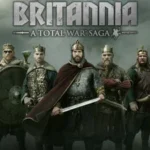
A Total War Saga: Thrones of Britannia
 75
★ /10
75
★ /10
 PC
PC
 1C-SoftClub,
  SEGA Corporation
Where to buy

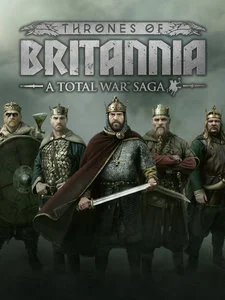
A Total War Saga: THRONES OF BRITANNIA (May 3, 2018) stands as one of the most critical, experimental, and hyper-focused turning points in the history of the legendary grand strategy and real-time tactics franchise. Following the massive, multi-theater sandbox sprawl of previous historical mainlines and the simultaneous growth of fantasy spin-offs, the series introduced the Saga brand—a line of standalone titles designed to drill deep into highly specific historical flashpoints rather than sweep across entire centuries.
British developer The Creative Assembly took the robust core architecture of Total War: Attila, stripped away historical abstraction, and focused development duties on a tight, claustrophobic geographical theater: The British Isles in 878 AD. Faced with the intense task of redefining historical pacing, Creative Assembly delivered an incredibly distinct chapter that traded vast world map sizes for deep logistical and tactical realism.
The Core Evolution: Total Structural Streamlining
To mirror the stark reality of early medieval warfare, Thrones of Britannia completely severed ties with several long-standing franchise staples, implementing aggressive design shifts that remain deeply discussed across the strategy community:
- The Naked Minor Settlement Layout: The campaign map threw out traditional town management rules. While major provincial capitals remain heavily fortified, multi-slotted walled hubs, minor settlements possess zero walls and zero automatic garrisons. They feature a single, fixed resource building (e.g., a farm, mine, or abbey) that can be upgraded but never swapped out. This means single enemy cavalry units can instantly capture your defenseless villages, turning territorial defense into a high-stakes spatial game of active border patrolling.
- The Global Recruitment & Manpower Muster Loop: The production loop completely abandoned instant unit creation. Units are drafted globally from a finite pool that slowly replenishes over time. Crucially, newly recruited units do not materialize at 100% strength; they enter your army as a 25% skeleton crew and must spend consecutive turns stationary to muster (replenish manpower) up to full operational capability, preventing players from conjuring instant, full-strength relief armies.
- The Abolition of Agent Spam: In a radical quality-of-life shift, Thrones of Britannia entirely removed autonomous map agents (Spies, Dignitaries, Champions). Map manipulation, economic optimization, and counter-espionage were completely folded back into the active generalship of your family tree and regional governors.
- Deed-Based Technological Research: Traditional turn-locked technology queues were replaced by direct actions on the ground. To unlock a specific technology branch, your empire must perform explicit deeds—such as training 10 basic swordsmen to unlock tier-2 weapon blueprints, or capturing a set number of monasteries to unlock advanced civic advancements.
The Deep Meta: The Estate Redistribution & Food Logistics
To simulate the delicate tightrope walked by dark age monarchs, management is governed by a strict matrix of Feudal Land Distribution and Caloric Supply Lines:
- The Noble Estate Matrix: Rulers do not manage characters with abstract money alone. Capturing and developing major territories awards physical Estates (grants of land). Nobles in your family tree continuously track an internal Loyalty meter affected by their personal greed and influence. If a noble’s personal influence eclipses the King’s, their loyalty plummets. Rulers must continuously strip land from their own crown holdings and redistribute physical Estates to ambitious lords to buy their allegiance, directly balancing internal political stability to prevent sudden civil wars.
- The Food and Supply Matrix: Army maintenance requires dual tracking. Units do not just cost gold; they drain a finite global Food supply generated by your minor agrarian villages. Furthermore, moving armies through hostile territory drains a localized Supply Bar. Letting your supplies run dry triggers immediate starvation attrition, forcing players to actively plan campaigns around active harvest nodes and secure supply lines.
The Battle Layer: Shield Walls and Critical Trauma
On the 3D tactical battlefield, combat shifted away from loose skirmish lines to replicate the gritty, claustrophobic weight of early medieval combat:
“This is the era of the shield wall. The short, sharp clashing of swords and shields makes combat feel faithful to this intimately intense combat style.” — Creative Assembly Design Core
- The Shield Wall Stance: Units with shields pack tightly into dense, physics-heavy block formations. Braced shield walls gain massive defensive multipliers against frontal missile volleys and melee charges.
- The Charge Refusal Attribute: Cavalry can no longer brainlessly run over braced infantry lines. Horses will actively refuse to slam frontally into a stationary, braced shield wall—rearing up and losing all impact momentum, forcing commanders to carefully maneuver horses around to play the hammer to their infantry’s anvil.
- The Critical Hit Engine: Mitigating the abstract “health-bar chipping” of modern strategy engines, the combat layer introduced a Critical Hit Chance. Melee attacks and arrows have a random chance to deliver 10x standard damage, simulating an instant, lethal “arrow-in-the-eye” strike that drops individual soldiers instantly, drastically shaking up unit survivability.
Cultural Alignments & Unique Faction Metrics
The campaign map features 5 distinct culture groups split across 10 playable factions, each utilizing dedicated mechanics to shape the destination of the islands:
| Culture Group | Playable Exemplars | Cultural Unique Mechanic | Tactical Battle Trait & Roster Meta |
| Anglo-Saxons | West Seaxe (Alfred) / Mierce | The Fyrd: Raises temporary peasant conscripts based on the number of owned regions; over-conscripting hurts farm output. | Heavily armored, well-rounded rosters featuring superior shield values and elite sword infantry. |
| The Gaels | Mide / Circenn | Legitimacy: Gained by defending allies and owning cultural lands, permanently boosting public order. | Highly mobile, skirmish-focused arrays featuring deadly javelin throwers and excellent light cavalry. |
| Welsh Kingdoms | Gwined / Strat Clut | Heroism: Gained by winning consecutive heroic victories, unlocking global recruitment caps and stat buffs. | Unrivaled long-range missile dominance utilizing legendary Welsh Longbowmen alongside elite heavy spears. |
| Great Viking Army | Northymbre / East Engle | War Fervor: Tracks a faction-wide momentum meter; winning battles sparks economic growth, while peace decays output. | Brutal, unshielded shock infantry columns wielding high-damage two-handed Dane Axes to shatter shield lines. |
| Viking Sea Kings | Dyflin / Sudreyar | Expeditions & Tribute: Tracks naval raiding profiles, allowing them to extract money from neutral ports. | Highly well-rounded, armor-heavy infantry tiers but severely lacking in high-tier cavalry options. |
The Modern Standard: Retrospective Optimization Appreciation
While it was highly polarized at launch for its aggressive mechanical trimming and smaller scope compared to mainlines, Thrones of Britannia experiences a massive retrospective renaissance today. Strategy purists highly praise the title for possessing some of the absolute finest, most complex, and visually stunning tactical siege maps ever designed in Total War history.
The game stands natively preserved on Steam under the Sega catalog. Because it operates on a highly optimized iteration of the Attila codebase, it natively sidesteps the historical multi-core crashes and resolution stretching of older titles. Strategy communities running the title on modern PC systems leverage its crisp UI and engine scaling to run the intense, small-scale dark age clashes in flawlessly smooth, native 1440p and 4K widescreen configurations out-of-the-box.