R.U.S.E.
 78
★ /10
78
★ /10
 PC
PC PS 3
PS 3 Xbox 360
 Eugen Systems
 1C-SoftClub
 Ubisoft
Where to buy

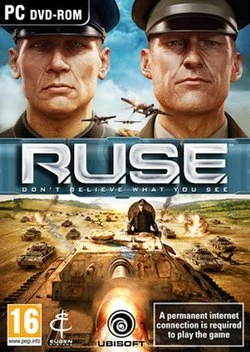
R.U.S.E. (2010) stands as one of the most critical turning points in the history of the legendary real-time strategy genre. Following the exhausting market fatigue of hyper-fast, micro-intensive traditional RTS clones and the subsequent structural stagnation of intense individual unit babysitting, the future of macro-tactical warfare was highly uncertain.
Parisian developer Eugen Systems stepped in, partnered with publisher Ubisoft, and focused development duties on a revolutionary psychological wargame. Faced with the intense task of distinguishing a new intellectual property during a period of transition for real-time strategy, Eugen delivered a stellar, redemptive chapter that beautifully bridged classic macro resource gathering with unprecedented psychological warfare and technological scale leaps.
The Grand Reset: A Tabletop Theatre of War
R.U.S.E. completely severed ties with the traditional, single-perspective battlefield mechanics of its contemporaries. Instead, it established a tightly constructed World War II narrative framework: The Global Commander’s War Room.
The game’s vast geographical landscapes, military theaters, and tactical combat engagements are structured precisely as an interactive, live tabletop war room. The single-player campaign tracks the historical career of Major Joseph Sheridan, a Yale dropout turned commander of the US First Armored Division. As Sheridan fights his way from the arid sands of North Africa through Italy, France, and into the heart of Germany, the campaign unfolds like a political thriller, tasking players with weeding out a deep-cover double agent code-named “Prometheus” who is leaking critical Allied intel directly to the Axis powers.
The Core Evolution: The IrisZoom Engine & Sector Tactics
Eugen Systems deliberately looked back at classic board games and grand-scale military theater layouts as a mechanical anchor, completely abandoning microscopic unit babysitting and individual health-bar tracking. Instead, they heavily evolved the strategy engine:
- The Leap to the IrisZoom Engine: Running on a highly advanced, proprietary engine shell, R.U.S.E. was the first strategy game to eliminate rigid map camera constraints. Players can seamlessly scroll from a close-up tactical dirt view of individual Sherman tanks firing in a forest up to a massive, extreme bird’s-eye view of the entire theater. At maximum zoom, the map physically transforms into an elegant wooden war table inside a bunker, and your battalions seamlessly collapse into stacks of physical plastic poker chips.
- The Structural Sector Grid: The maps abandoned free-form construction lines, breaking geographic fields into distinct, bounded Sectors. Resources are streamlined into a simplified grid of autonomous supply trucks traveling from static refineries to your Headquarters. This shifts the core focus entirely away from base building toward macroscopic logistics choke-point defense and wide-scale territorial manipulation.
- The Ranged Crosshair Calculus: Units automatically engage based on specialized rock-paper-scissors counter logic. Ordering a platoon to fire brings up an intuitive crosshair indicator, calculating real-time odds from Very Easy to High Danger. Critically suppressed or heavily stressed divisions will experience sudden operational shock, completely ignoring user inputs to retreat automatically into deep cover.
The Deep Meta: The Ruses Matrix
To maximize faction mind games, R.U.S.E. introduced a revolutionary, card-based layer of active Deception Mechanics. Every player is granted periodic access to “Ruse Cards” played directly onto specific geographic map Sectors, fundamentally altering how information is filtered through the fog of war:
- Information Suppression (Radio Silence / Camouflage Nets): Radio Silence completely hides all friendly unit markers in a sector from enemy radar grids, while Camouflage Nets renders infrastructure entirely invisible, allowing players to mask massive offensive staging grounds unless the opponent deploys direct visual recon squads.
- Information Extraction (Spy / Decryption): Spy reveals the specific identity of unspotted enemy unit silhouettes within a sector, while Decryption physically draws real-time arrows on the map showing exactly where an opponent’s units have been ordered to march.
- False Flag Operations (Decoy Army / Decoy Building): Allows commanders to build entirely fake bases or spawn ghost armies of wooden tanks and paper airplanes. These decoys march across enemy lines on the opponent’s screen, drawing away heavy artillery barrages and panic reactions while your real strike force flanks from deep cover.
- Behavior Alteration (Blitz / Terror / Fanaticism): Blitz scales unit movement velocity across a sector up by 50%, Terror forces enemy squads to mentally shatter and retreat at double speed, and Fanaticism locks your own troops into a zero-panic state, forcing them to fight to the absolute last man.
- Reverted Intel (Reintel): A psychological masterpiece that intentionally swaps unit radar profiles, making fragile light recon jeeps look like monolithic super-heavy Tiger tanks on the enemy’s minimap, causing them to completely abandon an entire flank out of sheer paranoia.
Faction Specialization & Strategic Asymmetry
The base game introduced six fully distinct historical superpowers, later expanded by downloadable content to feature highly specialized operational strengths:
| Faction Nation | Macro-Strategic Identity | Signature Unit Variant | Core Battlefield Role & Passives |
| United States | Balanced flexibility and superior late-game aviation versatility. | B-17 Flying Fortress | Exceptional long-range, high-yield heavy bombers built to flatten entrenched defensive grids. |
| Germany | Elite, hyper-expensive armor tech that requires high research investments. | King Tiger / Maus | Monolithic, heavily armored juggernauts capable of effortlessly crushing standard armored lines. |
| United Kingdom | Early-game air dominance and highly specialized unit line breakdowns. | Spitfire Fighter | Cheap, hyper-efficient air superiority aircraft designed to effortlessly secure control of the skies. |
| Soviet Union | Mass-production infantry spam backed by devastating ranged ordnance. | Katyusha Rocket Launcher | Rapid-fire, area-of-effect rocket artillery built to instantly panic and suppress massive chunks of the map. |
| France | Heavily fortified defensive infrastructure and powerful early heavy armor. | Char B1 bis | Absurdly thick early-game heavy tank built to soak up anti-tank fire and grind down early rushes. |
| Italy | Lightning-fast, dirt-cheap light units optimized for aggressive early rushes. | Carro M13 / M15 | Ultra-cheap $15 light armor built to cripple an opponent’s economy before they can tech up. |
The Rising Sun Expansion
The game’s primary post-launch content wave introduced the Japan faction. Japan completely disrupted the macro-meta by combining hyper-stealthy infantry arrays and specialized prototype weaponry—featuring the Ha-To mortar tank and advanced long-range kamikaze air units—operating as an ultimate asymmetric wildcard faction.
The Modern Standard: The 2026 Steam Preservation Renaissance
For over a decade, R.U.S.E. was tragically classified as a piece of strategy abandonware. In December 2015, Ubisoft officially pulled the game from all digital storefronts due to the sudden expiration of its complex real-world military and vehicular naming licenses, leaving keys to skyrocket in price on secondary markets.
However, in a monumental, highly celebrated victory for game preservation, Eugen Systems officially re-released R.U.S.E. on Steam on May 5, 2026. Having fully reclaimed the intellectual property rights from Ubisoft, the studio completely updated the title for contemporary hardware.
The definitive modern standard strips out legacy third-party launcher mandates, fixes the direct-draw resolution bugs that crashed modern desktops, adds full native support for 64-bit multi-core configurations on Windows 10 and Windows 11, and features pristine Steam Deck optimization. This allows players to zoom from the wooden war table down into the tactical mud in natively scaled 1080p, 2K, and 4K display formats without a single technical hitch.
Release History
- Original Retail Launch: September 7, 2010 (North America) / September 10, 2010 (Europe)
- The Rising Sun DLC Pack: Deployed in late 2010 (Formally integrated the Japanese faction and custom operational maps).
- The Steam Delisting: December 8, 2015 (Abruptly pulled from digital storefronts due to license expirations).
- The Eugen Systems Re-Release: May 5, 2026 (Natively restored to Steam with all expansions, upgraded modern operating system wrappers, and Valve Anti-Cheat updates).