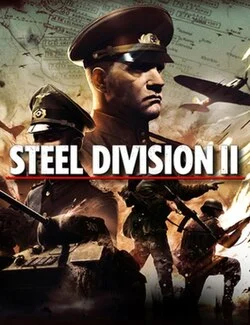
Steel Division II
 73
★ /10
73
★ /10
 PC
PC Eugen Systems

Steel Division II (2019) stands as one of the most structurally massive, mechanically punishing, and highly respected high-water marks in the history of the real-time tactical strategy (RTT) genre. Following the Western Front boundaries of their 2017 predecessor, Paris-based developer Eugen Systems boldly stepped up to handle full self-publishing duties.
They discarded the narrow constraints of regional maps and focused development duties on a sprawling simulator of sheer industrial scale. Faced with the intense task of matching the tactical depth of their previous titles, Eugen delivered a redemptive chapter that bridged microscopic, physics-based tank duels with a macroscopic, theater-level operational campaign matrix.
The Grand Reset: Operation Bagration & The Eastern Front
Steel Division II completely severed ties with the claustrophobic French bocage and hedgerows of Normandy. Instead, it established an ironclad commitment to a brutal, historically rich landscape: The Eastern Front during Summer 1944.
The game’s vast tactical battlefields shift from small village clearings to sprawling, wide-open Soviet plains, dense marshlands, and massive forest sectors. The theater documents the historic reality of Operation Bagration—the titanic Soviet offensive that systematically shattered and dismantled Germany’s Army Group Centre. It locks players into a bloody, multi-front war of attrition involving millions of soldiers, thousands of armored combat vehicles, and authentic multinational divisions clashing across Belarus, Poland, and Romania.
The Core Evolution: Army General Mode & Expanded Macro Mechanics
Eugen Systems heavily evolved their proprietary IrisZoom Engine, blowing past standard scripted single-player campaigns to engineer an completely unique, dual-layer strategy concept:
- The Leap to Army General Mode: The single-player experience was fully revolutionized. It introduces a massive, turn-based, 1:1 scale operational strategy layer. Players act as genuine theater generals on a physical map board, moving entire historical regiments, battalions, and air wings across actual geographic contours. The moment opposing markers collide on the operational grid, the game seamlessly drops you into a fully realized 3D tactical map to resolve the fight in real time.
- The Structural Defensive Suite: In specialized breakthrough modes, the combat grid moves beyond open-field skirmishing. The engine introduced real-time pre-battle fortification tools. Defensive factions can physically dig networks of infantry trenches, layout extensive barbed wire barriers, establish tank traps, and erect concrete bunkers to absorb high-impact kinetic shell lines.
- The 10v10 Multiplayer Scale: The multiplayer engine was scaled up to support catastrophic 24-player and 10v10 multiplayer operations simultaneously on massive 25×25 kilometer battlefields, turning standard positional warfare into an absolute symphony of combined-arms coordination, smoke screens, and heavy artillery suppression.
The Deep Meta: Economy Matrices & Granular Ballistics
To maximize tactical customization, Steel Division II heavily expanded its card-based Battlegroup Deck Matrix. Alongside balancing Veterancy (troop quality) versus Availability (troop quantity), the meta introduced a game-changing Income Economy Selection, letting you choose exactly how many resource points you generate across the standard three combat phases:
- Balanced: The uniform default; awards a steady, predictable rise in deployment currency across Phases A, B, and C.
- Vanguard: Spikes resource points heavily in Phase A; designed to achieve rapid, early-game territory captures and early player surrenders.
- Maverick: Delivers a massive resource boom explicitly in Phase B; ideal for launching intense mid-game mechanized counter-offensives.
- Flat Line: Grants an unyielding, identical tick of points from minute one to the end of the match; rewards patient, long-form defensive players.
The Ballistic Calculus
On the 3D tactical field, armor penetration calculation is hyper-authentic. The engine computes kinetic muzzle velocity decay over true distance fields, computing precise shell angling physics against front, side, and rear plating. A heavy Soviet IS-2 tank shell can physically trigger a catastrophic internal explosion inside a Panzer IV from two kilometers away, while lighter anti-tank rounds will simply bounce harmlessly off a Tiger’s reinforced hull mantle.
The Battlegroup Roster Spectrum
Through a massive, multi-year support cycle, Eugen Systems introduced dozens of highly asymmetric Allied and Axis divisions, capturing the military machines of the Soviet Union, Germany, Finland, Hungary, Romania, and Bulgaria:
| Historical Battlegroup | Primary Faction Alignment | Roster Mechanical Trait | Signature Historical Weapon Profile |
| 2nd Guards Tank Corps | Allied (Soviet Union) | Maximum heavy armored breakthrough momentum. | IS-2 / T-34-85 (Monolithic heavy armor and versatile medium tanks built for frontal pressure). |
| 5th Panzer Division | Axis (Germany) | Elite, hyper-expensive armored veterancy caps. | Panther G / Tiger E (High-precision long-range kinetic optics that dominate open plains). |
| Panssaridivisioona | Allied / Axis (Finland) | Expansion Content. Masterful forest ambushers and stealth infantry. | BT-42 / Captured T-34s (Lightweight, agile assault guns optimized for close-range jungle/forest traps). |
| 1st Czechoslovak Independent Armoured Brigade | Allied (Czechoslovakia) | Nemesis Content. High-speed mechanized flanking lines. | Cromwell VII & VIII (Rapid-fire mobile siege line armor and heavy siege guns). |
The Modern Standard: A Massive Archival Sandbox
Steel Division II experiences a highly stable and deeply active renaissance among strategy purists. Operating as a fully mature, standalone digital title hosted natively on Steam, the game completely sidesteps the legacy launcher crashes, frame drops, and operating system exceptions that frequently cripple historical PC wargames.
Eugen Systems maintains a robust commitment to the community, actively extending the lifecycle with content updates. This includes major expansions like the Battle of Dukla Pass, which injects a massive new Army General campaign and six historic divisions into the eastern theater, alongside the highly competitive Nemesis #7: Hell’s Highway pack.
Running on a highly optimized 64-bit shell under Windows 10 and Windows 11, players can scale the zoom seamlessly from an operational map down to individual tank treads in native 1080p, 2K, and 4K widescreen monitor formats with zero technical hitch, cementing it as an absolute monument to World War II simulation.
Release History
- Steel Division II (Original Worldwide Launch): June 20, 2019 (Published by Eugen Systems)
- Tribute to Normandy ’44 Expansion: April 9, 2024 (Brings the original game’s iconic western divisions into the updated engine architecture)
- Nemesis #7 – Hell’s Highway DLC: January 20, 2025 (Introduces the British 43rd Wessex and German Kampfgruppe Walther)
- Battle of Dukla Pass Expansion: September 7, 2025 (Major operational campaign detailing the bloody Polish-Slovak frontier battles)
- Modern Packaging: Readily available as a master classic title on PC via Steam, natively hosting a comprehensive library of tactical skirmish maps, historical operations, and modular division packs.