Metal Gear Solid V: The Phantom Pain
 93
★ /10
93
★ /10
 PC
PC PS 3
PS 3 PS4
PS4 Xbox 360
 Xbox One
 1C-SoftClub
 Konami Digital Entertainment

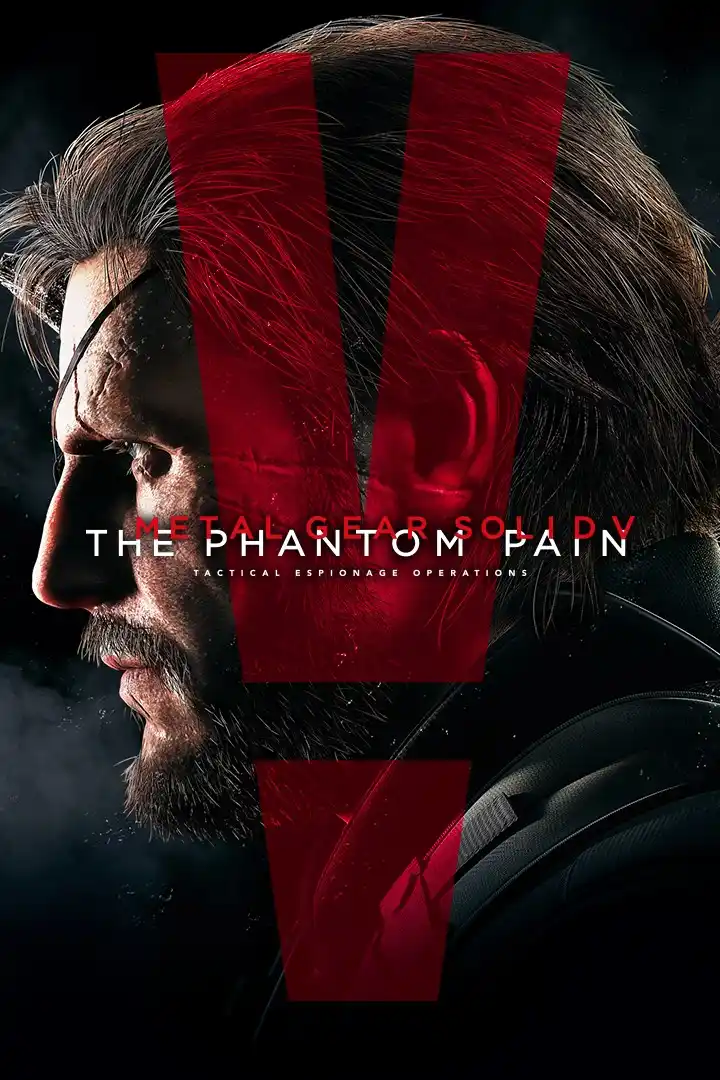
Metal Gear Solid V: The Phantom Pain is a 2015 open-world stealth action game developed by Kojima Productions and published by Konami. Released on September 1, 2015, for PlayStation 3, PlayStation 4, Xbox 360, Xbox One, and PC, it is the final entry in the Metal Gear series directed by Hideo Kojima — his last game with Konami before the split that ended a nearly thirty-year professional relationship.
The game received Metacritic scores of 95 on PS4 and 96 on PC, making it the highest-rated entry in the series on those platforms. It is widely considered to have the best gameplay of any Metal Gear game and the most controversial and unfinished story in the franchise’s history.
Technical Specifications
| Attribute | Details |
|---|---|
| Developer | Kojima Productions |
| Publisher | Konami |
| Director / Writer | Hideo Kojima |
| Composer | Ludvig Forssell (score) · Various (licensed 80s music) |
| Engine | Fox Engine |
| Platform(s) | PS3 · PS4 · Xbox 360 · Xbox One · PC |
| Release Date | September 1, 2015 (all platforms, NA) |
| Genre | Stealth, Open world, Action-adventure |
| Mode(s) | Single-player · Online (FOB — Forward Operating Bases) |
1984: The Phantom Limb and the Phantom Pain
The Phantom Pain picks up nine years after Metal Gear Solid V: Ground Zeroes (2014), in which Big Boss’s forces — Militaires Sans Frontières — were destroyed in an attack by a rogue black operations unit called XOF. The player character wakes from a coma in a Cyprus hospital in 1984 to find that everything he was has been stripped away: his base, his soldiers, his identity, the arm he lost in the attack.
He is referred to — by his enemies, by the narrative, and eventually by the player — as Venom Snake. He and his former comrade Kaz Miller rebuild their private military company, now called Diamond Dogs, from a rented oil platform in the Caribbean while simultaneously waging a covert war against XOF and its commander, Skull Face, who is pursuing a weapon capable of eliminating language itself — a vocal cord parasite engineered to kill speakers of specific languages.
The title’s double meaning is established early. “Phantom Pain” is both a medical condition — the sensation of pain in a limb that no longer exists, which Venom Snake experiences in his prosthetic arm — and the game’s thematic preoccupation: grief for what has been destroyed, phantom legacies, pain that has no physical source. The game is about loss expressed through violence, and the violence is expressed with exceptional mechanical fluency.
The Open World and the Fox Engine
The Phantom Pain is the first fully open-world Metal Gear game, set across two large maps — Afghanistan and the Angola-Zaire Border Region — rendered in the Fox Engine, Konami’s proprietary technology that delivers a level of environmental detail and lighting quality that remained competitive several years after release.
The open world serves the stealth mechanics rather than filling space for its own sake. Every settlement, outpost, and enemy position is exploitable from multiple angles, with multiple approaches producing meaningfully different tactical situations. The distances between objectives are traversable on horseback (D-Horse) or by helicopter, and the time of day affects guard rotations, visibility, and which tactics are available. Rain suppresses noise detection; sandstorms impair vision for both Snake and enemies. The simulation depth extends to individual guards who learn from previous encounters — guards in areas where Snake has been active begin wearing helmets (countering headshots) and carrying extra ammunition.
The Gameplay Systems
The Fulton Recovery System is the game’s most immediately distinctive mechanic and the one most associated with it in cultural memory. Any soldier, scientist, prisoner, animal, vehicle, or piece of equipment can be attached to an inflatable balloon and recovered to Mother Base — the offshore platform where Diamond Dogs operates. Fulton’ing guards rather than killing them turns enemy forces into friendly recruits; the better a soldier’s skills, the more valuable they are to recover. The system makes combat non-lethal by default in a way that previous games’ tranquiliser darts did not — enemies you extract become your staff.
Mother Base functions as a management layer between missions. Recovered staff are assigned to units — combat, R&D, support, medical — and the productivity of those units determines what equipment and upgrades Snake can deploy on missions. Expanding the base, rescuing skilled soldiers, and developing the R&D tree provide a persistent progression that makes every mission outcome financially relevant to the next.
Companions accompany Snake on missions: D-Dog (a wolf pup rescued in Afghanistan, raised on base, and trained to locate enemies and items), Quiet (a supernatural sniper who can suppress an entire enemy position from a distance while Snake approaches), D-Horse (transport), and D-Walker (a manned walker unit). Each companion changes the tactical options available for a mission in ways that make companion selection a meaningful pre-mission decision.
The Soundtrack: 80s Pop as War Counterpoint
The Phantom Pain uses licensed 1980s popular music as its primary ambient audio when Snake is airborne or in the helicopter between missions. The songs — David Bowie’s “The Man Who Sold the World,” A-Ha’s “Take On Me,” Hall & Oates’ “Maneater,” Billy Joel’s “Sins of the Fathers,” Tears for Fears’ “Everybody Wants to Rule the World,” Yazoo’s “Only You,” among others — play against the brutal military content of the missions they bracket.
The contrast is intentional. The game is set in 1984 and the music is period-appropriate, but it functions as a kind of ironic dissonance: cheerful, commercially produced pop songs scored to a narrative about mercenaries, private war, child soldiers, and weapons of mass language destruction. David Bowie’s “The Man Who Sold the World” appears twice — once in the opening and once in the end credits — in ways that frame the game’s central twist.
Chapter 1, the Twist, and the Missing Chapter 2
The Phantom Pain‘s structure divides into two chapters of markedly unequal quality and completeness.
Chapter 1 is the game at its best: varied mission types, escalating stakes, environmental and narrative momentum building toward a confrontation with Skull Face and a conclusion that recontextualises the entire prologue. At the end of Chapter 1, the game reveals through cassette tapes and a final scene that the player character is not Big Boss. He is Venom Snake — a medic from Militaires Sans Frontières who was given Big Boss’s memories through a hypnotherapy/surgery programme and reconstructed to serve as Big Boss’s double, absorbing the attention and danger that would otherwise be directed at the real Big Boss. The real Big Boss has been operating elsewhere the entire time.
The tape that delivers this revelation is titled “The Man Who Sold the World.”
Chapter 2 is substantially shorter, includes repeat missions (prior Chapter 1 missions replayed at harder difficulty), and concludes storylines that Chapter 1 established without fully resolving. Mission 51 — “Kingdom of the Flies” — the mission that would have concluded Eli’s storyline and the fate of the Sahelanthropus (the Metal Gear unit) — was cut from the final release. The mission exists in the game’s files and on the Collector’s Edition bonus disc as concept materials; it was never completed into a playable state for inclusion in the shipped game.
The absence of Mission 51 — and the truncated state of Chapter 2 — are universally attributed to the breakdown of the Kojima-Konami relationship during production. Neither party has provided a full account; the evidence is largely circumstantial but consistent.
The Kojima-Konami Split
The most significant corporate event in the franchise’s history occurred during The Phantom Pain‘s development. In March 2015, Konami removed Hideo Kojima‘s name from the game’s promotional materials — replacing it with generic Konami branding — and announced that his contract would not be renewed after the game’s completion. The Kojima Productions studio name was retired. The Metal Gear Solid website was reformatted to remove Kojima credits.
The reasons given publicly by Konami were structural: the company was reorganising toward mobile gaming. Industry reporting at the time cited creative differences, budget disputes, and the extended and expensive development timeline of The Phantom Pain specifically. The complete account has never been provided.
Kojima left Konami in December 2015, three months after The Phantom Pain shipped. He founded a new company — Kojima Productions — under a new structure partnered with Sony Interactive Entertainment, and proceeded to make Death Stranding (2019) and Death Stranding 2: On the Beach (2025). Every game he has made since 2015 has been released under the tagline “A Hideo Kojima Game,” reinstating the personal branding Konami removed.
The game exists, as a result, as a record of what a thirty-year creative relationship produced at its end — the best mechanical realisation of the Metal Gear formula and, simultaneously, the most incomplete conclusion the series has ever had.
Ground Zeroes
Metal Gear Solid V: Ground Zeroes (March 2014) is a prologue chapter — sold separately for $30 — set in 1975 and lasting approximately two to four hours. It establishes the circumstances of the attack on Mother Base that precede The Phantom Pain‘s opening. It is available as a standalone purchase and was later bundled with The Phantom Pain in The Definitive Experience edition. Players coming to the series for the first time are not required to complete it before The Phantom Pain, but its events are referenced throughout and its tone — notably a brutal scene at the end — sets the register for what follows.
Ten Years Later: Still Not Finished
GamingBolt’s 2025 retrospective “Metal Gear Solid 5 Ten Years Later: I’m Finally Free of the Phantom Pain” captures a specific experience that a large portion of the player community describes: the game is substantial enough — over 100 Side Ops, S-ranking all main missions, the Forward Operating Base online component — that players begin it and return to it over years rather than completing it in a single sustained engagement. “Finally finishing MGSV” has become a recognisable type of accomplishment in gaming discussion, connoting both the time investment required and the unresolved feelings about what the game is when it ends.
The Definitive Experience edition, bundling Ground Zeroes and The Phantom Pain, is the currently available version on PC and consoles. Neither a remaster nor a Master Collection version has been announced for either game.
Reception
The Phantom Pain received Metacritic scores of 95 on PS4 and 96 on PC — the highest in the franchise — alongside unanimous critical praise for its gameplay and significant critical discussion of its narrative structure. IGN gave it 10/10, GameSpot 10/10, GamesRadar 5/5. The unfinished Chapter 2 and the missing Mission 51 were noted but not, in most reviews, weighted heavily enough to reduce scores significantly.
The player community’s assessment, consolidated over ten years, is more ambivalent: the gameplay is unambiguously the best in the series; the story, as shipped, is not the story the game was building toward. Whether the gameplay is sufficient, or whether the narrative incompleteness undercuts the experience, is a question the community continues to argue — and the GrimDark Magazine analysis at position #5 in current search results, drawing nearly 4,000 monthly visitors a decade after release, reflects that the argument has not resolved.