Metal Gear Solid 4: Guns of the Patriots
 94
★ /10
94
★ /10
 Nintendo Switch,
  Nintendo Switch 2,
  PC,
PC,  PS 3,
PS 3,  PS5,
PS5,  Xbox Series X/S
 Konami Digital Entertainment


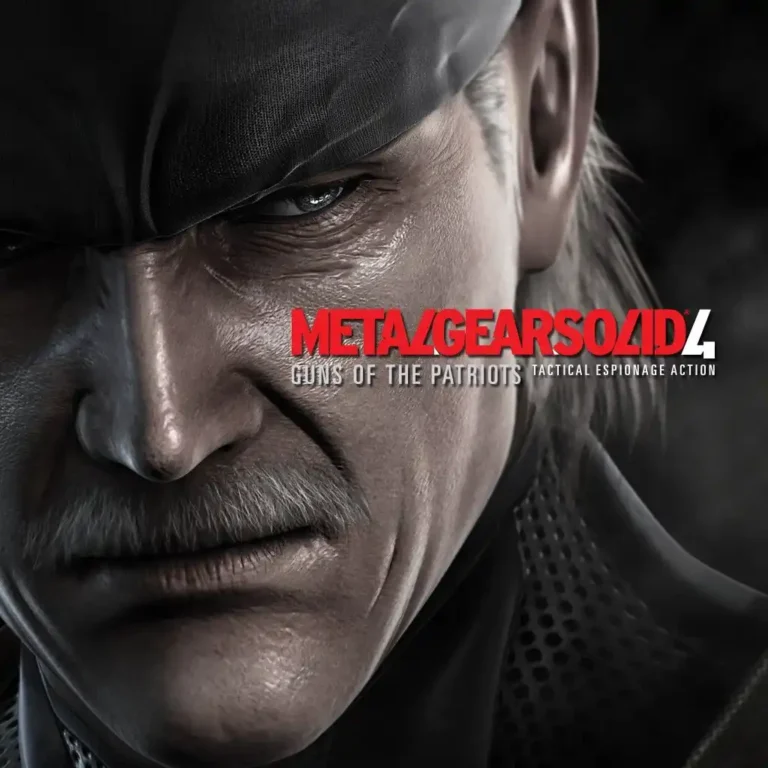
Metal Gear Solid 4: Guns of the Patriots is a 2008 stealth action game developed by Kojima Productions and published by Konami. Directed and written by Hideo Kojima, it was released for PlayStation 3 exclusively on June 12, 2008, in North America. It holds a Metacritic score of 94 — one of the highest ever recorded for a PS3 game — and remained exclusive to that console for nearly eighteen years.
Metal Gear Solid: Master Collection Vol. 2, which includes Guns of the Patriots, releases on August 27, 2026 for PS5, Xbox Series X/S, Nintendo Switch, Nintendo Switch 2, and PC. It will be the first time the game has been available on any platform other than the PlayStation 3. The Steam page for the upcoming release already draws more than 12,000 monthly organic visitors as of June 2026.
Technical Specifications
| Attribute | Details |
|---|---|
| Developer | Kojima Productions |
| Publisher | Konami |
| Director / Writer | Hideo Kojima |
| Art Director | Yoji Shinkawa |
| Composers | Harry Gregson-Williams · Nobuko Toda · Norihiko Hibino · Shuichi Kobori |
| Original Platform | PlayStation 3 (exclusive) |
| Current Platform | PS5 · Xbox Series X/S · PC · Switch · Switch 2 (Master Collection Vol. 2, Aug 27, 2026) |
| Original Release | June 12, 2008 (NA) |
| Genre | Stealth, Action-adventure |
| Mode(s) | Single-player · Online (Metal Gear Online, discontinued) |
2014: The World Without Private Armies
Guns of the Patriots is set in 2014 — six years after Sons of Liberty, in a world that has followed the conclusion of that game’s narrative logic to its endpoint. War has been privatised. Five large Private Military Companies (PMCs), all ultimately linked to a single controlling body called Outer Heaven, employ approximately 70% of the world’s active combat forces and have turned warfare into a regulated global commodity. The Sons of the Patriots (SOP) system — the Patriots’ network controlling nanomachines in every soldier’s bloodstream — allows this infrastructure to run efficiently, keeping soldiers battle-ready and preventing them from going rogue.
Liquid Ocelot — Revolver Ocelot, whose body and will appear to have been overtaken by the personality of the dead Liquid Snake through nanomachine-assisted psychic possession — commands one of the five PMCs and intends to seize control of SOP, use it to trigger a global revolution of uncontrolled warfare, and destroy the Patriots’ system entirely. He is the game’s primary antagonist and the final confrontation of the Solid Snake saga.
Old Snake and the Final Mission
Solid Snake is dying. The accelerated aging inherent to his Big Boss clone genetics — which produced a body designed to operate intensively and expire quickly — has advanced to the point where he appears elderly: grey hair, wrinkled skin, a persistent cough, a face that registers decades beyond his actual age. He requires regular doses of a medicine called Drebin Factor to suppress cellular deterioration. He is referred to throughout the game as “Old Snake,” a designation that is simultaneously ironic (he is in his late forties) and precise (he looks and moves like a man in his seventies).
His mission is to find and kill Liquid Ocelot before the SOP takeover can be completed. His support network includes Otacon (engineering), Naomi Hunter (genetics, returning from MGS1), and a weapons dealer named Drebin who also provides the nanomachine suppressant. Snake is told, and believes, that this is his last operation — not because of mission parameters but because his body will not sustain another.
OctoCamo and Weapons
The game’s primary new stealth mechanic is OctoCamo: an adaptive camouflage suit that reads the texture and colour of whatever surface Snake presses his body against and replicates it, making him effectively invisible while stationary. The system requires physical contact to initialise and updates in real time as Snake shifts position, producing a cloaking effect that is more intuitive and visually spectacular than any previous Soulslike camouflage system in the franchise.
Weapons are handled through Drebin, who serves as an in-game black market operator accepting battlefield pickups in exchange for points that can be spent on weapons, upgrades, and suppressors. This removes the strict weapon limitation of previous entries and gives Guns of the Patriots a more action-game-friendly feel — Snake can carry and equip a wide range of guns, sniper rifles, and heavy weapons simultaneously. The result is the most fluid combat system in the series to that point, incorporating cover, third-person aiming, and contextual CQC seamlessly.
The Mk. II, a small wheeled robot operated by Otacon, allows reconnaissance without Snake’s presence — it can scout ahead, deliver items, and interact with environment elements while remaining small enough to avoid detection.
The Five Acts
The game is structured across five acts, each set in a different location with a distinct atmosphere:
Act 1 (Middle East) opens in an active war zone — a proxy conflict between PMC forces, depicted as the normalised industrial product that warfare has become. The contrast between MGS1’s isolated, conspiratorial Shadow Moses and a battlefield where soldiers fight because it is their contracted employment sets the tone.
Act 2 (South America) takes place in a rebel-controlled jungle, involving Naomi Hunter’s presence and the introduction of the Beauty and the Beast unit — four soldiers whose trauma has been weaponised into boss encounters that explicitly contrast with the Cobra Unit of Snake Eater.
Act 3 (Eastern Europe) involves the series’ most sophisticated political conspiracy, with the game’s full Patriots mythology made explicit.
Act 4 (Shadow Moses) is the game’s emotional centre for any player who began with Metal Gear Solid in 1998. Snake returns to the exact facility from the first game, nine years later, now abandoned and ruined. The architecture is intact but corroded; the layout is the same but empty; the BGM from Metal Gear Solid 1 plays as atmospheric memory rather than active score. The sequence is approximately an hour of walking through the ruins of the game that began the series, with no enemies and no objectives beyond moving forward. It is one of the most sustained and unconventional acts of nostalgia in the franchise’s history, and it works precisely because the emotional weight it carries has been accumulated across the entire saga.
Act 5 (Outer Haven) is the finale, set aboard Liquid Ocelot’s aircraft carrier/fortress, leading to the final confrontation.
The Cutscenes, the Installations, and the PS3
Guns of the Patriots attracted immediate criticism for two aspects of its design that arose directly from its PS3 hardware context.
Mandatory installations: The PS3’s Cell Processor architecture and Blu-ray drive required each of the game’s five acts to be pre-installed to the console’s hard drive before play could begin. Each installation took approximately four minutes; the total installation time across the complete game was approximately twenty minutes of waiting at intervals. The game became famous for these pause-and-install sequences as a running complaint and, eventually, a nostalgic feature of the original PS3 experience.
Cutscene length: Guns of the Patriots has the longest total cutscene runtime of any game in the franchise. The game’s final act contains a single continuous cutscene of approximately 27 minutes. Total cutscene time across the entire game is estimated at eight to nine hours, in a game with twelve to fifteen hours of gameplay. Critics who praised the narrative almost universally noted that the cutscene ratio exceeded what most players would accept, and several recommended the fast-forward option as mandatory for second playthroughs. The game remains the most frequently cited example in gaming discourse of Hideo Kojima’s tendency toward extended cinematic sequences at the expense of interactive pacing.
The Final Fist Fight
The concluding boss encounter between Snake and Liquid Ocelot is a close-quarters fist fight in the rain — no weapons, no gadgets — during which the musical score transitions through combat themes from each of the previous games in order: the tense ambient score of Metal Gear Solid gives way to the orchestral swell of Sons of Liberty, then the adventure theme of Snake Eater. The fight is mechanically simple; its function is ceremonial, a physical summary of the entire saga played out through the two characters who represent its opposing forces.
The game’s ending, following this fight, involves Big Boss — long presumed dead, revealed to have been sustained by the Patriots’ systems — appearing at his own grave, removing the life support from Zero (the comatose founder of the entire Patriots system), and dying peacefully after a final conversation with Snake. The cycle of conflict that has run through every game in the series ends not through violence but through the quiet expiration of the last person who still had a stake in maintaining it.
The PS3 Prison: Eighteen Years of Exclusivity
Guns of the Patriots was built specifically for the PlayStation 3’s Cell Processor — a proprietary architecture that achieved high performance through unusual parallel processing methods that made ports to other hardware technically demanding in ways most games did not require. The game occupied a full 50GB Blu-ray disc. When Konami and Hideo Kojima’s partnership ended in 2015, the combination of technical complexity, unresolved rights questions, and unclear commercial priority left the game effectively stranded.
For nearly eighteen years, the only official options for playing Guns of the Patriots were owning a PlayStation 3 or using the RPCS3 PS3 emulator — which achieved increasing compatibility over the years and currently draws over 700 monthly organic visitors from MGS4 searches specifically. Physical PS3 copies of the game still generate Amazon traffic of nearly 3,000 monthly visitors, reflecting demand from players without emulator access.
Master Collection Vol. 2, announced February 12, 2026 at PlayStation State of Play and scheduled for August 27, 2026, brings the game to PS5, Xbox Series X/S, Nintendo Switch, Nintendo Switch 2, and PC. The collection includes an updated version with higher internal resolution and customisable controls, alongside Metal Gear Solid: Peace Walker and Metal Gear: Ghost Babel as a bonus title. It can also be purchased as a standalone digital title separately from the full collection.
Digital Foundry’s February 2026 article “The Metal Gear Solid 4 remaster can finally deliver on the promise of its earliest PS3 demo” captures the technical context: the 2006 E3 demo footage showed graphical quality the final PS3 hardware could not fully sustain, and the Master Collection version running on PS5 and PC has the hardware budget to realise what was promised.
Reception
Metal Gear Solid 4: Guns of the Patriots received a Metacritic score of 94 on PS3 — matching the first game, higher than the second and third, and one of the highest scores in the platform’s library. Critics praised the technical achievement, the emotional weight of Solid Snake’s final mission, and the conclusion of the franchise’s long-running threads. The cutscene ratio was the consistent point of criticism across nearly every positive review, with most outlets noting that enjoyment of the game was contingent on tolerance for that structure.
The game has not aged in the conventional sense — it has been inaccessible for most of the period during which it might have been reassessed — and its reception has accordingly remained tied to 2008 impressions rather than subsequent reappraisal. What it means for a player in 2026 who first encounters it via Master Collection Vol. 2 will constitute the first large-scale encounter with the game since its original release.