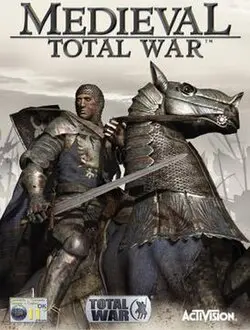
Medieval: Total War
 88
★ /10
88
★ /10
 PC
PC
 1C Company,
  Activision


Medieval: Total War (2002) stands as one of the most critical turning points in the history of the legendary grand strategy and real-time tactics franchise. Following the exhausting market fatigue of hyper-fast, high-APM traditional RTS clones and the subsequent structural stagnation of flat, spreadsheet-reliant war simulations, the future of the genre was highly uncertain.
British developer The Creative Assembly stepped in, boldly expanded the scale of their groundbreaking dual-layer framework, and focused development duties on a massive geopolitical scope. Faced with the intense task of solidifying a newly born sub-genre during the golden era of PC gaming, The Creative Assembly delivered a stellar, redemptive chapter that beautifully bridged complex feudal politics with massive, fully 3D real-time tactical leaps.
The Grand Reset: A Continental Canvas
Medieval: Total War completely severed ties with the isolated, localized province borders of feudal Japan seen in Shogun. Instead, it established a massive, tightly constructed historical lore continuity: Medieval Europe, North Africa, and the Middle East from the 11th to the 15th Centuries.
The game’s geopolitical landscapes, economic growth, and military operations are hard-locked across a dynamic seasonal timeline divided into three distinct start dates: the Early (1087), High (1205), and Late (1321) eras. The massive campaign plays out like an interconnected political thriller, tracking major royal dynasties as shifting border alliances, religious crusades, and sudden faction structural re-emergences (like the sweeping Mongol Golden Horde invasion) completely rewrite map control across dozens of historical provinces.
The Core Evolution: Feudal Estates & Sprawling 3D Sieges
The Creative Assembly deliberately looked back at their debut title as a mechanical anchor, retaining the highly successful “Risk-style” turn-based strategic board layer while heavily evolving the limits of the engine:
- The Leap to 10,000-Soldier Tactical Grids: Running on an incredibly optimized, upgraded 3D graphics engine, the tactical layer shattered previous scale ceilings. Battles could natively field up to 10,000 individual soldiers simultaneously on screen. Players commanded massive formations of chivalric knights, disciplined crossbowmen, and peasant levies across sprawling 3D topographies, transforming combat into a masterclass in grand positional geometry.
- The Introduction of Structural Siege Warfare: The combat grid completely moved beyond basic open-field clashes. The engine introduced multi-tiered tactical siege mechanics. Attackers deploy historical artillery—such as ballistas, catapults, and massive trebuchets—to physically shatter castle walls and fortress gates, while defenders fight house-by-house behind stone fortifications to prevent complete annihilation.
- The Florin and Estate Economy: Turn-based management traded koku for florins. Players cultivate regional farmlands, establish deep maritime merchant trade lanes, and construct specialized infrastructure—such as massive keeping towers, armorers, and shipyards—to scale up their financial yields and fuel expensive military mobilization lines.
The Deep Meta: Religious Dogma & The Royal Lineage
To maximize macro-strategy variance, Medieval: Total War introduced twelve fully playable historical empires (including England, France, the Holy Roman Empire, Byzantium, and the Ottoman Turks). Progression across the campaign map is governed by an intricately complex web of Religious Metrics and Succession Hazards that dictate your macro-strategy:
- The Papal Excommunication Wheel: Catholic factions do not operate with absolute freedom. A global AI entity, the Pope, monitors all Christian actions. Launching unprovoked wars against fellow Catholic kingdoms will tank your Papal standing, leading to immediate Excommunication—which instantly tanks your civilian population happiness, triggers widespread provincial rebellions, and invites rival empires to attack your lands without penalty.
- The Crusade and Jihad Assemblies: Religious leaders can unleash massive mobile army stacks. Catholic Popes can declare Crusades, and Islamic factions can declare Jihads, allowing commanders to build a zealot army that grows exponentially for free as it moves across provinces toward a holy target, completely turning the tide of long-distance wars.
- The Bloodline and Princess Matrix: Generals aren’t just expendable stat blocks; they belong to a dynamic family tree. Rulers must actively monitor royal titles, assign regional vices or virtues, and deploy Princesses as political agents across the map grid to secure iron-clad marriage alliances or physically seduce and steal highly capable enemy generals away from rival crowns. Neglecting the lineage risks triggering a massive, empire-shattering Succession Crisis civil war upon your monarch’s death.
The Viking Invasion Expansion & Alternate Unit Matrices
In 2003, the game received its highly celebrated definitive expansion: The Viking Invasion. This massive standalone campaign completely shifted the focus onto a hyper-localized, high-intensity map of the British Isles during the Early Dark Ages (793 to 1066 AD). Operating on a fast, attrition-heavy tactical timeline, players manage unique regional cultures like the raiding Vikings, the defending Anglo-Saxons, the Picts, and the Irish.
More importantly, the expansion and subsequent patches finalized highly specialized unit armor and weapon counter profiles, which heavily altered frontline combat parameters:
| Faction Type / Culture | Specialized Unit Variant | Primary Weapon Profile | Tactical Combat Role & Passives |
| The Vikings | Viking Berserkers | Twin Battleaxes | High-damage shock infantry who naturally enter a “Frenzy” state, completely immune to morale routs but lacking armor shields. |
| The Vikings | Landsmenn | Heavy Spear & Shield | Elite defensive wall infantry specializing in holding tight choke points against heavy cavalry momentum. |
| Anglo-Saxons | Huscarles | Two-Handed Dane Axe | Armor-piercing heavy vanguard troops built to rapidly chew through frontline shield walls. |
| Generic Feudal | Swiss Armored Pikemen | Monolithic Long Pike | Forms an impenetrable, stationary anti-cavalry wall; completely dominates narrow bridge or gate defenses. |
The Modern Standard: The Steam Compatibility Resolution Meta
While the game’s original 2002 software execution shell is an archaic relic designed for Windows XP and early direct-draw rendering, Medieval: Total War experiences a vital archival and retro renaissance today through its native Collection package distributed digitally via Steam and GOG. Following years of unplayability where modern graphics processors caused immediate campaign map crashes, Creative Assembly and community developers overhauled the client’s stability lines.
The modern standard successfully reconstructs the legacy engine stability. Strategy purists utilize open-source graphical wrappers (like dgVoodoo2) alongside targeted widescreen custom registries to bypass original fixed-resolution barriers. This locks the classic game into crisp 1080p, 2K, or 4K desktop environments under Windows 10 and Windows 11 out-of-the-box—ensuring that the glorious cinematic orchestral score, Papal influence rings, and grand 3D tactical siege battles operate flawlessly on contemporary multi-core gaming systems.
Release History
- Medieval: Total War (Base Game Launch): August 20, 2002 (North America) / August 30, 2002 (Europe)
- The Viking Invasion (Expansion Pack): May 7, 2003
- Medieval: Total War – Collection (Steam Re-Release): May 2015 (Updated with modern OS optimization shells)
- Modern Packaging: Natively preserved and readily available as a digital absolute classic, Medieval: Total War™ – Collection, hosted globally on Steam and GOG.
When taking up your absolute sovereign crown to dominate the medieval world, are you planning to play a patient, deeply political strategy by maximizing your Papal standing and launching massive, holy Crusades, or will you test the absolute limits of raw tactical attrition by spearheading a rapid, unshielded assault using the berserker shock columns of the Viking hordes?