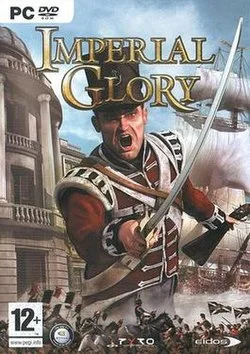
Imperial Glory
 69
★ /10
69
★ /10
 PC
PC
 ND Games


Imperial Glory (2005) stands as one of the most critical turning points in the history of the legendary turn-based strategy and real-time tactical franchise. Following the exhausting market fatigue of traditional flat strategy board clones and the subsequent structural stagnation of the early grand campaign formula, the future of the tactical genre was highly uncertain.
British publisher Eidos Interactive stepped in, bought the global publishing rights, and handed development duties to the Spanish studio Pyro Studios. Faced with the intense task of salvaging a deeply passionate community after the highly polarizing experiments of contemporary micro-intensive clones, Pyro delivered a stellar, redemptive chapter that bridged classic turn-based empire board game logic with modern real-time 3D tactical leaps.
The Grand Reset: A Brand New Universe
Imperial Glory completely severed ties with the loose medieval and fantasy realms of contemporary real-time tactics clones. Instead, it established a completely fresh, tightly constructed historical lore continuity: The Napoleonic Era (1789–1815).
The world’s geopolitical landscapes, trade monopolies, and imperial expansions are strictly governed by the fierce rivalries of five Great Powers. The massive campaigns play out like an interconnected political thriller, tracking empires as industrial revolutions disrupt traditional borders, sparking a continent-wide war that drags Great Britain, France, Russia, Prussia, and Austria into a grand struggle to prevent total annexation of the civilized world across more than 50 strategic provinces spanning Europe and North Africa.
The Core Evolution: Dual-Layer Imperialism & Tactical Geography
Pyro Studios deliberately looked back at early tabletop rules and Total War frameworks as their mechanical anchors, discarding continuous micromanaged local base building. However, they heavily evolved the engine:
- The Leap to Dual-Layer Warfare: Running on an advanced 3D tactical engine, Imperial Glory was a distinct entry that divided the loop into a macro turn-based management grid and localized real-time 3D battles. Players use a risk-style map to build embassies, establish commercial trade routes, and levy troops, before plunging directly onto the tactical map coordinates to execute field maneuvers.
- The Interactive Cover & Elevation Suite: The combat field completely abandoned wide-open flat terrain blobs. Pyro implemented a fully destructible structural mechanic where infantry could physically garrison inside farmhouses, take cover behind stone walls, or secure high-elevation hills to gain devastating defensive and missile damage modifiers against charging armies.
- The Revolutionary Real-Time Naval Battles: While rival contemporary franchises struggled to move beyond automated naval simulations, Imperial Glory introduced fully playable 3D maritime combat. Players manually maneuver Sloops, Frigates, and massive Ships of the Line—balancing wind vectors, selecting customized ammunition (solid shot, grape shot, chain shot), and initiating direct boarding commands to capture enemy vessels intact for their own fleet.
The Deep Meta: Great Power Passives & The Three-Era Tech Tree
To maximize faction asymmetry within its historical framework, Imperial Glory threw out uniform copy-paste statistics. Every alignment was granted a mandatory, entirely exclusive military legacy and specialized unique forces that dictated their macro-strategy:
- Great Britain (Naval Supremacy): Emphasizes deep global commerce and unmatched naval engineering, deploying premium Highlanders and superior war vessels to choke out rival maritime channels.
- France (The Revolutionary Guard): Leverages high morale and rapid tactical infantry movement, deploying elite Imperial Guards who refuse to break under immense psychological pressure.
- Russia (The Unyielding Steppe): Focuses on cheap, massive manpower pools and brutal attrition warfare, marshaling deadly Cossacks to ruthlessly flank and harass exposed enemy lines.
- Prussia (The Military Absolute): Emphasizes strict discipline and cheaper, highly organized military research paths, fielding precise Landwehr and advanced shock forces.
- Austria (The Imperial Citadel): Maximizes deep defensive infrastructure and flexible border expansion, fielding highly versatile Grenzer rangers to pick off enemy vanguards from a distance.
The Hidden Three-Era Research Tree
Progression was governed by a massive, intricately complex web of cultural and scientific advancement. The empire tech layout was hard-locked across three progressive historical Eras (The Enlightenment, The Industrial Revolution, and Imperial Supremacy). To unlock game-breaking endgame military divisions, players had to precisely balance their economy—carefully choosing between Autocratic or Democratic government shifts, turning political philosophy into a precise science of nation cultivation.
The Expansions and Alternate Upgrades
While the game operated without a standalone premium expansion, continuous optimization finalized Alternate Upgrades for your baseline military assets via specific provincial production levels. For example:
| Base Unit (Class) | Upgrade Path A | Upgrade Path B (Alternate) |
| Line Infantry | Grenadiers (Gains heavy close-range shock damage and structural demolition metrics) | Light Infantry / Chasseurs (Sacrifices armor for extended skirmish rifle range and stealth parameters) |
| Cavalry | Hussars (High-speed, light cavalry built for rapid scouting and hunting fleeing routing units) | Cuirassiers (Heavy, steel-plated shock horsemen built to break defensive infantry ranks through frontal momentum) |
| Artillery | Howitzers (Fires explosive high-trajectory shells over hills to shatter static enemy formations) | Foot Artillery (Mobile field cannons specializing in close-quarters canister shot to shred advancing infantry blobs) |
The Modern Standard: The Compatibility Restoration Meta
While the official retail lifecycle concluded in the mid-2000s under Eidos, Imperial Glory experiences an incredible casual and preservation renaissance today. Currently published and maintained by Kalypso Media on modern digital storefronts, the game has been fully extracted from old physical disc dependencies that historically triggered game-breaking errors on modern operating systems.
The modern standard completely reconstructs the engine stability. Strategy communities utilize simple widescreen registries and compatibility wrappers to bypass original Windows XP multi-core execution crashes. This locks the classic game into sharp 1080p, 2K, or 4K resolutions out-of-the-box, allowing players to watch thousands of line infantry form absolute, anti-cavalry defensive Square Formations in flawlessly sharp high-definition on Windows 10 and Windows 11.
Release History
- Imperial Glory (Base Game Launch): May 17, 2005 (North America) / May 20, 2005 (Europe)
- Mac OS X Port: December 1, 2006 (Published by Feral Interactive)
- Modern Packaging: Natively preserved and readily available as a digital title on Steam and GOG under the Kalypso Media catalog.