Call of Duty 2
 89
★ /10
89
★ /10
 PC,
PC,  Windows Mobile,
  Xbox 360
 1C-SoftClub,
  Activision,
  Konami Digital Entertainment
Where to buy

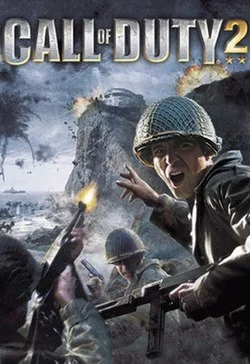
Call of Duty 2 is a 2005 historical first-person shooter video game developed by Infinity Ward and published by Activision. Released on October 25, 2005, for Microsoft Windows and on November 22, 2005, as a high-profile, era-defining launch title for the Xbox 360, the title stands as the second primary installment in the Call of Duty franchise.
Call of Duty 2 is widely recognized by historians as the definitive software blueprint that modernized the structural pacing of the entire first-person shooter genre. Serving as the flagship showcase for the seventh generation of console hardware, it was the very first Xbox 360 title to sell over one million copies.
By fundamentally discarding the genre’s decade-long reliance on physical health bars and static world pickups, Infinity Ward introduced revolutionary design pillars—most notably automatic health regeneration—that permanently reshaped the mechanical expectations of mainstream action games.
Technical Specifications
| Attribute | Details |
| Developer | Infinity Ward (OS X port by Aspyr Media) |
| Publisher | Activision (Konami in Japan) |
| Directors | Jason West (Project Lead), Vince Zampella (Studio Head) |
| Lead Programmer | Jason West |
| Engine | Proprietary IW Engine (First iteration of the custom in-house framework) |
| Platform(s) | Microsoft Windows, Xbox 360, Mac OS X, Mobile |
| Release Date | October 25, 2005 (Xbox 360 Launch: November 22, 2005) |
| Genre | First-person shooter (FPS), Historical |
| Mode(s) | Single-player, Multiplayer |
Global Frontlines: Campaign Architecture
The single-player campaign is split across three distinct national military tracks, encompassing 27 individual missions spanning from 1941 to 1945. Moving away from the strictly linear paths of the 2003 original, Call of Duty 2 granted players the operational freedom to play through the international campaigns in whichever chronological order they preferred.
1. The Soviet Campaign (1941–1943)
Players control Private Vasili Koslov of the 13th Guards Rifle Division. The narrative opens on the snow-covered outskirts of Moscow, famously initiating player training by throwing physical potatoes instead of real fragmentation grenades due to critical resource shortages.
The perspective swiftly moves into the brutal, claustrophobic urban ruins of the Battle of Stalingrad. Gameplay shifts from intense tunnel-crawling through frozen pipelines to executing desperate, block-by-block building defenses against advancing Wehrmacht infantry.
2. The British Campaign (1942–1944)
This track splits its mechanical focus across two unique operational lenses:
- The Desert Rats: Players step into the boots of Sergeant John Davis of the 7th Armoured Division fighting across North Africa. Lobbies experience wide-scale trench assaults, heavy artillery defense lines at El Alamein, and high-velocity town clearance loops to repel Field Marshal Erwin Rommel’s Afrika Korps.
- Armored Reconnaissance: Shifting to vehicular mechanics, players take direct command of Captain David Welsh, piloting a British Crusader tank across massive, dust-churning tank skirmishes in Libya. The campaign eventually concludes in Europe with the grueling, close-quarters infantry battle to liberate Caen, France.
3. The American Campaign (1944–1945)
Following Corporal Bill Taylor of the elite 2nd Ranger Battalion. The American perspective kicks off with one of the most cinematic and physically intense set-pieces of the early HD gaming era: the harrowing D-Day assault on Pointe du Hoc. Players must scale sheer, 100-foot seaside cliffs under blisteringly dense German machine-gun fire using grappling hooks and ropes.
Following the Normandy landing, Taylor’s squad pushes deep into Germany, undertaking a terrifying vertical siege to capture the strategically vital Hill 400 before executing the definitive amphibious crossing of the Rhine River.
Mechanical Revolution: The Blueprint of the Modern Shooter
Infinity Ward utilized Call of Duty 2 to cleanly break away from legacy PC shooter logic, establishing three structural pillars that defined modern action game design:
The Removal of the Health Bar
Prior to 2005, first-person shooters forced players to scout environments for medical health packs or armor shields to survive. Call of Duty 2 pioneered the Regenerating Health System. When taking bullet damage, the player’s vision dynamically blurs, blood splatters color the borders of the screen, and heavy, panicked heartbeat audio cues trigger. To fully heal, players simply seek physical cover for a brief, uninterrupted window. This altered the pacing of shooter sandboxes, allowing designers to throw waves of high-density enemy crossfire at the player without worrying about resource exhaustion.
- Spatial Grenade Indicators: To prevent sudden, frustrating deaths from blind explosive throws, the engine introduced the first-ever on-screen grenade threat indicator. A contextual HUD icon dynamically tracks the spatial coordinates of nearby live explosives relative to the player’s physical placement, signaling exactly which direction to sprint to dodge the blast radius.
- The Battle Chatter System: The game’s audio design pioneered interactive AI communications. Rather than shouting generic generic combat audio lines, friendly and enemy soldiers dynamically call out real-time situational tracking data based on active geometry (e.g., “Sniper in the second-story window!” or “Flanking behind the red tractor!”), actively providing players with structural situational awareness purely through spatial audio.
- Volumetric Smoke Physics: The IW engine prioritized state-of-the-art particle streaming. Throwing a smoke grenade dynamically generated dense, volumetric walls of fog that physically blocked the sightlines of enemy AI combatants, transforming standard smoke utilities into essential tactical masking tools.
Multiplayer & The Launch of Xbox Live HD
The competitive multiplayer sandbox stood as the absolute crown jewel of the Xbox 360’s launch era, cementing Call of Duty as a mandatory cultural staple of online console lobbies. Supporting up to 8 players on console and up to 64 players on PC, the game offered a pure, weapon-skill-focused sandbox entirely devoid of modern modern streaks, perks, or attachments.
Matchmaking revolved around highly tactical, baseline game modes: Search & Destroy, Capture the Flag, Headquarters, and Team Deathmatch. Arenas like Carentan, Burgundy, Toujane, and El Alamein are universally revered as masterclasses in historical three-lane structural balance. The game forced a heavy reliance on iron-sights tracking, distinct bolt-action rifle precision (such as the Kar98k or Mosin-Nagant), and tactical smoke positioning, establishing a pure competitive baseline that birthed the very first wave of console esports tournaments.
Contemporary Stance & 2026 Preservation
Looking back from mid-2026, Call of Duty 2 is championed as a flawless, immortal foundational text. While subsequent generations transitioned the franchise toward advanced mobility suites, custom pick-10 classes, and expansive live-service frameworks, this 2005 classic is increasingly praised for its clean, unbloated, and hyper-focused tactical loops.
The game is beautifully preserved and actively playable across modern platforms:
1. Console Perfection
On Xbox Series X and Xbox Series S hardware via native backward compatibility, the game functions in an absolute dream state. While the original 2005 Xbox 360 hardware was plagued by severe frame-pacing hitches and struggled to maintain its 60Hz target, the modern Series X framework leverages system-level emulation black magic to deliver a flawlessly locked 60 frames per second. Coupled with Auto HDR tone mapping, the game’s classic volumetric smoke and lighting pop with crisp, clean contrast on modern 4K displays.
2. PC Desktop Stability
On PC, the title remains highly functional and directly available via Steam. The engine runs effortlessly under modern 64-bit Windows 11 frameworks. While the official global matchmaking pipelines are quiet outside of retro community clans, enthusiast groups routinely host private dedicated server networks, allowing purists to seamlessly organize weekend Search & Destroy tournaments utilizing the exact same bolt-action mechanics that started a global revolution over twenty years ago.
Call of Duty news
More news
Xbox Game Pass September Wave 2: 13 Games Including E-Day
Doom Slayer Joins Call of Duty in Season 6's Halloween Update
Activision Films Cheat Maker Being Served Cease and Desist Order
Modern Warfare 4 Beta Update Adds Map, Mode, and Quieter Footsteps