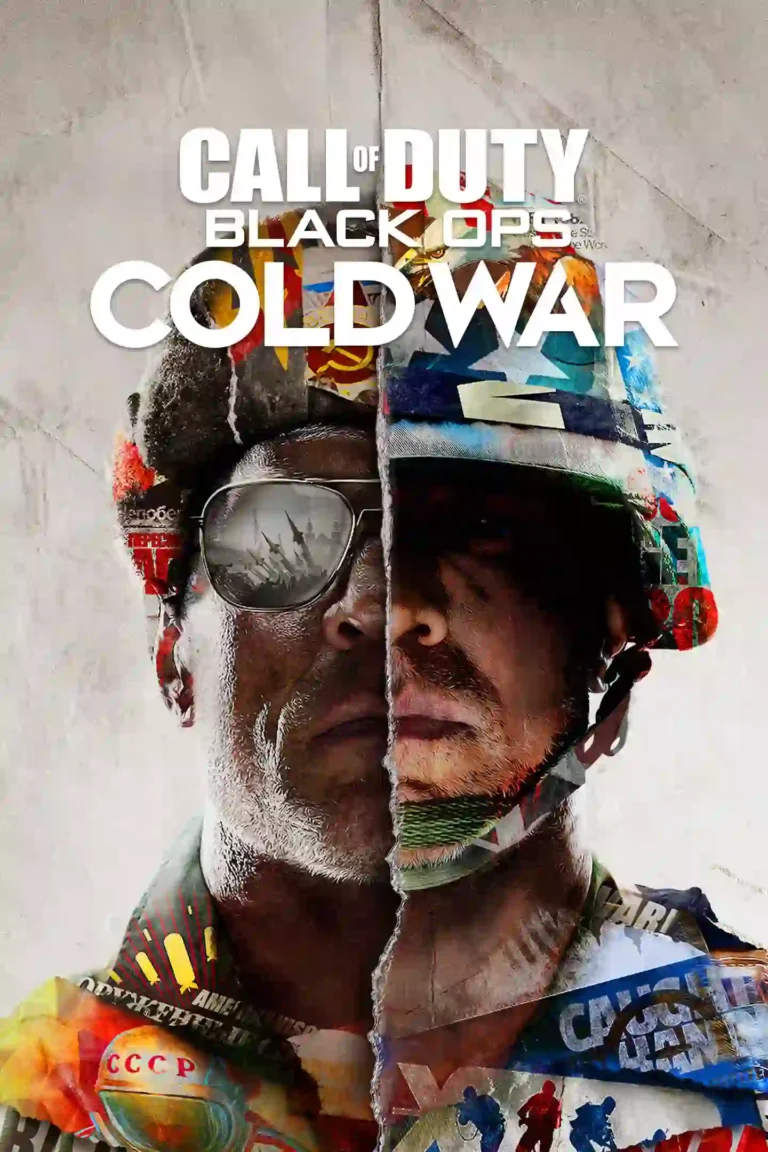
Call of Duty: Black Ops Cold War
 76
★ /10
76
★ /10
 PC,
PC,  PS4,
PS4,  PS5,
PS5,  Xbox One,
  Xbox Series X/S
 Activision


Call of Duty: Black Ops Cold War is a 2020 first-person shooter video game developed co-jointly by Treyarch and Raven Software, and published by Activision. Released worldwide on November 13, 2020, for Microsoft Windows, PlayStation 4, PlayStation 5, Xbox One, and Xbox Series X/S, the title stands as the seventeenth primary installment in the Call of Duty franchise and the sixth overall entry within the Black Ops sub-series, functioning as a direct narrative sequel to the original 2010 Call of Duty: Black Ops.
The production of Cold War was historically turbulent. Following severe creative disagreements and development gridlocks between Raven Software and Sledgehammer Games in 2019, Activision abruptly restructured the project mid-cycle, drafting Treyarch to take over as the overarching lead developer.
The studios cleanly divided corporate responsibilities: Raven spearheaded the single-player campaign, while Treyarch engineered the multiplayer and Zombies suites. Despite a condensed development timeline, the game launched as a critical and commercial blockbuster, bridging the hardware generation gap as the very first entry natively optimized for both eighth- and ninth-generation consoles.
Technical Specifications
| Attribute | Details |
| Developer | Treyarch (Multiplayer/Zombies), Raven Software (Campaign), Beenox (PC) |
| Publisher | Activision |
| Directors | Dan Vondrak, Corky Lehmkuhl |
| Lead Writers | David S. Goyer, Craig Houston, Brent Friedman |
| Composer | Jack Wall |
| Engine | Upgraded Black Ops Engine (Integrating modern IW shared asset tools) |
| Platform(s) | Microsoft Windows, PlayStation 4, PlayStation 5, Xbox One, Xbox Series X/S |
| Release Date | November 13, 2020 (Steam Release: March 8, 2023) |
| Genre | First-person shooter (FPS), Spy Thriller |
| Mode(s) | Single-player, Multiplayer, Co-Op Zombies |
Mind Games and Choices: Campaign Overview
The single-player campaign takes place during the early 1980s, dropping players into a tense, paranoia-fueled world of espionage at the height of the Cold War during the Ronald Reagan presidency. The plot is catalyzed by a high-stakes intelligence leak revealing that Perseus—a mythical, deeply entrenched Soviet rogue agent—has resurfaced to execute a catastrophic operation designed to permanently dismantle the Western global power structure.
To counter Perseus, the CIA authorizes an off-the-books, black-operations task force led by the cold, calculating operative Russell Adler (Bruce Thomas). The squad seamlessly integrates legacy sub-series icons like Alex Mason, Frank Woods, and Jason Hudson alongside fresh operatives like Helen Park and Lawrence Sims.
1. The Safehouse Hub & Psychological Profiling
Raven Software deeply modernized the campaign’s structural pacing by introducing Character Creation. Players construct their custom operative, code-named “Bell.” Beyond picking cosmetic backgrounds, players select specific Psychological Profiles (e.g., Paranoid, Lone Wolf, Violent) that translate into passive gameplay perks like permanent reload-speed buffs, increased kinetic damage resistance, or expanded health pools.
Between missions, the team returns to a CIA Safehouse in West Berlin. The hub allows players to freely converse with squadmates to gather deep lore, inspect an interactive evidence board to solve optional cryptographic puzzles, and unlock side-operations.
2. The Hypnotic Twist and Branching Finales
The Illusion of Control: The narrative reaches an iconic, reality-shattering climax during the level “Break on Through.” Adler subjects an injured Bell to a profound, drug-induced chemical hypnosis to unlock suppressed memories of a 1968 Vietnam War deployment. The gameplay transforms into a fluid psychological horror sandbox; Adler narrates Bell’s memories in real-time, and players can actively choose to obey or forcefully defy his commands.
This sequence culminates in a massive narrative twist: Bell was never an American soldier. They were actually a high-tier Soviet asset who survived a near-fatal assassination attempt by a rival faction before being captured by Adler. Using MK-Ultra brainwashing techniques, the CIA systematically implanted synthetic memories into Bell’s mind to exploit their true knowledge of Perseus’s location.
Upon waking from the hypnosis, the game forces the player to make a permanent moral choice that drastically alters the ending:
- The Truth (Solovetsky): Bell guides the CIA to Perseus’s active broadcast array, successfully preventing the catastrophic nuclear destruction of Western Europe, though the path ends with Adler tragically tying up “loose ends.”
- The Lie (Duga): Bell misleads the CIA team into a trap at a defunct Soviet radar array, coordinating a massive ambush alongside Soviet forces to slaughter Adler’s entire squad, cementing the absolute global dominance of the Soviet Union.
Multiplayer Dynamics: Traditional Arcade Speed
The competitive multiplayer sandbox deliberately retreated from the heavy, tactical pacing of 2019’s Modern Warfare to restore Treyarch’s signature fast, colorful arcade shooter flow. Map design prioritized traditional three-lane layouts with high visibility, fast time-to-kill tracking, and smooth boots-on-the-ground movement mechanics.
- The Scorestreak Safeguard: The game completely re-architected the reward economy by ensuring that Scorestreaks did not reset upon death. Instead, the system implemented internal weapon cooldowns and multiplied reward values based on high-skill kill-streaks secured during a single life, allowing objective-minded players to consistently build points toward high-tier rewards like the Chopper Gunner or VTI Combat Bow.
- Large-Scale Operations: Alongside standard 6v6 playlists, Cold War introduced Combined Arms (12v12 combined-arms objective warfare with heavy vehicular integration) and Fireteam: Dirty Bomb, a chaotic 40-player sandbox where ten squads of four competed on sprawling Ural Mountain maps to detonate dirty bombs and extract radioactive uranium.
- Warzone Ecosystem Integration: The title marked a major milestone for the free-to-play battle royale network, executing a seamless weapon and operator integration that imported Cold War’s entire 1980s arsenal directly into the active Warzone Verdansk meta.
Dark Aether Rebirth & The Genesis of Outbreak
The co-op suite served as the official debut of the Dark Aether narrative universe, a comprehensive storyline reset that clean-slated the old, convoluted Aether lore. Players step into the combat boots of standard military Operators working under Requiem—a secret, CIA-backed research division headed by Grigori Weaver—combating a rogue Soviet faction known as Omega Group that seeks to harvest a powerful, reality-warping element called Aetherium.
The mode introduced massive structural modernizations to future-proof the survival loop:
- Decoupled Loadouts: Players permanently discarded standard, weak starting pistols, gaining the total freedom to spawn into matches with any customized primary weapon from their multiplayer stash.
- The Exfiltration Option: Instead of fighting to an inevitable, game-ending death, squads could actively initiate an Exfil sequence every five rounds. This triggered an intense, high-stakes countdown timer forcing the squad to clear a designated zone of a dense zombie horde to safely board a helicopter, rewarding successful extractions with rare Aetherium Crystals spent to permanently upgrade skill tiers, perk tiers, and weapon mods out of game.
The Outbreak Mode Evolution
Midway through the live-service cycle, Treyarch deployed Outbreak—a massive, experimental mechanical departure that completely flipped the script on round-based survival. Dropping squads into the wide, open-world regions of the Ural Mountains, players piloted vehicles, completed macro-objectives (such as escorting automated rovers or defending giant dimensional anomalies), and chose when to warp into subsequent, exponentially harder regions. This massively successful open-world experiment served as the direct mechanical blueprint that eventually birthed Modern Warfare Zombies (MWZ) in 2023 and the massive Dark Aether vehicle sandboxes developed for 2025’s Call of Duty: Black Ops 7.
Contemporary Status & 2026 Perspective
Six years removed from its initial 2020 launch, Call of Duty: Black Ops Cold War enjoys a highly revered, nostalgically vindicated legacy within the community. While initially criticized at launch for visual adjustments following the gritty realistic engine of Modern Warfare 2019, retrospective design circles celebrate Cold War as a massive triumph that successfully saved a fractured development cycle while laying down the absolute story and gameplay foundations that eventually culminated in the high-speed Omnimovement trilogies of 2024’s Black Ops 6 and 2025’s Black Ops 7.
Today, the game is beautifully preserved and actively populated:
The title continues to display exceptional technical health. On PlayStation 5 and Xbox Series X/S hardware, the title benefits from immaculate, system-level optimization, running at a locked, native 60Hz or a high-refresh 120Hz performance profile complete with hardware-accelerated ray tracing and responsive DualSense haptic trigger integration.
On PC, the game operates with absolute stability under modern 64-bit Windows 11 desktop frameworks via Battle.net and its subsequent 2023 retail launch onto Steam. Because cross-platform matchmaking metrics remain unified and fully operational, finding active lobbies for traditional Core multiplayer, the deep Round-Based Zombies maps, or expansive Outbreak runs remains a seamless, lightning-fast experience for retro-minded squads today.
Call of Duty news
More news
Xbox Game Pass September Wave 2: 13 Games Including E-Day
Doom Slayer Joins Call of Duty in Season 6's Halloween Update
Activision Films Cheat Maker Being Served Cease and Desist Order
Modern Warfare 4 Beta Update Adds Map, Mode, and Quieter Footsteps