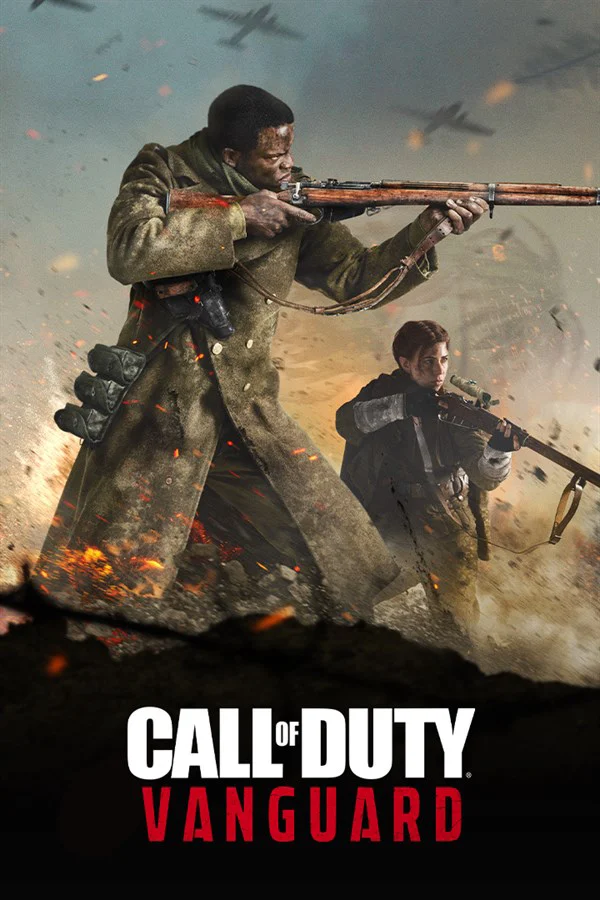
Call of Duty: Vanguard
 73
★ /10
73
★ /10
 PC,
PC,  PS4,
PS4,  PS5,
PS5,  Xbox One,
  Xbox Series X/S
 Activision


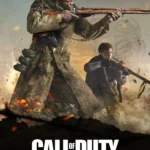
Call of Duty: Vanguard is a 2021 first-person shooter video game developed by Sledgehammer Games and published by Activision. Released worldwide on November 5, 2021, for Microsoft Windows, PlayStation 4, PlayStation 5, Xbox One, and Xbox Series X/S, the title serves as the eighteenth primary installment in the Call of Duty franchise.
Vanguard marks the third time Sledgehammer Games spearheaded a historical World War II setting. However, unlike their 2017 entry Call of Duty: WWII, which prioritized a traditional, grounded aesthetic, Vanguard utilized a modernized, high-performance tactical engine framework.
While the game launched with an unprecedented amount of content—including 20 multiplayer maps on day one—its aggressive integration of hyper-modern live-service crossover cosmetics into a historical sandbox resulted in a highly polarized community legacy.
Technical Specifications
| Attribute | Details |
| Developer | Sledgehammer Games (Zombies by Treyarch, PC port by Beenox) |
| Publisher | Activision |
| Engine | IW 8.0 (Upgraded Modern Warfare 2019 Engine Pipeline) |
| Platform(s) | Microsoft Windows (Battle.net & Steam), PlayStation 4, PlayStation 5, Xbox One, Xbox Series X/S |
| Release Date | November 5, 2021 (Steam Release: March 8, 2023) |
| Genre | First-person shooter (FPS), Historical |
| Mode(s) | Single-player, Multiplayer, Zombies (Cooperative) |
The Birth of Special Forces: Campaign and Narrative
The single-player campaign takes place near the absolute tail-end of the European theater in 1945. Rather than tracking a singular standard military platoon, the narrative focuses on the origin story of the world’s very first multinational special operations unit: Task Force One.
Captured during a covert infiltration mission into Berlin, the squad is held captive inside a Gestapo interrogation facility. The story unfolds over a sequence of non-linear flashbacks as the main antagonist, the ruthless Nazi Officer Hermann Wenzel Freisinger, tries to break the squad down while safeguarding Project Phoenix—a contingency plan engineered to establish a Fourth Reich.
The narrative splits its gameplay focus across four distinct international heroes, each possessing unique mechanical abilities:
- Sergeant Arthur Kingsley (British Army): The tactical leader of Task Force One. His special mechanic allows players to issue direct field commands to companion AI squadmates, directing them to draw enemy crossfire or suppress entrenched machine-gun nests.
- Lieutenant Polina Petrova (Soviet Red Army): A lethal sniper modeled closely on the historical Soviet sniper Lyudmila Pavlichenko. Her chapters focus on high-mobility traversal, letting players rapidly scale yellow structural bricks, slide through tight ventilation ducts, and execute quick flank maneuvers.
- Private Lucas Riggs (Australian Army): A demolitions expert fighting across the North Africa Campaign. Riggs can carry a vastly expanded inventory of tactical explosives, complete with unique physical HUD trajectories to hurl grenades across massive combat fields.
- Lieutenant Wade Jackson (U.S. Navy): A reckless dive-bomber pilot fighting in the Pacific theater. His mechanic introduces Focus, an active ultimate ability that slows down time, highlights enemy hitboxes through lush island foliage, and grants temporary auto-aim accuracy.
Multiplayer Metamorphosis: Combat Pacing & Destructibility
By migrating the franchise back to the IW 8.0 Engine, Sledgehammer Games successfully brought modern mechanical depth to a World War II landscape, permanently altering the spatial flow of combat arenas:
1. Tactical Environmental Mechanics
The engine natively integrated mechanics popularized by 2019’s Modern Warfare, introducing Tactical Sprinting alongside a robust Weapon Mounting system that allows players to lock their weapons against physical corners or horizontal barriers to dramatically reduce recoil. This was coupled with a novel Blind Fire mechanic, allowing players to safely spray ammunition over low cover without exposing their operator’s hitbox.
2. Tactical Destructibility
Maps introduced physics-based geometric alteration. Soft walls, wooden barricades, structural doors, and plaster ceilings can be systematically blown open with explosives or shattered via continuous heavy-caliber bullet fire. This fluid destructibility allows players to organically manufacture entirely fresh sightlines and flanking lanes mid-match.
3. Combat Pacing
To give players ultimate control over lobby chaos, Vanguard introduced the Combat Pacing System. Regardless of selected game modes, players filter their matchmaking searches across three distinct player-density thresholds:
- Tactical: The classic, calculated Call of Duty experience, enforcing strict 6v6 player match limits.
- Assault: A balanced mid-tier alternative, scaling match pools up to 10v10 or 14v14 engagements.
- Blitz: Absolute unmitigated arcade chaos, cramming up to 24v24 player configurations onto compact maps, resulting in constant close-quarters firefights.
Zombies: The Dark Aether Crossover Deviation
In a historic franchise first, Treyarch was drafted to develop the Zombies mode for a Sledgehammer-led title, attempting to build an official prequel narrative to the Dark Aether universe established in Black Ops Cold War.
The storyline centers on the demonic entity Kortifex the Deathless, who forms a blood pact with Nazi Oberführer Wolfram Von List, granting him the power to reanimate a massive army of the undead out of the mass graves of Stalingrad. To combat the threat, players bond with opposing Dark Aether entities via mystical artifacts.
                  [ VANGUARD ZOMBIES FLOW ]
                              |
         -------------------------------------------
        |                                           |
        v                                           v
 [ THE ROGUELIKE HUBS ]                     [ THE CRITICISM SHIFT ]
 • Launch: Der Anfang / Terra Maledicta     • Severe Fan Backlash at Launch
 • Objective-Based Arena Teleports          • Absence of Classic Easter Eggs
 • Randomized Altar of Covenants Buffs     • Later Repaired with Round-Based Maps
                                              (Shi No Numa / Archon Remakes)
The mode launched with a highly controversial, non-traditional structural layout across maps like Der Anfang and Terra Maledicta. Instead of the classic, round-based wave defense format, players spawned into a non-aggressive hub zone, interacting with portals to teleport into brief, objective-based roguelike scenarios (Blitz, Transmit, Harvest).
Completing loops rewarded items spent at the new Altar of Covenants, a random vending system granting specialized perks like explosive melee strikes or automated revives. Due to severe community backlash mourning the absence of traditional round-based maps and complex easter egg quests, Treyarch spent the final seasons completely re-engineering the loop, eventually rolling out traditional, round-based remakes of Shi No Numa and The Archon to restore the mode’s classic identity.
Retrospective Assessment (2026 Perspective)
From a mid-2026 perspective, Call of Duty: Vanguard is remembered as a commercially soft yet technically robust entry that suffered heavily from thematic identity crises. During its active live-service lifecycle, Activision aggressively pushed boundaries to monetize cosmetics. By its final seasons, the game’s historical setting was completely overshadowed by the introduction of laser rifles, fully automatic plasma weaponry, and high-profile non-historical operator skins—ranging from Snoop Dogg and The Terminator to a massive, server-wide Godzilla vs. King Kong crossover event.
While purists criticized this complete erasure of World War II verisimilitude, competitive tracking circles praise Vanguard for delivering an exceptionally smooth, competitive weapon handling engine that laid the groundwork for the structural stability of Warzone’s highly popular Caldera map era.
The software remains actively maintained, stable, and populated across modern networks:
The software runs flawlessly across contemporary ninth-generation computing setups. On PlayStation 5 and Xbox Series X/S hardware, the title maintains a locked 60 frames per second at native resolutions, complete with optimized field-of-view sliders and responsive DualSense haptic trigger feedback arrays.
On PC, the game is fully optimized under modern 64-bit Windows 11 frameworks via both Battle.net and its subsequent 2023 retail integration onto Steam, keeping its massive 20-map base multiplayer rotation cleanly active for retro shooter enthusiasts organizing weekend playlist events.
Call of Duty news
More news
Xbox Game Pass September Wave 2: 13 Games Including E-Day
Doom Slayer Joins Call of Duty in Season 6's Halloween Update
Activision Films Cheat Maker Being Served Cease and Desist Order
Modern Warfare 4 Beta Update Adds Map, Mode, and Quieter Footsteps