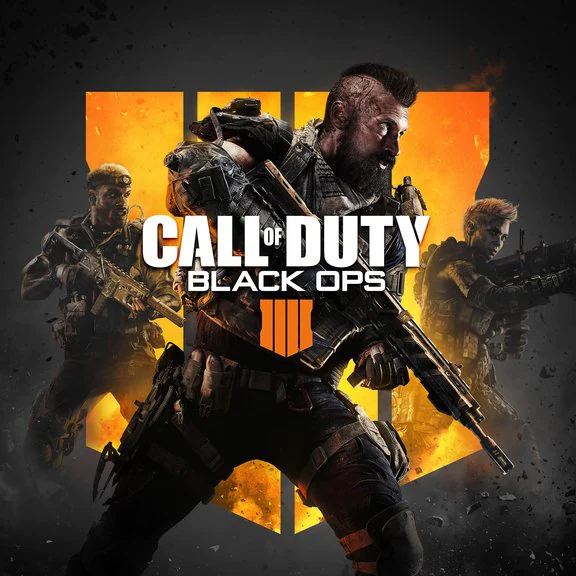
Call of Duty: Black Ops 4
 83
★ /10
83
★ /10
 PC
PC PS4
PS4 Xbox One
 Activision
Where to buy

Call of Duty: Black Ops 4 (stylized as Call of Duty: Black Ops IIII) is a 2018 multiplayer first-person shooter video game developed by Treyarch and published by Activision. Released worldwide on October 12, 2018, for Microsoft Windows, PlayStation 4, and Xbox One, the title stands as the fifteenth primary installment in the Call of Duty franchise and the fifth overall entry within the Black Ops sub-series.
Black Ops 4 occupies a highly controversial and experimental position within the franchise’s history. It represents the very first mainline entry to completely abandon a traditional single-player narrative campaign, a design pivot that initially sparked severe backlash from lore purists. To fill the vacuum, Treyarch reallocated its resources to pioneer the series’ first-ever massive battle royale sandbox, Blackout, while radically re-engineering the tactical pacing of its multiplayer and Zombies frameworks.
Technical Specifications
| Attribute | Details |
| Developer | Treyarch (PC port by Beenox) |
| Publisher | Activision |
| Director(s) | Dan Bunting, David Vonderhaar, Jason Blundell |
| Engine | Upgraded Black Ops 4 Engine (Upgraded lighting and ballistics system) |
| Platform(s) | Microsoft Windows (Battle.net), PlayStation 4, Xbox One |
| Release Date | October 12, 2018 |
| Genre | First-person shooter (FPS), Battle Royale |
| Mode(s) | Multiplayer, Blackout (Battle Royale), Zombies (Cooperative) |
Multiplayer Re-Architecture: Tactical Hero Shooting
Following the high-velocity “jetpack” movement of 2015’s Black Ops III, Black Ops 4 returned the competitive multiplayer suite to a grounded, “boots-on-the-ground” philosophy. However, Treyarch chose to heavily integrate mechanics heavily inspired by contemporary hero-shooters, resulting in the most tactical, squad-dependent multiplayer sandbox in the franchise:
1. The 150 HP Health Matrix & Manual Healing
In a complete subversion of a decade of design philosophy, the game permanently removed automatic health regeneration from the online environment. Base player health pools were expanded up to 150 HP, significantly extending the time-to-kill. To recover from a firefight, players had to manually trigger an injection stim tool bound to a dedicated tactical cooldown button, forcing users to actively manage their healing cycles mid-combat.
2. Specialist Synergies
The character-based Specialist system returned from Black Ops III, but swapped individual lethal weapons for high-tier tactical gear designed to dictate map control:
- Crash: Deploys an assault ammo pack that grants bonus score points per kill and triggers the TAK-5 ultimate to instantly boost the maximum health cap of the entire squad up to 200 HP.
- Torque: Anchors chokepoints by deploying razor-sharp Razor Wire barricades and heavy Barricade microwave-shield walls that slow down and melt charging hostiles.
- Ajax: Wields a mobile, high-density Ballistic Shield with an integrated machine pistol while utilizing blinding 9-Bang tactical flashbangs to clear entrenched rooms.
- Zero (Post-Launch): A hacker Specialist commanding the Icepick terminal, enabling her to systematically disrupt enemy HUDs, freeze active scorestreaks, and forcefully hack hostile equipment (like automated Sentry Guns) to turn them against their original owners.
Blackout: The Blueprint of Warzone
Constructed as the definitive replacement for the single-player campaign, Blackout served as Call of Duty’s historic debut entry into the battle royale landscape. Dropping up to 100 players onto the largest map infrastructure Treyarch had ever produced, the sandbox functioned as a massive, high-budget celebration of Black Ops history.
The physical terrain ingeniously stitched together iconic legacy map coordinates, including Nuketown Island, Firing Range, Estates, and a horror-fueled Asylum zone teeming with active, AI-controlled zombies protecting high-tier mystical loot boxes.
The movement engine incorporated wing-suit glides, tactical helicopter dogfights, and scavenger perks that altered physical audio propagation. Blackout laid down the absolute operational, financial, and network foundations that Activision subsequently utilized to deploy the free-to-play Warzone ecosystem in 2020.
Zombies: A House Divided
The cooperative Zombies suite launched as the most ambitious, content-dense offering in the mode’s history, featuring four sprawling maps on day one. However, it was deeply fractured by a risky decision to run two entirely separate narrative tracks concurrently:
The Chaos Storyline
An entirely fresh, mythologically driven historical universe tracking an archeological crew consisting of Scarlett, Diego, Bruno, and Shaw. Maps like IX placed teams inside a brutal, sun-drenched Roman gladiator coliseum, battling elemental undead variants and cosmic champions, while Voyage of Despair took place on a sinking RMS Titanic infested with Eldritch anomalies.
The Aether Storyline
The definitive continuation of the beloved legacy narrative tracking the final, tragic stands of the Primis and Ultimis crews. This track focused heavily on massive, reimagined remakes of older locations, including Blood of the Dead (an expanded rendition of Mob of the Dead set inside a purgatorial Alcatraz prison) and Tag der Toten (a snowy finale set within a frozen Siberian shipping outpost).
The Mechanical Controversy: To future-proof the mode, Treyarch completely removed classic, sacred perks like Juggernaut, Speed Cola, and Double Tap. Instead, players manually assigned a curated loadout of four active perks to literal vending altars before entering a match. This total erasure of classic progression heavily polarized core survival purists, turning a massive portion of the community away from the mode’s launch window.
Contemporary Stance & 2026 Perspective
From a mid-2026 perspective, Call of Duty: Black Ops 4 stands out as a highly unique, deeply flawed transitional artifact. Look, let’s be entirely candid: the game’s modern ecosystem is in an exceptionally rough, unmaintained state due to a complete lack of modern cross-platform support and a total absence of recent security updates from Activision.
The modern landscape is fractured across platforms:
The Defunct PC Platform
On PC, the game is functionally dead. Because it launched exclusively behind the gated infrastructure of Battle.net without cross-play capabilities, finding an organic, non-bot multiplayer match or a functional Blackout lobby during standard weekdays is practically impossible.
The Gated Console Environment
On PlayStation 4/5 and Xbox One/Series consoles via backward compatibility, a dedicated community continues to keep the baseline servers alive, but the experience is heavily bottlenecked. Active multiplayer playlists are strictly restricted to Team Deathmatch or Nuketown 24/7 queues. Within the battle royale sandbox, Blackout’s standard Solos and Duos modes are entirely deserted; the only consistently active, high-population matchmaking lane is Alcatraz Port Squads, which regularly populates lobbies during peak weekend hours.
The Security Crisis
The game’s legacy servers have been severely tarnished by malicious actors. Due to ancient engine exploits that have gone unpatched into 2026, lobbies are routinely disrupted by cheaters utilizing Jetpack movement exploits (porting over physics engines from Black Ops III), Invisibility/Invincibility glitches, and severe Zero Glitch script exploits that instantly crash match instances.
Consequently, while retrospective gaming circles still champion the raw mechanical gunplay and clean map designs of Black Ops 4, the vast majority of the modern player base has permanently migrated to well-fortified, highly secure modern networks like Black Ops 6 or the active, high-speed terrain of Black Ops 7.
Call of Duty news
More news
Xbox Game Pass September Wave 2: 13 Games Including E-Day
Doom Slayer Joins Call of Duty in Season 6's Halloween Update
Activision Films Cheat Maker Being Served Cease and Desist Order
Modern Warfare 4 Beta Update Adds Map, Mode, and Quieter Footsteps