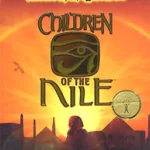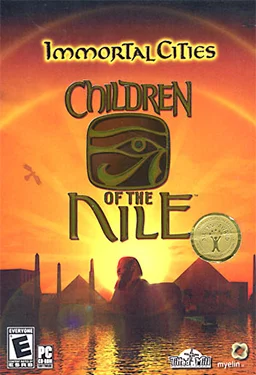
Immortal Cities: Children of the Nile
 75
★ /10
75
★ /10
 PC
PC
 1C-SoftClub, Myelin Media,
  SEGA Corporation


Immortal Cities: Children of the Nile (2004) stands as one of the most radical, daring, and structurally revolutionary milestones in the entire history of the city-building genre. Following the corporate restructuring of Impressions Games by Sierra, a core team of elite wargaming and management design veterans—led by Chris Beatrice and Peter Haffenreffer—broke away to form independent studio Tilted Mill Entertainment.
Faced with the monumental challenge of moving past the classic 2D isometric templates they themselves had built (Pharaoh, Zeus), they skipped the incremental upgrades of their peers to deliver a fully 3D, deeply cerebral masterpiece. Released on November 9, 2004, the game completely threw out the traditional rules of the genre to engineer the world’s first true “sociological” city builder.
The Grand Reset: A Fully Agent-Driven Universe
Children of the Nile permanently shattered the foundational mechanical anchor of the 1990s: the “Random Walker” system. In previous titles, cities were driven by faceless service workers pacing mindlessly down sidewalks to spread invisible, abstract circles of coverage to buildings.
Tilted Mill completely replaced this logic with a Desire-Based Individual Agent Simulation. Every single citizen moving across your real-time 3D map is an explicit, fully realized person. They possess a unique name, an interactive family tree, a dedicated home, an assigned workplace, and a shifting psychological deck of personal needs.
Citizens do not wander randomly; they leave their homes with direct intent. A housewife walks across town to a specific marketplace because her household is out of dried fish; a laborer finishes his shift at a limestone quarry and walks to a medical shrine because he is physically injured. If the marketplace is empty or the local priest is unavailable, the citizen doesn’t just display a minor warning icon—their individual dissatisfaction actively ticks up, directly influencing their family’s loyalty to your reign.
The Core Evolution: The Pure Bread Economy
The game executed an absolute masterstroke by completely eliminating traditional abstract gold treasuries and monetary systems. True to the realities of ancient Egypt, the entire macroeconomic engine runs purely on a single currency: Grain (Bread).
Money does not exist. Instead, the entire wealth circulation of your city functions as a direct food-and-barter network. Peasant farmers cultivate the banks of the Nile, and local Nobles collect the raw grain harvests as a mandatory tax layer. The nobles then use this grain to pay rations to their own private household staff, or funnel it to your palace treasury.
As Pharaoh, you spend your stored grain sacks to pay your state workers—your scribes, architects, and military forces. These civic workers then take their earned bread rations to the local market squares to barter with shopkeepers for essential everyday items like reed baskets, pottery, and linen clothing. Managing your budget is no longer about balancing a mathematical ledger; it is about physically ensuring your granaries contain enough actual grain to feed your entire population before the next seasonal harvest.
The Deep Meta: The Factional Hierarchy Matrix
To maintain domestic stability and keep your civilization from descending into open rebellion, you must balance the overlapping economic and social desires of several distinct societal strata.
| Social Strata Class | Primary Workplace & Housing | Structural Economic Role | Core Desires & Motivations |
| Pharaoh & Royals | The Palace Complex | Generates Prestige points, defines macro international trade paths, and initiates monument blueprints. | Absolute domestic loyalty, lavish palace decorations, and grand historical burials. |
| The Nobles | Luxurious Estates | The primary employers of the peasantry. They manage local farming logistics and store massive localized grain caches. | High-tier luxury goods (jewelry, fine garments), elaborate estate grounds, and personal servants. |
| Scribes & Priests | Government Offices, Temples, and Medical Shrines | Oversee city administration, tax assessments, spiritual pacification of the gods, and civic healthcare. | Direct access to papyrus, clean water, and well-maintained worship facilities. |
| Artisans & Shopkeepers | Marketplace Stalls and Dedicated Craft Shops | Refine raw goods into usable items. They bake bread, weave flax into linen, shape clay into pottery, and forge copper tools. | Constant access to raw materials (clays, metals) and a steady stream of buying customers. |
| Peasants & Laborers | Simple Mud-Brick Huts | The manual blue-collar engine of the state. They pull fish from the Nile, farm the silt fields, and physically haul stone blocks. | Reliable access to baseline food rations, basic healthcare, and safety from foreign raiding forces. |
Monument Engineering Block-by-Block
Monument construction was elevated to a physical, breathtakingly realistic logistical feat. Structures like Step Pyramids, True Pyramids, Obelisks, and massive Mortuary Temples cannot be rushed with gold or built by passive construction crews.
When you lay down a monument blueprint, your Scribes must first survey the land and clear the terrain. Next, your under-employed Peasants must be mobilized into active transport crews. You watch as individual laborers walk to the stone quarries, wedge out blocks of limestone or granite, load them onto wooden sledges, and physically drag them across the sand map coordinates step-by-step.
Because these laborers are real agents, they cannot work indefinitely. If a pyramid takes fifty game-years to build, generations of workers will age, retire, and pass away on the construction site, requiring a constant stream of fresh, well-fed youth from your residential sectors to sustain the physical build.
The Expansion and Contemporary Versions
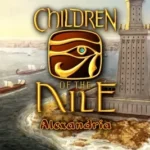
1. Children of the Nile: Alexandria (2008)
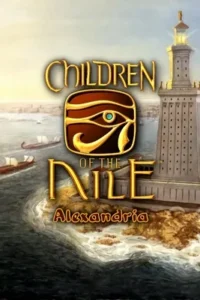
The official expansion pack shifted the historical lens forward to the twilight of Egyptian history, focusing entirely on the rise of the Ptolemaic era. It introduced an extensive new mini-campaign tracking the construction of the legendary city of Alexandria, adding specialized Greek-influenced architectural styles, new luxury commodities, and unique monumental projects including the grand Pharos Lighthouse and the Great Library.
2. The Enhanced Edition Upgrade
Tilted Mill later overhauled their own game client to release the Enhanced Edition. This update fixed major compatibility issues with modern operating systems, optimized the game’s internal 3D memory tracking to prevent mid-game crashes, and added several new structural buildings—most notably the Brickyard, which allowed players to store building materials much closer to active monument sites to dramatically accelerate construction speed.
Modern 2026 Preservation Status & Optimization
Over two decades after its initial groundbreaking release, Immortal Cities: Children of the Nile remains fully preserved and legally available to purchase on PC via both Steam (sold as the Enhanced Edition) and GOG (distributed as the Children of the Nile Complete compilation pack, which includes the Alexandria expansion natively).
The digital version is highly stable and fully compatible out-of-the-box with modern Windows 10 and Windows 11 frameworks. Because it was an early 3D title built on a 32-bit architecture, modern 2026 players running the game on ultra-high-definition 4K monitors occasionally encounter interface scaling friction where the main menu texts appear extremely tiny. The global strategy community resolves this seamlessly by right-clicking the game’s executable, opening the properties tab, and checking the High DPI Scaling Override box, locking the game into a flawlessly sharp, crisp modern visual display.
Release History
- Immortal Cities: Children of the Nile (Base Game): November 9, 2004 (North America / Europe)
- Children of the Nile: Alexandria (Expansion Pack): September 22, 2008 (Global Digital Release)
- Modern Packaging: Natively bundled together as a definitive digital package, the complete legacy experience is sold globally as Children of the Nile Complete or Enhanced Edition on digital storefronts like Steam and GOG.