Caesar
 PC
PC
 Sierra
Where to buy

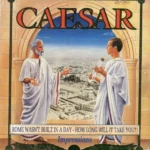
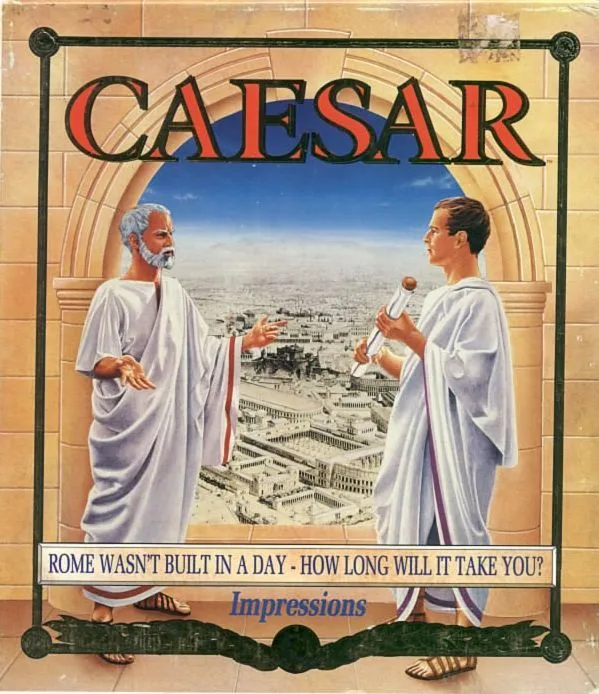
Caesar (1992) is the foundational cornerstone, the absolute blueprint, and the genesis of the historical city-building genre. Developed by Impressions Games under the design leadership of David Lester and programmed by Simon Bradbury, the title made its historic debut on the Amiga on October 12, 1992, before being ported to MS-DOS, Atari ST, and Macintosh in 1993.
At a time when the city-building market was entirely synonymous with Maxis’s modern-day powerhouse SimCity (1989), Caesar arrived to completely re-engineer the genre. It introduced ancient historical parameters, granular micromanagement, and structural defensive warfare, establishing a template that would eventually spawn a massive, highly celebrated multi-decade franchise.
The Core Loop: SimCity in a Toga
In Caesar, the player strips away the role of a modern mayor to assume the mantle of an ambitious Roman Governor appointed by Emperor Augustus.
Your baseline objective isn’t merely to lay out functional zones; it is to successfully guide a frontier province from a muddy outpost into a sprawling, hyper-wealthy, and highly cultured Roman metropolis. The game balances a brutal campaign structure spanning multiple escalating scenarios, grading your architectural performance across four unyielding metrics required to satisfy Rome: Empire Favor, Peace, Culture, and Population Wealth.
Groundbreaking Mechanical Innovations
1. The Early Birth of the “Walker System”
The absolute most significant mechanical contribution Caesar made to gaming history was the primitive genesis of the Walker System. In traditional building games of the era, services magically radiated in a perfect geometric circle from a central building.
Buildings like Forums, Prefectures (Fire/Police), and Reservoirs would physically spawn human worker avatars onto your road coordinates. These “Walkers” would march mindlessly through your street layouts. Services were only successfully rendered if a physical worker unit walked directly past a piece of real estate. This forced players into meticulous, tight city-planning, demanding optimized road loops to ensure that patrols reached neighborhoods before homes were burned down by arsonists or flattened by structural decay.
2. The Cohort 2 Tactical Link
The first entry in the series handled warfare via an incredibly innovative cross-game executable linkage that was light-years ahead of its time. While you built your city in Caesar, Impressions was concurrently developing a dedicated, Roman-themed real-time tactical wargame titled Cohort 2 (1993).
If barbarians breached your provincial walls in Caesar, the engine allowed you to physically save your city file, boot up Cohort 2, load your town grid directly into the combat engine, and manually command your Roman legions in real-time tactical formations. Once the battle concluded, the resulting casualty data was compiled and exported directly back into your Caesar save client. Paradox later automated this pipeline by launching Caesar Deluxe (1993), which natively wrapped the Cohort 2 combat engine directly inside the city-building executable.
3. The Housing Evolution Matrix
Rather than forcing players to purchase expensive, pre-built luxury villas, Caesar introduced the dynamic Housing Evolution Loop. You begin by laying down cheap, low-tax Plebeian Huts. As you manually route water via aqueducts, build schools, open public baths, and place theaters nearby, the land value dynamically inflates. The huts automatically undergo visual and structural transformations—evolving through various housing tiers to finally morph into highly lucrative, tax-heavy Patrician Insulae and villas.
The Evolution Matrix: The Impressions City-Building Family
The mechanical success of the 1992 client served as the structural springboards for several sequels and cultural spin-offs that dominated the PC gaming market for over a decade:
| Title / Expansion | Release Date | Engine & Architectural Paradigm Shifts |
| Caesar (Original) | Oct 12, 1992 | The foundational 2D layout; introduced road-loop navigation, housing progression, and Cohort 2 tactical linkages. |
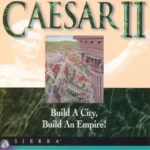
| Caesar II | Sep 4, 1995 | Migrated the series into a beautiful, isometric pseudo-3D viewport. Introduced a dual-map layer system (managing the macro province layout and micro city grids concurrently). |
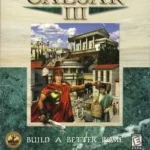
| Caesar III | Sep 30, 1998 | The definitive masterwork of the classic era. Fully perfected the Walker System, introduced deep-tier religious management across five distinct Roman gods, and completely overhauled trade networks. |
| Pharaoh / Zeus / Emperor | 1999–2002 | Impressions took the Caesar III engine and masterfully applied it to other legendary ancient civilizations: Ancient Egypt (Pharaoh), Mythological Greece (Zeus), and Ancient China (Emperor). |
| Caesar IV | Sep 26, 2006 | Developed by Tilted Mill Entertainment. Permanently abandoned isometric 2D sprites for a fully real-time 3D vector graphics engine, completely changing production loops. |
Modern Digital Preservation Status
For retro gaming preservationists and strategy historians looking to experience the literal genesis of the genre, the 1992 masterpiece is preserved and legally accessible on PC via GOG.
The digital package is listed under the simple title Caesar and comes fully pre-patched and wrapped inside a pre-configured DOSBox emulation container out-of-the-box. This ensures that the original 320×200 VGA visuals, early AdLib MIDI music tracking, and the historic first-generation Walker pathfinding mechanics execute flawlessly on contemporary Windows 10 and Windows 11 operating frameworks.