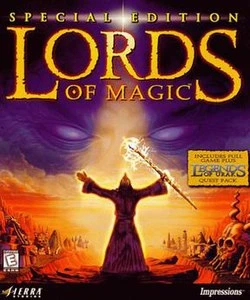
Lords of Magic
 PC
PC
 Sierra

Lords of Magic (1997) occupies a legendary, highly nostalgic space in PC strategy history. Developed by the city-builder virtuosos at Impressions Games and published by Sierra On-Line, the title was pitched as the ultimate evolutionary bridge between two gaming titans: the turn-based empire-building of Heroes of Might and Magic and the real-time tactical battlefield grid of Impressions’ own Lords of the Realm.
By tossing out traditional standard factions in favor of a rigid, theology-driven elemental wheel, Lords of Magic delivered an open-ended, deeply systemic fantasy sandbox.
The Narrative: The Scourge of Balkoth
The game unfolds across the primordial, high-fantasy continent of Urak—a realm structurally bound by ancient elemental lines.
- The Death Incursion: The fragile balance of the world is shattered when Balkoth, the ruthless Lord of Death, mounts a apocalyptic, continent-spanning campaign. Wielding the scythe of decay, Balkoth overruns the land, corrupting local strongholds and forcing neutral monsters to occupy the sacred capitals of the other elements.
- The Resistance: Players choose one of the remaining elemental factions. Starting as a lone, wandering exile with a microscopic retinue, you must explore the wilderness, clear out dangerous dungeons to generate global renown, liberate your element’s occupied Great Temple, and forge an alliance of disparate faiths to launch a final siege against Balkoth’s shadow citadel.
The 8 Faiths & Strategic Ideology Matrix
Urak’s civilizations are arranged in a strict Cosmic Wheel of Opposites. Elements sitting directly across from one another on the wheel are ancestral archenemies, starting the match with severe diplomatic penalties that make peaceful treaties virtually impossible.
| Elemental Faith | Cosmic Opposing Element | Inhabitant Visual Aesthetic | Core Strategic & Tactical Identity |
| Life | Death | High Elves draped in radiant gold and yellow silks. | Glass Cannon Ranged Dominance: Possesses fragile melee units but commands the absolute most lethal long-range archers in the game. |
| Death | Life | Undead skeletons, necromancers, and ghouls led by Balkoth. | Battlefield Attrition: Mages can cast spells mid-battle to forcefully resurrect fallen corpses into friendly skeleton meat-shields. |
| Order | Chaos | Stoic, Roman-style armored humans and griffins. | High Durability: Slow-moving, heavily disciplined shield-vanguards with excellent line formation buffs. |
| Chaos | Order | Grotesque barbarians, charging orcs, and wild sorcerers. | Asymmetrical Skirmishing: Unpredictable magical spells and hyper-fast shock infantry that rely on breaking enemy morale instantly. |
| Earth | Air | Heavy Dwarves, subterranean Gnomes, and stone constructs. | Immovable Tanks: Mechanically the slowest moving units on the map, offset by astronomical defense and physical melee damage ratings. |
| Air | Earth | Ethereal avians, giant pegasi, and lightning elemental spirits. | Hyper-Mobility: Blazing fast movement parameters allows them to effortlessly kite ground forces and bypass frontline tanks to butcher backline mages. |
| Fire | Water | Volcanic fire-giants, lava salamanders, and efreeti. | Pure Raw Offense: Completely sacrifices armor values and defenses to maximize explosive, close-quarters physical and magical attack damage. |
| Water | Fire | Amazonian warrior women, lizard-men, and sea serpents. | Naval & Economic Mastery: The ultimate macro-faction; starts with neutral or positive relations to four distinct faiths, allowing rapid diplomatic expansion. |
Core Gameplay Mechanics
1. The Leader Class Trinity
When initializing a campaign, your main Lord must select one of three baseline professional paths, which dictates your starting equipment and army leadership options:
- The Warrior: The ultimate physical damage sponge. Restricted entirely to close-quarters melee, they possess a passive Rally capability that actively boosts the physical attack and defense ratings of all adjacent friendly units on the grid.
- The Thief: The only leader type equipped with a native ranged projectile attack. On the overworld layer, they handle critical espionage—using Stealth to move invisibly, scouting enemy garrisons, or stealing high-tier artifacts. In combat, they can use Subdue to forcefully capture enemy champions alive for post-battle interrogation.
- The Mage: Physically fragile with abysmal movement speeds, but commands the entire elemental spellbook. Mages must spend overworld turns inside Mage Towers to manually research defensive wards, terrain-altering exploration tracking, or battlefield nukes.
2. The “Triple-Pay” Resource Economy
The economy moves away from a unified treasury pool, breaking upkeep costs into strict thematic resource drains to prevent players from spamming single-unit armies:
- Gold: Consumed continuously to pay the background salaries of all ranged archers and sneaky Thieves.
- Ale: The direct economic upkeep currency required to feed your frontline physical Warriors and melee infantry.
- Crystals: Extracted from magical nodes to fund spell research and sustain the spiritual upkeep of Mages and legendary elemental beasts.
3. The Temple Liberation System
You begin the game with zero baseline income or labor because your element’s Great Temple is occupied by neutral monsters.
- Generating Fame: Winning local skirmishes generates Fame.
- The Follower Engine: Once you gather a small army and successfully purge your Great Temple, your Capital city unlocks. Your accrued Fame instantly acts as a beacon, causing wandering Followers to migrate to your town.
- You must physically assign these Followers to work inside localized Gold Mines, Crystals caves, or Breweries to kickstart your continuous passive income loops.
The 1998 “Special Edition” Upgrade & Legends of Urak
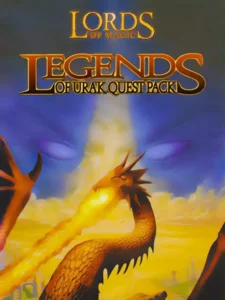
In September 1998, Sierra released the definitive version of the software: Lords of Magic: Special Edition. This update bundled the core game alongside a massive, high-concept standalone expansion pack titled Legends of Urak.
Rather than dropping you onto the massive, open-ended global conquest map of Urak, Legends introduced highly scripted, linear narrative campaigns inspired by ancient real-world mythology and folklore.
- The Quests: Players could embark on the Quest of King Arthur (governed by the Order faction), the frozen trials of Beowulf (Earth), the dragon-slaying epics of Siegfried (Fire), and a harrowing, dark journey tracking The Ring of the Nibelungs (Death).
Release History & Modern Salvation
- PC (Original MS Windows Launch): December 2, 1997
- Special Edition Launch: September 30, 1998
- Modern Availability: The title is perfectly preserved and digitally accessible on PC via both GOG and Steam under the unified listing Lords of Magic: Special Edition.
The Essential Unofficial 3.02 Patch
While beloved for its atmosphere and the sweeping, classical orchestral soundtrack composed by Keith Zizza, the retail version was historically plagued by memory leaks, broken AI pathfinding, and serious faction balance issues.
To enjoy the game smoothly on modern systems, installing the community-maintained Lords of Magic Unofficial Patch 3.02 is highly recommended. This open-source fix patches out ancient multi-core desktop crashes, completely overhauls the passive behavior of the AI to make rival factions aggressively liberate their own temples, and calibrates the UI rendering engine to display cleanly on modern widescreen monitors.