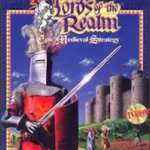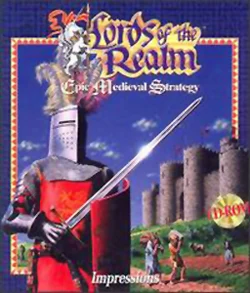
Lords of the Realm
 Amiga
Amiga PC
PC

Lords of the Realm (1994) is the foundational genesis of a legendary strategy lineage and one of the earliest successful hybrids of grand turn-based management and real-time tactics. Conceived by David Lester and programmed by Simon Bradbury at Impressions Games, this debut MS-DOS and Amiga classic laid down the entire mechanical and logistical framework that would later make its 1996 sequel a mainstream masterpiece.
While later entries streamlined the user experience, the 1994 original remains deeply respected by strategy purists for its uncompromising depth, its brutal simulation of medieval husbandry, and a highly customizable castle-building tool that subsequent games tragically abandoned.
The Narrative & Historical Scope: 1268 A.D.
The game takes place against a backdrop of sweeping, cutthroat geopolitical ambition. The year is 1268 A.D., and the English throne lies entirely empty following a vacuum of royal succession (with an alternate scenario map shifting the theater of war to medieval Germany).
You step into the mud as a minor, unranked local noble governing a lone, vulnerable county. Surrounded by up to five fiercely competitive, land-hungry AI rival lords, your objective is absolute and unyielding: manage your peasantry, turn untamed wilderness into economic powerhouses, fortify key chokepoints, and systematically crush all opposition until the entire realm is unified under your crown.
The Overworld Economy: Meticulous Serf Management
The turn-based layer is divided into four distinct seasonal turns per year (Winter, Spring, Summer, Autumn). Rather than extracting generalized “gold per turn,” the 1994 economic engine functions as a tight, unforgiving resource simulation where allocating manpower incorrectly spells instant disaster.
1. Crop Rotation & Soil Fertility
The grain engine in the original game required careful agricultural planning. You could not endlessly plant wheat in the same field without consequence; the engine simulated soil degradation. To prevent your county from plunging into a catastrophic winter famine, players had to actively manage a Crop Rotation cycle, purposely leaving fields empty (“fallow”) for select seasons to allow the soil nutrients to naturally regenerate.
2. The Dairy Overcrowding Trap
While cattle farming yielded steady, non-seasonal Dairy produce, the original game penalized players who tried to abuse the system. Keeping too many cows in a localized space triggered a hidden Diseconomies of Scale modifier. Overcrowded herds suffered massive, sudden disease outbreaks that could instantly wipe out 80% of your livestock. If a famine hit, you were forced to order your peasants to slaughter the herd for immediate Beef, which temporarily fed the populace but systematically destroyed your long-term dairy infrastructure.
3. The Toolmaking Chain
Unlike its sequel, which simplified materials directly into weapons, the 1994 original featured a dedicated Tool-Making industry. Pulling peasants from the fields to mine Iron and chop Wood wasn’t just for spears—you had to actively task blacksmiths with manufacturing physical farming tools. A county lacking tools suffered a severe penalty to peasant extraction rates, creating a brutal bottleneck if your manufacturing centers were sabotaged by rival outlaws.
The Castle Sandbox: Modular, Brick-by-Brick Architecture
The absolute standout feature of the 1994 original—which many hardcore fans argue makes it superior to its celebrated sequel—is its completely open, grid-based Castle Design Suite.
- No Presets: Lords of the Realm II streamlined fortifications into unchangeable, pre-made blueprints (e.g., clicking a button to buy a standard “Norman Keep”). The 1994 original threw this restriction out, handing you a blank tactical drafting grid.
- Complete Layout Freedom: Players could physically map out their custom strongholds block-by-block, dynamically drawing the exact structural paths of Castle Walls, Outer Keeps, Gatehouses, inner Great Halls, and defensive Moats.
- Adjustable Wall Elevations: You could manually toggle the physical height of individual stone wall sections. Taller walls demanded vastly more Quarry Stone and peasant labor to complete, but provided unparalleled protection against scaling ladders during eventual assaults. You could build historically accurate fortifications modeled after King Edward I’s iconic designs, or assemble completely experimental layouts designed to trap invaders in deadly crossfire zones.
Tactical Real-Time Warfare: The Hourglass System
When hostile armies or revolting peasant groups collided on the overworld map, the game transitioned to a flat, scrolling top-down 256-color VGA tactical field. Because 1994 lacked the smooth, modernized real-time mechanics of later decades, combat was managed via a unique Hourglass Simulation mechanic:
- The Command Phase: When a battle initiated, the action was frozen. Players could take their time scrolling across the map to analyze terrain features like movement-slowing marshes.
- Issuing Directives: You clicked on individual weapon regiments (Archers, Pikemen, Swordsmen, or pitchfork-wielding Peasants) to assign explicit pathfinding movement lines or set manual line-of-sight targets for your archers.
- The Hourglass Toggle: Once your tactical formations were assigned, you clicked the Hourglass icon. The game would seamlessly unfreeze into real-time animation, causing troops to actively march and trade blows according to your directives. You could click the hourglass at any second to re-freeze the field, re-assess your positioning, and issue emergency fallback orders.
Unit Archetypes Matrix
| Troop Type | Primary Resource Cost | Speed Profile | Strategic Tactical Role on the Field |
| Peasants | None (Conscripted) | Medium | Disposable meat shields armed with pitchforks; low morale but vital for filling enemy moats. |
| Archers | Wood (Longbows) | Fast | Glass-cannon ranged units; highly lethal at a distance but immediately crushed if caught in melee. |
| Pikemen | Wood + Iron | Slow | The unbreakable frontline; boasts high defensive armor and acts as a hard counter to cavalry. |
| Swordsmen | Iron | Medium | Balanced assault vanguard; high offensive values designed to breach gates and clear castle walls. |
| Knights | Iron (Plate) | Extreme | Elite mounted cavalry; used for flanking maneuvers to swiftly wipe out exposed enemy archer ranks. |
Legacy & Digital Preservation
- Release Date: June 15, 1994
- Accolades: The title was a major critical success, winning PC Gamer’s Best Historical Simulation award in 1994, with editors praising its ability to “strike a delicate balance between micro- and macro-management.”
Modern Availability
The original Lords of the Realm is preserved alongside its successor on GOG and Steam under the comprehensive Lords of the Realm Complete bundle.
The GOG package is pre-configured with a calibrated DOSBox wrapper wrapper right out of the box, ensuring that the pixel-perfect 1994 VGA display, the digitized court voice acting, and the complex agricultural crop-rotation loops run flawlessly on modern Windows 10 and 11 environments. Furthermore, the digital download archives the extensive original 49-page core manual and the 12-page Castle Siege and Battle Manual, providing players with an authentic, uncompromised retro strategy deep dive.