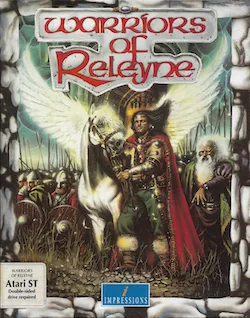
Warriors of Releyne
 Amiga
Amiga Atari ST
Warriors of Releyne (1992) is a fascinating, deeply old-school fantasy wargame that stands as an early artifact from the formative years of Impressions Games. Long before they conquered the strategy world with city-building masterpieces like Caesar or tactical hybrids like Lords of the Realm, Impressions used this title to experiment with fantasy-themed tactical grid warfare.
Designed by Chris Bamford and programmed by the foundational coding duo of Andrew Prime and Edward Grabowski, Warriors of Releyne was released simultaneously for the Commodore Amiga, Atari ST, and MS-DOS. It blended traditional board-game wargaming elements with dynamic, individual unit tracking and a heavy focus on user-generated content.
The Narrative: The Bulwark Against Chaos
The story unfolds within the high-fantasy landscape of the ancient empire of Keln, tracking a localized, high-stakes defense on the titular island of Releyne.
Across the waters of the Straits of Kem lies Dharak, the desolate, shadow-soaked land of absolute chaos. A ruthless, demonic warlord known as Turellin the Great has successfully unified the warring, subterranean monstrous races under a single black banner. Turellin launches a massive amphibious invasion across the straits, intending to completely purge and conquer the peaceful island of Releyne.
With the empire’s main forces too distant to assist, players take command of a small, desperate coalition of local heroes, rangers, and high-fantasy defenders fighting a brutal series of holding actions to contain the Dharaki horde before the island falls completely.
Core Gameplay Mechanics: The Hexagonal Skirmish Engine
Mechanically, Warriors of Releyne functions as a tactical fantasy wargame, shifting entirely away from resource gathering and base construction to focus on localized unit management and skirmish logic.
- The Hexagonal Map Layer: Battles play out across top-down battlefields divided into a strict hexagonal grid. The terrain is densely packed with interactive physical coordinates, including dirt roads (which boost movement speed), winding rivers (which severely penalize traversal), dense forests (providing defensive covers), and tactical choke-point buildings.
- The Granular Unit Variance: Unlike standard wargames of the early 90s where every generic “Orc” unit shared identical numbers, Releyne introduced individual unit personality. The engine tracked over 10 unique individual characteristics per creature. Two goblins on the field could have completely different attack values, baseline speed metrics, magic resistance thresholds, and health tracking, forcing players to examine specific unit sheets before trading blows.
- The Morale & Allegiance Framework: Units on the battlefield are dynamically divided into three primary alignment categories that actively shift based on the tides of the skirmish:
The Alignment Matrix
| Faction/Alignment Group | Controlled By | Species Varieties Included | Core Strategic and Tactical Role |
| The Releyne | The Player | Humans, High Elves, specialized Paladins, and local Rangers. | Defensive Chokehold Mastery: Relies heavily on high-defense vanguards and ranged line-of-sight archers holding forests or structures. |
| The Dharaki | The AI / Enemy | Goblins, Orcs, Cave Trolls, and demonic constructs. | Overwhelming Wave Aggression: Suffers from lower individual defensive stats but utilizes massive swarm queues to flank and overwhelm positions. |
| The Neutrals | Dynamic / Map AI | Wild beasts, neutral monsters, and unaligned regional clans. | The Battlefield Wildcard: These units start completely unaligned. Depending on proximity, casualties inflicted, or the active use of localized magic, neutral units can be successfully rallied to your banner or terrified into joining Turellin’s horde. |
The Dual-Disk System: The Construction Kit
Due to strict floppy disk memory limits in 1992, Impressions Games split the retail package across a unique dual-disk architecture:
- Disk 1 (The Campaign): Packed in the base core engine alongside three highly distinct built-in scenario maps tracking the progressive push of Turellin’s invasion.
- Disk 2 (The Scenario Builder): Universally praised by retro hobbyists, Disk 2 was a complete, standalone Construction Kit. It wasn’t just a simple map painter; it granted players the programmatic freedom to modify almost every underlying variable in the game database. You could redesign the hexagonal maps from scratch, rewrite the 10+ core stat parameters for all 20+ unit species, set custom deployment zones, and tweak the victory triggers (such as dictating capture quotas or assassination targets), vastly extending the game’s longevity.
Critical Reception & Historical Lifecycle
At retail, Warriors of Releyne received heavily mixed, mediocre reviews from the prominent European computer magazines of 1992:
- Amiga Mania: 81%
- Amiga Action: 64%
- Amiga Power: 60%
- Amiga Format: 59%
While reviewers heavily lauded the incredible creative freedom offered by the bundled Disk 2 Construction Kit and the satisfying depth of the individual unit stat variances, the game was severely bottlenecked by its presentation. Outlets noted that the 2D scrolling was notably jerky, the combat animations left much to be desired, and Chris Denman’s audio score was almost entirely non-existent outside of simple door-opening or sword-slashing sound cues.
Modern Accessibility Notice
Because Warriors of Releyne was a highly localized, early release that predated the studio’s massive commercial breakthrough, the game is completely unavailable on modern digital storefronts like GOG or Steam. It remains bound to legacy 16-bit console architectures and early MS-DOS configurations. To experience this early stepping stone of fantasy wargaming history today, players must rely on original Amiga/Atari physical floppy discs or open-source system emulation software (such as WinUAE or DOSBox).