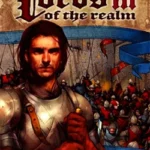
Lords of the Realm III
 65
★ /10
65
★ /10
 PC
PC Sierra

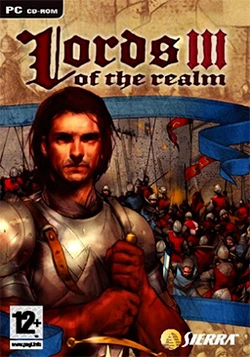
Lords of the Realm III (2004) is historically remembered as one of the most radical, jarring, and deeply polarizing structural departures in the history of medieval strategy. Developed by the city-builder legends at Impressions Games and published by Sierra Entertainment, this final entry completely abandoned the franchise’s celebrated turn-based foundation.
Attempting to compete with the full-3D RTS explosion of the early 2000s, Lords III threw out the turn-based overworld layer entirely. It shifted the entire meta into a fully real-time, simultaneous double-layer simulation, stripping away the meticulous “cows vs. wheat” farming micro-management in favor of a macroscopic feudal vassal system. While it achieved historical accuracy, it alienated its core fanbase, cementing it as the fascinating “black sheep” of the trilogy.
The Narrative Layer: Historical Chronicling
Unlike the generic, fictional sandboxes of the first two games, Lords of the Realm III heavily rooted its campaign architecture in real-world medieval geopolitical history. The single-player mode features four major historical campaigns broken into 14 progressive scenarios:
- The Campaigns: Players navigate the fractured kingdoms of Ireland, England, France, and Germany.
- The Cast: Scenarios directly recreate massive turning points led by legendary historical icons, including Joan of Arc, William the Conqueror, Brian Boru, and Edward the Black Prince.
- Depending on your chosen faction, victory conditions dynamically shift from executing a strict war of absolute territorial extermination against rival bloodlines to actively safeguarding your royal family from encroaching assassination networks.
The Gameplay Overhaul: The Vassal Parcel System
The core engine completely discarded the old economic loops where you manually distributed individual workers to grain fields or toolmaking shops. Instead, the map is split into Regions governed by an estate parcel, which are further divided into localized land Parcels.
As a King or Duke, you do not manage land; you manage the people who manage the land through Four Feudal Vassal Archetypes:
                     /---> Serfs ------> Grow Food (Feeds the War Machine)
                    /----> Burghers ---> Spawn Towns & Generate Gold
Strategic Court ---+-----> Clergy -----> Build Churches & Provide Region Buffs
                    \----> Knights ----> Govern Estates & Lead Companies
- Serfs: Automatically handle agricultural scaling. Placing a Serf steward on a fertile parcel spawns farms that scale up to Level 4 to feed your marching army.
- Burghers: Tasked with macroeconomic scaling. Dropping a Burgher onto a capital parcel transforms it into a thriving commercial town, generating a passive flow of gold crowns used to hire elite specialized mercenaries.
- Clergy: Spiritual optimization. Priests construct churches that bolster local population health, speed up army recruitment times, and grant massive adjacent output bonuses to nearby farming parcels.
- Knights: The core of your military. Every knight you appoint acts as an individual count over an estate, automatically generating and garrisoning a specific company regiment of troops bound to that region.
The Real-Time Simultaneous Form Format: Time never stops. If an enemy army attacks your borders, you drop down to the Battle Level in real-time. However, while you are micro-managing your vanguard on the battlefield, the strategic overworld map keeps running simultaneously in the background. Rival armies will continue marching, and resources will continue to be collected, forcing you to constantly toggle back and forth between multi-front conflicts.
The Moral Alignment Framework: The Three Meters of Karma
To regulate your diplomatic and recruitment capabilities, the game introduced a rigid alignment system governed by three moral pillars: Chivalry, Christianity, and Honor.
- The Neutrality Penalty: Staying in the middle yields zero benefit. The game strictly demands you commit to a lifestyle of absolute virtue or unmitigated cruelty to attract high-tier historical vassals.
- The Path of Virtue: Placing churches, paying fair taxes, and honorably ransoming captured enemy knights back to their families maxes out your Karma meters, allowing you to recruit highly loyal, high-morale paladin-style captains.
- The Path of Terror: Setting your combat stance to “No Quarter” automatically slaughters routing enemies and executes captured nobles without a prompt. While this tanked your Karma, it provided a small boost to enemy routing thresholds and unlocked access to brutal, coin-hungry mercenary captains and high-tier dark alignment knights.
The Tactical Engine: Grouped Companies & 3D Transition
Combat moved away from the 2D top-down “hourglass phase” layout into a fully polygonal 3D real-time tactical battlefield with zoom and rotate cameras.
- Company Mechanics: Players no longer select individual archers or swordsmen. Soldiers are strictly grouped into massive Companies bound to the Knight who generated them. Commands are issued to the group as a single entity.
- The Frontline General Rule: Your assigned Knight physically participates on the grid, leading the formation from the back to preserve their life. You can manually toggle them to Lead from the Front, which infuses the entire company with an immediate morale boost. However, if that Knight falls in combat, the entire company suffers a severe morale break and will almost immediately rout from the field.
- Streamlined Sieges: Fortifications became simplified grid arrays where you drag and snap Walls, Towers, and Gatehouses. Attackers must lead their siege engines directly to the walls, fighting through automated archer towers to breach the gate.
The Downfall & Modern Availability
Upon its release on March 16, 2004, Lords of the Realm III was heavily criticized by strategy fans. By automating the economy via vassals, it stripped away the precise, satisfying micro-management loop (the delicate dance of balancing wheat harvests and cattle breeding) that made Lords II legendary. Furthermore, the early-3D combat frequently degenerated into chaotic, tangled clumps of infantry, making flanking maneuvers mechanically irrelevant.
Current Digital Status
The game is currently owned, preserved, and managed by Rebellion. It is legally available for modern computers as a standalone digital download on both Steam and GOG.
The modern digital release is optimized to run smoothly out-of-the-box on Windows 10 and Windows 11 architectures. While the game’s old multiplayer master servers are permanently offline, Local Area Network (LAN) play remains fully operational for players looking to test the real-time vassal system against friends.