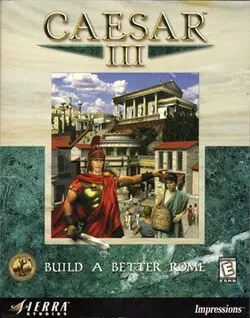
Caesar III
 PC
PC
 1C Company,
  Activision,
  Sierra


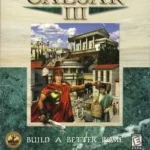
Caesar III (1998) is widely considered the absolute pinnacle masterwork of the classic 2D isometric city-building era. Released by Impressions Games and Sierra On-Line on September 30, 1998, the game didn’t just iterate on its predecessors—it perfected a distinct formula of micro-urban management that fans still play, mod, and obsess over today.
Unlike Caesar II, which split the gameplay across a macro province map and a localized town grid, Caesar III unified the simulation. Everything unfolds directly on a single, living city canvas. Barbarian invasions, burning insulae, collapsing aqueducts, and bustling market lines all collide in real-time right before your eyes.
The Unforgiving Backbone: “Sharp” Walker System Dynamics
The legendary Walker System returned with unprecedented complexity and absolute mathematical unforgiveness. Every civic building spawns specialized workers (Prefects, Engineers, Priests, Market Traders) who pace mindlessly along your roads, randomly choosing their direction at every intersection.
Because services are only rendered when a walker physically brushes past a house, Caesar III is a game of extreme precision. A single poorly planned intersection or an un-optimized road loop can cause a priest to make a wrong turn. This creates a cascading failure: the neighborhood loses access to spiritual care, the local Insulae houses instantaneously devolve into tents, tax revenues tank, and a massive riot breaks out—all because a single walker went left instead of right.
The Divine Threat: The Pantheonic Religion Ledger
Domestic stability requires keeping five temperamental Roman Gods thoroughly appeased through temples, shrines, and lavish festivals:
                     /---> Ceres ----> (Agriculture) ----> Blessing: Multiplies harvest / Wrath: Withers crops
                    /----> Mercury --> (Commerce) -------> Blessing: Fills granaries / Wrath: Steals treasury
The Roman Pantheon -+----> Neptune --> (Sea/Trade) -------> Blessing: Speeds up ships / Wrath: Sinks trade fleets
                    \----> Mars -----> (Warfare) --------> Blessing: Guards walls / Wrath: Summons enemy legions
                    \----> Venus ----> (Public Health) --> Blessing: Boosts mood / Wrath: Spreads severe plagues
Ignoring a specific deity while throwing festivals for another will provoke their targeted, literal wrath. Neglect Mars for too long, and a localized divine curse will break out, leveling your city walls or spawning an enemy legion right inside your residential district.
The Housing Evolution Ladder
The dynamic soul of your economy relies on steering crude Plebeian Tents through a rigorous 20-tier Housing Evolution Matrix. To morph a slum into a tax-heavy Luxury Palace, you must satisfy an escalating checklist of infrastructure demands:
- Water Access: Moving from primitive wells to functional fountains connected directly to Reservoirs via structural Aqueducts.
- Dietary Diversity: Upgrading a neighborhood’s diet from basic grain to a multi-tiered food web containing meat, fruit, and imported wine.
- Societal Pillars: Layering the district with localized health access (Baths, Doctors, Barber Shops), foundational education (Academies), and expansive entertainment networks (Theaters, Amphitheaters, and Colosseums running active gladiator shows).
The Imperial Assignment Matrix
The grand historical campaign guides you through 11 sequential provincial ranks (stretching from Citizen up to Caesar). Starting at Tier 3, the Emperor presents you with a branch choice for every assignment: a Peaceful Province (focusing on massive population thresholds and high financial goals) or a Military Province (focusing on active combat, wall fortification, and intercepting dynamic barbarian invasions).
To secure your promotion, your city must satisfy the Empire across four harsh, volatile rating scales:
- Culture: Measures the absolute ratio of your citizens who have direct access to active schools, libraries, academies, and temples.
- Prosperity: Tracks your city’s financial profitability, industrial export volumes, average wage scales, and structural housing quality.
- Peace: Tied strictly to your ability to prevent local riots, structural arson, thefts, and foreign military devastation.
- Favor: The personal opinion of the Emperor. It constantly decays over time, forcing you to send expensive personal gifts from your salary or fulfill urgent imperial trade demands (“Send 40 crates of pottery to Rome within 24 months!”) to prevent an Imperial Legion from being dispatched to forcefully depose you.
The Modern Overhaul Era: Julius & Augustus (2026 State)
Because the vanilla 1998 executable suffers from modern OS display inversions, memory bugs, and a complete lack of widescreen support, the global community completely reverse-engineered the code. Today, playing Caesar III optimally on contemporary hardware utilizes one of two brilliant, open-source engine reimplementations:
1. The Julius Source Port
- The Pure Preservation Track: Julius acts as a flawless, drop-in replacement for the original game logic. It adds native support for crisp widescreen resolutions, windowed modes, and UI quality-of-life additions, but deliberately changes zero core gameplay or balance choices. Save files are 100% interchangeable with the original 1998 code.
2. The Augustus Source Port (Augustus 4.0)
- The Modern Mechanical Evolution: Built as a fork of Julius, the Augustus source port introduces game-changing, highly requested features adapted from later sequels like Pharaoh. It natively integrates Roadblocks (letting you completely block random walkers from wandering off their optimized neighborhood tracks), a unified global labor pool option, dedicated cart depots to manage trade bottlenecks, and new monument projects.
Digital Storefront Presence
Unlike its predecessor, Caesar III is fully available on both Steam and GOG (published via Activision). Both installations operate beautifully out-of-the-box on Windows 10 and Windows 11 architectures, serving as the perfect, low-cost baseline files required to run the advanced Julius or Augustus community source engines.