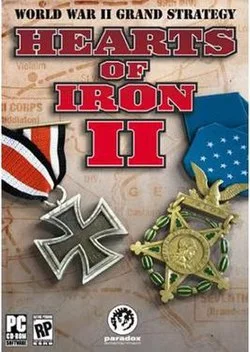
Hearts of Iron II
 83
★ /10
83
★ /10
 PC
PC
 1C Company, PAN Vision, Paradox Interactive

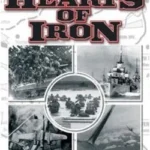
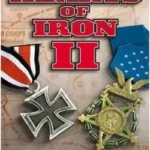
Hearts of Iron II (2005) is universally revered by grand strategy veterans as the definitive golden era, ultimate structural refinement, and absolute peak of Paradox Interactive’s legacy 2D Europa Engine era. Released on January 4, 2005, for Microsoft Windows and Mac OS X, the title took the overwhelmingly clunky spreadsheet micromanagement of the 2002 original and transformed it into a streamlined, sleek, and highly addictive operational masterpiece of World War II simulation.
The Grand Strategic Theater (1936–1947)
The baseline grand campaign launches players into the geopolitical powder keg of January 1, 1936, guiding the planet hour-by-hour through the logistical escalation, industrial mobilization, and global military clashes of World War II, concluding on December 30, 1947.
Players can assume absolute command over any of the 175 sovereign nations or colonial entities active on Earth. Just like its predecessor, the international stage is dictated by a ruthless ideological three-way tug-of-war:
- The Axis: Led by Germany, Italy, and Japan; features zero legislative barriers to early-game warmongering and massive starting military organization bonuses.
- The Allies: Led by the United Kingdom, France, and the Commonwealth; highly advanced navies, heavily restricted early-game by domestic anti-war isolationist sentiment.
- The Comintern: Led by the Soviet Union; backed by endless manpower reserves and a vast, deeply insulated internal industrial base.
Key Mechanical Innovations
1. The Movement-is-Attack Revolution
Before 2005, grand strategy units moved like traditional board game pieces: you walked into a tile, and if an enemy was present, time froze or a battle initiated. Hearts of Iron II completely shattered this loop by introducing the Movement-is-Attack system.
When you command an armored division to cross into a hostile province, the offensive operation initiates instantly from your current position. The speed of your arrival in that target province is dynamically tied to the combat’s resolution and the terrain. If your division breaks the enemy line, it seamlessly advances into the tactical vacuum. If it fails, it remains safely in its starting coordinates. This breakthrough made frontlines incredibly fluid, turning tactical encirclements (Kesselschlachten) and rapid blitzkrieg thrusts into highly precise operations.
2. Historical Research Teams (The Blueprint Meta)
The original game’s tedious, hundreds-of-components tech tree was entirely dismantled. In its place, Paradox introduced the celebrated Research Team Matrix.
Your nation’s total Industrial Capacity (IC) dictates how many physical research slots you can run concurrently (up to a maximum cap of 5). Instead of spending abstract points, you physically contract real-world historical corporations, military design bureaus, or legendary scientists to fulfill specific projects:
- Germany: Contracts Krupp or Rheinmetall for heavy artillery, Messerschmitt for fighter wings, and Heinz Guderian for armor doctrines.
- United States: Enlists Boeing for strategic bombers, Ford for assembly lines, and J. Robert Oppenheimer for nuclear rocketry.
- United Kingdom: Appoints Vickers-Armstrong for dreadnoughts and Alan Turing for electronic cryptography and computer computing.
Every research team possesses an explicit Skill Level (1 to 9) and specialized component icons (e.g., Aeronautics, Nuclear Physics, Artillery, Chemistry). Matching a team’s icons to a tech project’s component blocks dramatically speeds up research. This pairs beautifully with espionage gameplay, where you can steal tech blueprints from rivals to instantly double your design speeds.
3. Mission-Based Naval and Air Logistics
Planes and naval fleets were entirely freed from tedious tile-by-tile micro-movement. Instead, air wings and carrier groups are assigned directly to broader Geographic Zones and ordered to execute continuous, automated Missions:
- Air Command: Air fleets can be locked into Air Superiority, Ground Attack, Interdiction (targeting moving troops), or Logistical Strike (bombarding enemy infrastructure and factory lines).
- Naval Command: Fleets are assigned to Convoy Raiding to starve island nations of supplies, Anti-Submarine Patrols to safeguard shipping lanes, or Shore Bombardment to support coastal beach landings.
The Evolution Stack: Expansions & Standalone Spinoffs
Because the core engine of Hearts of Iron II was incredibly stable and beloved by programmers, it generated a massive multi-year expansion lifecycle, eventually leading Paradox to license the source code out to community developers to build standalone commercial spinoffs:
| Game / Expansion | Release Date | Core Gameplay & Paradigm Shifts |
| Hearts of Iron II (Base) | Jan 4, 2005 | The foundational vanilla client; established the movement-is-attack engine and historical research team mechanics. |
| Doomsday (Expansion) | Apr 4, 2006 | A massive standalone expansion that extended the timeline out to 1953. Introduced a hypothetical Cold War WWIII scenario, spy mechanics, tactical nuclear weapons, and automated production sliders. |
| Armageddon (Booster Pack) | Mar 29, 2007 | Extended the chronological clock all the way to 1964. Added custom naval attachments, brigade-pre-attached recruitment queues, and fictional alternate-history sandbox maps. |
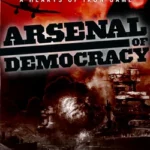
| Arsenal of Democracy (Spinoff) | Feb 23, 2010 | A community-developed standalone overhaul. Completely re-engineered the logistics network, added detailed production pipelines, and optimized the combat AI. |
| Darkest Hour (Spinoff) | Apr 5, 2011 | Universally considered the ultimate evolution of the HOI2 engine. Features a gorgeous new map layout, completely re-engineered diplomatic trees, and an extended grand campaign beginning in 1914 (World War I). |
Modern Preservation & Storefront Status
Today, the original 2005 legacy experience is fully preserved and instantly accessible on PC via both Steam and GOG under the title Hearts of Iron 2 Complete.
This comprehensive digital compilation automatically packages the original base game client alongside its two essential, defining expansions (Doomsday and Armageddon) pre-merged right out-of-the-box. The download client comes completely pre-configured inside an automated compatibility layer, ensuring the hour-by-hour time tick, component-matched research teams, and intense frontline encirclements run flawlessly on modern Windows 10 and Windows 11 architectures.
Alternatively, for players looking for the highest tactical complexity this engine era can possibly muster, tracking down the standalone spinoff Darkest Hour on Steam remains highly recommended by the strategy community to this day.