Arsenal of Democracy: A Hearts of Iron Game
 PC
PCWhere to buy

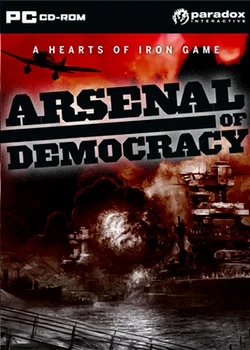
Arsenal of Democracy: A Hearts of Iron Game (2010) occupies a legendary, highly respected place in the history of grand strategy. It represents one of the earliest and most successful instances of Paradox Interactive officially licensing out its internal source code to its own community.
Developed by BL-Logic—a studio formed entirely by hardcore fans and prominent modding community members—and published on February 23, 2010, the game was built directly upon the legacy 2D Europa Engine code of Hearts of Iron II: Armageddon. Project Leader Lennart Berg famously summarized the game’s design philosophy by describing it as “Hearts of Iron II on steroids!” It systematically rebuilt the mechanics of its predecessor to be smarter, deeper, and infinitely more punishing.
The Grand Chronological Clock: 1936–1964
While vanilla Hearts of Iron II wrapped up its simulation quickly after the conclusion of World War II, Arsenal of Democracy pushed the chronological boundaries wide open.
The game guides the planet hour-by-hour across an extended canvas stretching from January 1, 1936, through the entirely of WWII, and deep into the early Cold War up to 1964. This allows players to navigate not only the traditional clashes between the Allies, Axis, and Comintern, but also the initial nuclear standoffs, proxy skirmishes, and post-war decolonization struggles of the mid-20th century.
Key Mechanical Masterstrokes
1. The Dynamic Infrastructure and Factory Overhaul
Production and macro-economics received a massive algorithmic upgrade.
- The 200% Infrastructure Rule: In standard entries, infrastructure was a passive map feature. In AoD, players can physically upgrade local province infrastructure up to 200%. Surpassing baseline thresholds directly multiplies the resource and factory output of that province while exponentially increasing the speed and efficiency of your localized supply network.
- The Serial Rush Mechanic: To simulate urgent wartime mobilization, the production queue added the ability to “rush” active military construction pipelines. By expending extra liquid Industrial Capacity (IC) and siphoning extra stockpiled raw resources, you can drastically cut down the calendar days required to deploy vital armored divisions or carrier fleets.
- Synthetic Conversion Facilities: Deep-tier sliders were implemented to let players allocate massive chunks of IC to manufacture dedicated synthetic materials and synthetic oil plants, giving resource-starved empires a structural baseline to survive international naval blockades.
2. Realistic Logistical Friction
The supply network was decoupled from instant, magical province transfers. The engine calculates explicit throughput bottlenecks, infrastructure damage from strategic bombing, and terrain friction. Shoving 100 divisions into a low-infrastructure coordinates grid causes your supply lines to buckle under their own weight, starving your vanguard of oil and ammunition without the enemy firing a single shot.
3. The Tech Team Preservation Fix
A massive, universally praised quality-of-life update targeted the core research system. In vanilla HOI2, if enemy strategic bombers flattened your factories and dropped your national IC below a certain threshold, your active Research Slots would instantly lock, and ongoing technology projects would be wiped out. Arsenal of Democracy patched this vulnerability: tech teams no longer disappear when you drop below the IC requirement, allowing embattled, blockaded nations to maintain their technological progress.
4. National Ideologies & Social Policy Sliders
BL-Logic expanded domestic management by introducing three overarching systemic registers: National Identity, Social Policy, and Culture.
Every register contains multiple specific sub-ideologies that players select as their society evolves. These choices have massive, long-term operational impacts on your country—altering consumer goods requirements, change production speeds, and modifying population rebellion thresholds far more permanently than generic cabinet ministers.
Structural Feature Matrix: HOI2 vs. Arsenal of Democracy
| Strategic Gameplay Metric | Hearts of Iron II: Armageddon | Arsenal of Democracy (AoD) |
| Chronological End Date | 1947 (Extended to 1964 via mod scripts) | 1964 natively integrated out-of-the-box. |
| Max Infrastructure Cap | Flat 100% per province tile. | Up to 200%, dynamically multiplying industrial and resource yields. |
| Tech Team Vulnerability | Dropping below IC thresholds instantly deletes slots and cancels projects. | Projects are preserved; slots remain active during economic damage. |
| Combat Dynamics | Standard division-level resolution. | Completely reworked, offering protracted, lethal combat calculations with realistic logistical losses. |
| Espionage System | High-click, passive text menus. | Fully overhauled interface featuring active intelligence gathering and industrial sabotage. |
| Display Options | Rigid, locked screen resolutions. | High-resolution support and freely selectable Windowed Mode. |
Modern 2026 Preservation Status
Because the game was engineered explicitly to cater to hardcore strategy purists who favored the tight, operational geometry of HOI2 over the massive province bloat of HOI3, it remains a cult-classic favorite.
The title is beautifully preserved and legally available as a digital download on PC today via Steam and GOG. The current digital build client is pre-packaged inside an automated compatibility wrapper, ensuring that the hour-by-hour time tick, component-based research matching, complex 200% infrastructure systems, and fluid tactical encirclements execute flawlessly on modern Windows 10 and Windows 11 desktop environments right from launch.