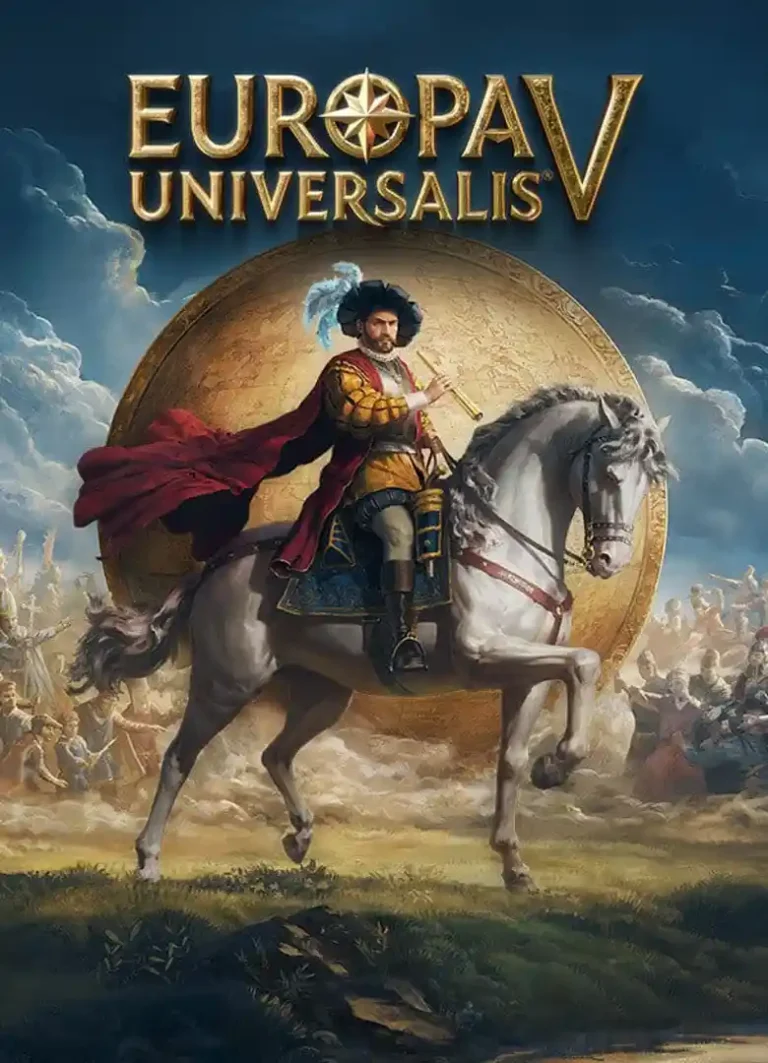
Europa Universalis V
 85
★ /10
85
★ /10
 PC
PC
Where to buy

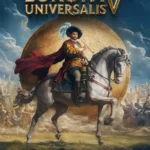
Europa Universalis V (2025) represents the most monumental, structurally radical, and conceptually ambitious paradigm shift in the history of grand strategy. Officially announced on May 8, 2025, and released on November 4, 2025, the game was developed by Paradox Tinto in Sitges, Spain, under the direct stewardship of studio veteran Johan Andersson.
Known throughout its secretive four-year development cycle as “Project Caesar”, EU5 completely decoupled itself from the board-game-style math, static provincial “development” clicks, and abstract mana points of Europa Universalis IV. Built on a modern iteration of the Clausewitz Engine, it re-engineered the franchise into a deeply simulated, organic world where population mechanics, shifting trade networks, and intense geographic logistics govern the rise and fall of nations.
The Grand Timeline: 1337–1837 (The Black Death to the Victorian Horizon)
The chronological canvas of Europa Universalis V completely shifted the series’ traditional boundaries, expanding to cover exactly five hundred years of human history:
- The Starting Gun (April 1, 1337): Pushes the starting era back over a century earlier than EU4‘s 1444 bookmark. Players drop directly into the high-stakes geopolitical powder keg right on the absolute eve of the Hundred Years’ War between England and France, and just years before the devastating arrival of the Black Death across Eurasia.
- The Finish Line (January 1, 1837): Concludes exactly at the dawn of the Victorian era, creating a perfect structural bridge directly into the starting matrix of Victoria 3.
Core Mechanical Pillars: Granular Simulation
1. The Living POP (Population) Engine
The single biggest architectural departure from EU4 is the total elimination of abstract “Development” numbers to determine provincial wealth. Instead, EU5 features a fully systemic Population (POP) System reminiscent of Victoria or Imperator: Rome.
Provinces are inhabited by raw numbers of individual human beings categorized by Culture, Religion, and Social Class (such as Nobles, Clergy, Burghers, Peasants, and Slaves). If a province is hit by a devastating plague, starved by a localized military siege, or choked by an economic embargo, its real population physically dies out, dynamically crashing its tax revenues, local manpower pools, and industrial productivity in real-time.
2. Localized Resource Extraction & Dynamic Markets
The world map is split into an incredibly microscopic grid of locations, each harvesting specific raw resources from a list of dozens of unique trade goods (e.g., Timber, Tin, Grain, Spices, Wool).
- Resources do not simply generate gold; they must be fed directly into simulated local and regional Market Hubs.
- To manufacture high-tier military assets like Plate Armor or Heavy Galleons, an empire must physically possess or securely import the exact raw material components required for production. Natural climate zones and winter weather logistics severely impact resource output and troop movement, making geography an active adversary.
3. The Automation Valve (Taming the Beast)
Because the layer of simulation in EU5 is so staggeringly deep, critics and early players noted that the game’s micro-management could easily become entirely overwhelming. To address this, Paradox Tinto implemented a robust, native AI Automation Matrix.
At any given point, players can flip explicit structural toggles to hand control of specific pillars of statecraft entirely over to the game’s internal AI. You can choose to completely automate your merchant trade routing, give the computer permission to dynamically construct local provincial infrastructure, or let the AI balance internal estate management, freeing you up to hyper-focus purely on high-tier macro diplomacy, complex marriage arrangements, or explicit military frontline campaigns.
The Asymmetric Geopolitical Matrix
True to its sandbox nature, players can select and guide any independent society or clan present on Earth in 1337. Factions operate under entirely distinct structural government profiles to reflect their historical realities:
| Empire/Society Type | Historical Starting Sandbox | Core Mechanical Gameplay Reality |
| The Holy Roman Empire | Central Europe | A hyper-complex, heavily fractured web of hundreds of tiny micro-states, requiring intricate diplomatic maneuvering and legal negotiations to navigate. |
| The Yuan Dynasty | East Asia | A massive, terrifyingly wealthy imperial powerhouse that starts the match facing immediate, catastrophic internal stability fractures and peasant revolts. |
| The Byzantine Empire | The Eastern Mediterranean | A fading, heavily localized relic of antiquity holding onto survival by a thread, surrounded by aggressively expanding hostile neighbors. |
| Nomadic Tribes & Stateless Societies | Global Frontiers / Americas | Operates completely outside traditional static borders; relies on mobile migration mechanics, animal herding, and localized clan dynamics. |
Critical Reception & Modern 2026 Status
Upon its late 2025 release, Europa Universalis V received “generally favorable” reviews, securing an 85/100 aggregator score on Metacritic and strong critic recommendations across the board.
While mainstream outlets like IGN heavily lauded the breathtaking scale of the population mechanics and the tactical brilliance of the terrain systems, publications like Rock Paper Shotgun noted that the steep learning curve and launch-day balancing issues made it a highly intense challenge for genre newcomers. On Steam, the community has cataloged it at a Mostly Positive (72%) baseline approval rating, praising its innovative leaps while continuously testing its deep mechanics.
The 2026 Roadmap: Fate of the Phoenix
Following its launch, Paradox Tinto rolled out its active live-service developmental roadmap for 2026. The game transitioned into its definitive 1.2 “Echinades” update cycle.
This milestone was accompanied by the game’s very first localized Immersion Pack expansion, Fate of the Phoenix, released on May 6, 2026. Designed to inject intense flavor, specialized unique mechanics, and custom branching mission trees into the Eastern Mediterranean basin, this content pack deeply overhauls the hyper-challenging survival struggles of the late Byzantine fragments and their immediate Balkan and Turkish rivals as they clash for control of the crossroads of Europe.