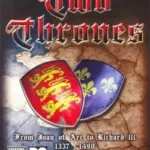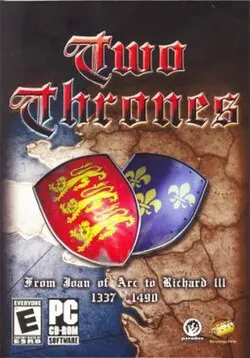
Two Thrones
 53
★ /10
53
★ /10
 PC
PC
 1C Company, Koch Media, PAN Vision, Strategy First
Two Thrones (2004)—subtitled in retail packaging as Two Thrones: From Joan of Arc to Richard III—occupies a unique transitional slot in Paradox Interactive’s early publishing timeline.
Initially released in Spain on January 21, 2004, before arriving in North America on February 11, 2004, and the rest of Europe on July 16, 2004, this title was developed internally by Paradox and distributed in the West by Strategy First. Built entirely upon the legacy 2D Europa Engine, Two Thrones is the direct mechanical sequel to Europa Universalis: Crown of the North. Chronologically, it also acts as the unofficial fourth installment of the classic Swedish Svea Rike series.
While it adopted the pausable real-time grand strategy framework Paradox was becoming famous for, Two Thrones deliberately traded the global sandbox of Europa Universalis II for a streamlined, board-game-style look at late-medieval Western European conflict.
The Historical Canvas: 1337–1453
The game shifts away from the Scandinavian fjords of its predecessor to plant players directly into the bloodiest, most generation-defining dynastic conflicts of the 14th and 15th centuries: The Hundred Years’ War and The Wars of the Roses.
The game includes five historical scenarios all playing out across the exact same geographic map layout of Western Europe (predominantly focused on the British Isles, France, Burgundy, and the Low Countries). Depending on the scenario selected, the ownership coordinates of individual provinces are dynamically reshuffled to fit the year’s political reality. The grand timeline kicks off in 1337 and marches day-by-day toward a firm end date of 1453. Victory is achieved either by accumulating the highest aggregate Score via victory points by the mid-15th century, or by executing a total military sweep to physically conquer the entire map canvas.
Key Mechanical Design Rules
1. The Domestic Estate Pillars
Just like Crown of the North, internal realm statecraft completely sidesteps the micromanagement sliders of EU2. Instead, domestic stability is governed by managing the happiness margins of Four Social Groups via pop-up choices:
- The Nobility: Keeping the nobles satisfied stabilizes your knight recruitment pools and infuses your heavy cavalry regiments with massive combat morale buffs.
- The Clergy: Pleasing the church minimizes localized revolt risk metrics across deeply religious provinces.
- The Townspeople: The foundational driver of your commercial sector. Happy merchants multiply global marketplace trade revenues and speed up resource extraction.
- The Peasants: Your primary workforce. Keeping the peasantry content accelerates baseline construction speeds and expands your basic levy manpower pools.
The Numerical Event Engine: As time ticks forward, scripted and random text choices pop up on screen. For example, a pop-up might ask whether you wish to back an unlanded pretender to a neighboring throne. Unlike later Paradox titles that hit players with unpredictable long-term ironman choices, Two Thrones explicitly reveals the exact numerical consequence of every single choice inside the prompt window, allowing players to easily throw surplus gold at discontented estates to keep internal satisfaction locked at 100%.
2. The Hardcoded Two-Action Bottleneck
The provincial construction and manufacturing model is remarkably simple. Individual territories feature basic building nodes tracking Farms, Markets, Fortification Defenses, Town Size, and Military Muster Points. Upgrading infrastructure or conscripting longbowmen and knights requires clicking directly on a province’s map graphics.
Crucially, every province is limited to executing exactly two concurrent actions at any given time—one structural building upgrade and one military unit recruitment task. Because the original 2004 client launched completely lacking a global macro-build menu or production queue system, players managing large empires are forced into a repetitive gameplay loop of clicking through every single individual territorial coordinate turn-by-turn just to keep construction moving.
The Asymmetric Playable Factions
| Playable Faction | Primary Geopolitical Position | Core Strategic Gameplay Loop |
| Kingdom of England | The British Isles & Gascony | The Amphibious Invader: Commands excellent longbowmen units and a secure home island base; requires constant naval coordination to protect continental holdings from French reclaiming waves. |
| Kingdom of France | Western Europe | The Continental Titan: Possesses unmatched domestic manpower pools and highly lucrative, high-population farming provinces; bottlenecked by early-game decentralized vassals. |
| Duchy of Burgundy | The Low Countries / Borderlands | The Opportunistic Spoiler: Sits precariously between the two heavyweights. The optimal meta involves quietly hoarding gold, waiting for England and France to bleed each other dry, and striking during scripted inheritance events to expand borders. |
| Minor Principalities (e.g., Brittany, Scotland) | Peripheral Borders | The Diplomatic Tap-Dancer: Economically and militarily completely outmatched. Survival relies entirely on spamming gold gifts to major kings to secure early defensive alliances. |
Critical Reception & Historical Backlash
Upon its launch in 2004, Two Thrones was met with a highly critical, lukewarm reception from the strategy community, securing a poor aggregate score of 53/100 on Metacritic. Major publications slammed the title for feeling like a massive mechanical step backward for the studio:
- GameSpot (5.4/10): Noted that the “limited scope, clunky build interface, and lackluster artificial intelligence mean this isn’t a game for veteran strategy gamers looking for a challenge.”
- Computer Gaming World (1.5/5): Criticized the title for being overly simplistic and lacking the grand scope expected of a title bearing connection to the broader Europa Universalis brand.
Strategy veterans were deeply frustrated by the game’s incredibly passive AI, which rarely launched coordinated strategic invasions and could easily be pacified simply by sending repeated diplomatic gold gifts. Combined with the tedious clicking required by the lack of a centralized management screen, Two Thrones quickly gained a reputation as an unpolished, value-priced experiment.
Modern 2026 Status & Abandonware Notice
Unlike mainline genre classics like Europa Universalis II or Crusader Kings I, which have been rescued and preserved on GOG, Two Thrones is completely missing from modern digital storefronts like Steam and GOG. The game has been completely left behind by Paradox’s modern operational lifecycle. To experience this niche look at the Hundred Years’ War today, retro strategy collectors must rely on hunting down original 2004 physical retail CD-ROMs or turning to specialized abandonware archival sites to run the legacy Europa Engine software inside a vintage 32-bit Windows compatibility wrapper or DOSBox configuration.