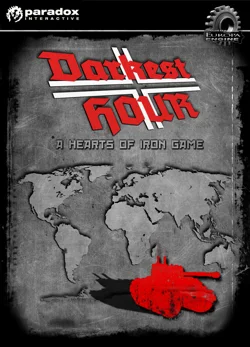
Darkest Hour: A Hearts of Iron Game
 81
★ /10
81
★ /10
 PC
PC
Where to buy

Darkest Hour: A Hearts of Iron Game (2011) stands in grand strategy history as the ultimate, definitive love letter to the community, widely considered by wargaming purists to be the absolute pinnacle evolution of the legacy 2D Europa Engine era.
Officially released on April 5, 2011 (arriving on Steam on April 8, 2011), the project was completely unprecedented: Paradox Interactive officially handed over their internal source code to an independent team of elite, battle-tested forum modders led by developer Martin Ivanov. The result was an astonishingly polished, deeply cerebral, and lightning-fast standalone grand strategy masterpiece that took the best elements of Hearts of Iron II: Armageddon and completely re-engineered them from the ground up.
The Chronological Canvas: 1914–1964
While mainline entries strictly locked players into the immediate buildup and execution of World War II, Darkest Hour completely blew the historical boundaries wide open. Depending on the scenario configuration selected at launch, the hour-by-hour simulation spans across two massive, fully realized grand historical eras:
- The Great War (1399/1914 Start): Launches on June 27, 1914—the exact eve of the assassination of Archduke Franz Ferdinand. Players navigate the grinding, catastrophic trenches of World War I, managing the collapse of old empires, the Russian Revolution, and the delicate post-war realignment treaties.
- The Day of Decision (1933 Start): Launches on March 4, 1933. This highly praised starting point drops players into the bleakest troughs of the Great Depression, allowing nations to structurally alter their industrial planning, exploit or suppress early ideological radicalization, and guide the global pre-war arms race years before the traditional 1936 timeline.
- The game also ships with a massive roster of historical campaign bookmarks spanning 1936, 1939, 1940, 1941, 1942, 1943, 1944, and 1945, alongside tight, operational battle scenarios like the 1904 Russo-Japanese War.
The Three-Tier Execution Matrix
Upon launching the game executable, Darkest Hour offers three distinct, native client variations right inside the launcher options, serving as both a backwards-compatible bridge and a total game overhaul:
| Launcher Modification Tier | Structural Code & Game Layout | Intended Player Experience Meta |
|---|---|---|
| Darkest Hour Core | Maintains absolute database compatibility with original Hearts of Iron II: Armageddon game files and older community mods. | Engineered strictly for legacy enthusiasts who want to run vintage 2000s-era mods inside a modern, highly optimized engine executable. |
| Darkest Hour Light | Retains the original HOI2 world map coordinates and basic resource layers, but turns on 90% of Ivanov’s newly coded technical engine features. | Designed for players who prefer the classic, streamlined visual shape of old school wargaming but want better AI processing. |
| Darkest Hour Full | Completely discards all HOI2 constraints. Implements an entirely new custom map, a fully reworked division model, and an absolute rewrite of the tech trees. | The Definitive Mode: The true masterpiece version of the game; highly complex, deeply atmospheric, and mechanically unique. |
Export to Sheets
Key Mechanical Masterstrokes
1. The Redesigned High-Resolution Map
Under Darkest Hour Full, the map was completely replaced with a meticulously researched, gorgeous new cartographic vector grid. The new map added thousands of new operational provinces and sea zones, dramatically sharpening territorial realism. Crucially, it re-engineered province pathfinding: choke points were widened, internal river networks became distinct tactical defense barriers, and urban centers transformed into lethal attrition traps. This completely fixed the AI’s ability to execute massive, sweeping operational encirclements (Kesselschlachten) without getting stuck on pathfinding nodes.
2. The Dynamic Mobilization System
In older titles, a nation’s available manpower pool was a passive, abstract number that slowly ticked up every day. Darkest Hour revolutionized this by introducing the Real-Time Mobilization System.
During peacetime, standing professional armies are kept small to protect national Industrial Capacity (IC) from severe economic strain. When a diplomatic play escalates to real-time war, players must physically trigger national mobilization edicts (ranging from Partial Mobilization to Total Conscription). Activating these edicts instantly drains your national treasury and spikes domestic dissent, but floods your mobilization queues with millions of raw draft reserves to instantly fill under-strength combat divisions sitting on the front lines.
3. Reworked Tech Trees & Automated Research Blueprints
The research matrix was entirely rewritten into a beautifully structured, highly linear historical blueprint timeline. Technology tiers are strictly bound to explicit historical years (e.g., 1916 Infantry Equipment or 1941 Medium Tank Hull).
Attempting to research a 1943 combat doctrine in 1938 inflicts a crushing, exponential research time penalty. This forced players to diversify their scientific assets across various fields—such as investing surplus slots into industrial manufacturing, computer cryptography, or espionage arrays rather than just rushing high-tier tank models.
4. Automated Production Sliders & Refined AI
One of the most profound quality-of-life updates was the implementation of a nearly flawless Production Slider Automation Matrix. The tedious, daily manual clicking of resource sliders was completely eradicated. The game’s internal AI seamlessly routes exactly the right amount of daily IC to keep consumer goods satisfied, military reinforcement lines filled, and supply caches maxed out, letting the player focus purely on high-tier macro-diplomacy, resource trading, and division-level theater maneuvering.
Modern 2026 Preserved Status & Continued Legacy
Darkest Hour: A Hearts of Iron Game is fully preserved and legally available as a standalone digital download on PC via Steam and GOG.
Demonstrating the unyielding dedication of its community and developers, the game received a surprise, highly comprehensive official stability update—Patch 1.05.2—which fully optimized the legacy 2D client for modern digital architecture. The digital game comes pre-packaged inside an automated compatibility wrapper right out-of-the-box, ensuring that the minute-by-minute time ticks, sweeping conscription mobilizations, and deep technological research trees execute flawlessly on modern Windows 10 and Windows 11 frameworks.
The Spiritual Successor Mod Scene
The name’s legacy is so monumental that it directly inspired a highly celebrated, modern total overhaul conversion project inside Hearts of Iron IV also titled Darkest Hour. This modern community mod functions as a direct spiritual successor, mapping the 1933 Great Depression start date, deep political choices, and granular historical mobilization events directly into the modern 3D Clausewitz engine. However, for retro strategy enthusiasts, nothing beats loading up the authentic, uncompromised 2011 standalone executable to experience the ultimate golden hour of classic grand strategy.