Caesar IV
 74
★ /10
74
★ /10
 PC
PC
 1C-SoftClub,
  Activision,
  Sierra


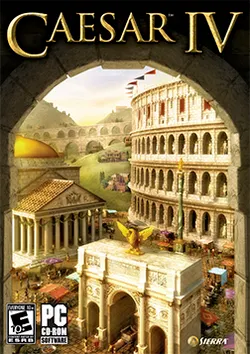
Caesar IV (2006) represents the grand architectural leap into the third dimension for the legendary Roman city-building franchise. Developed by Tilted Mill Entertainment—a studio formed largely by former Impressions Games veterans—and published by Sierra Entertainment on September 26, 2006, the title forever broke the mold of its classic isometric predecessors.
By transitioning to a fully real-time 3D hardware-accelerated vector engine, Caesar IV completely transformed how players interacted with the ancient Roman landscape. It traded the pixel-art nostalgia of the 90s for dynamic lighting, sweeping camera rotations, and a deeply re-engineered sociological simulation.
The Architectural Evolution: The Death of the Random Walker
The most radical change in Caesar IV was a total rewrite of citizen AI pathfinding. The infamous “Random Walker” system from Caesar III—where service workers randomly chose directions at every road intersection, accidentally starving neighborhoods of water or religion—was completely dismantled.
Instead, Caesar IV introduced a realistic, direct pathfinding engine. Citizens possess distinct homes, assigned workplaces, and personal daily schedules. They march intelligently and directly to where they need to go. An engineer walks straight from their post to fix a crumbling building; a citizen walks directly to a specific market to buy meat. While this eliminated the frustrating randomness of the previous era, it introduced a brand-new structural challenge: Traffic and Distance Logistics. If your housing sectors are placed too far away from the industrial zones, citizens waste their entire day commuting, causing production lines to stall out completely.
The Tri-Class Social Stratification Matrix
Instead of evolving a single plot of land from a crude tent into a massive palace, Caesar IV splits your population into three entirely distinct, co-dependent social classes. Every class requires its own dedicated housing zones, infrastructure pipelines, and cultural rewards.
| Social Class | Housing Architecture | Economic Role & Contribution | Primary Resource & Service Desires |
| Plebeians | Insulae Blocks | The blue-collar labor force. They run the foundational machinery of your city, working the farms, mines, factories, and basic maintenance infrastructure. | Basic grain, clean reservoir water, and localized Prefect protection. |
| Equites | Domus Homes | The white-collar middle class. They do not do manual labor; instead, they manage the city’s complex services, running bathhouses, theaters, tax offices, and commanding military forts. | Exotic foods, pottery, olive oil, basic entertainment, and access to clinics. |
| Patricians | Villas & Palaces | The ultra-wealthy elite. They refuse to work any jobs whatsoever. Their sole contribution is infusing your treasury with massive, luxury-tier property taxes. | Imported wine, fine clothing, jewelry, advanced theater shows, and grand temples. |
The Production Chain & Market Dynamics
To successfully transition your city from a frontier camp to an imperial jewel, you must master multi-tiered industrial supply lines. Raw materials can no longer be immediately consumed; they must be funneled through specialized processing facilities. For example, to satisfy your middle and upper classes, you must execute the following pipeline:
- The Agriculture Layer: Construct raw Olive Orchards or Vineyards.
- The Refining Layer: Transport the raw harvest via carts to Olive Oil Presses or Wine Wineries to manufacture finished luxury goods.
- The Distribution Layer: Route the finished products to specialized Markets where traders can sell them directly to Equites and Patrician neighborhoods.
Operational Game Modes
The game structures its campaigns to test both your peaceful architectural optimization and your tactical military defense capabilities across a series of historically grounded scenarios.
| Gameplay Mode | Structural Setup | Core Victory Focus |
| The Kingdom | 5 localized preparatory scenarios | Functions as a narrative-driven tutorial, teaching players basic economic, budgetary, and military defense loops. |
| The Republic | Branching campaign choices | The core historical mode. At every tier, players can choose between a peaceful, trade-heavy province or a hostile, military-heavy border campaign. |
| The Empire | High-difficulty macro provinces | The endgame campaign track, featuring massive map layouts, highly volatile economic hurdles, and intense resource demands from Rome. |
| Sandbox / Scenarios | Isolated standalone maps | Completely open-ended, free-form building layouts with zero imperial metrics or time limits, built for pure creative architecture. |
Modern 2026 Storefront Status & Performance Optimization
Two decades after its initial launch, Caesar IV is fully preserved and legally available as a digital download on PC via both Steam and GOG (published via Activision).
Because the game was built on an early 2006 real-time 3D engine designed for Windows XP, running the retail client straight out of the box on modern Windows 10 and Windows 11 rigs can occasionally cause performance issues, such as screen resolution stretching or sudden crashes on multi-core processors.
To achieve an absolute, optimized gameplay experience today, the strategy community highly recommends applying a simple, modern community fix: dropping a widescreen .ini wrapper or an open-source Direct3D fix into the game’s root installation folder. This locks the game into native modern resolutions, stabilizes frame rates during massive citizen rendering loops, and allows you to watch your Roman metropolis thrive without hardware friction.