Baldur’s Gate
 91
★ /10
91
★ /10
 PC
PC
 1C-SoftClub, Black Isle Studios,
  Interplay Entertainment
Where to buy





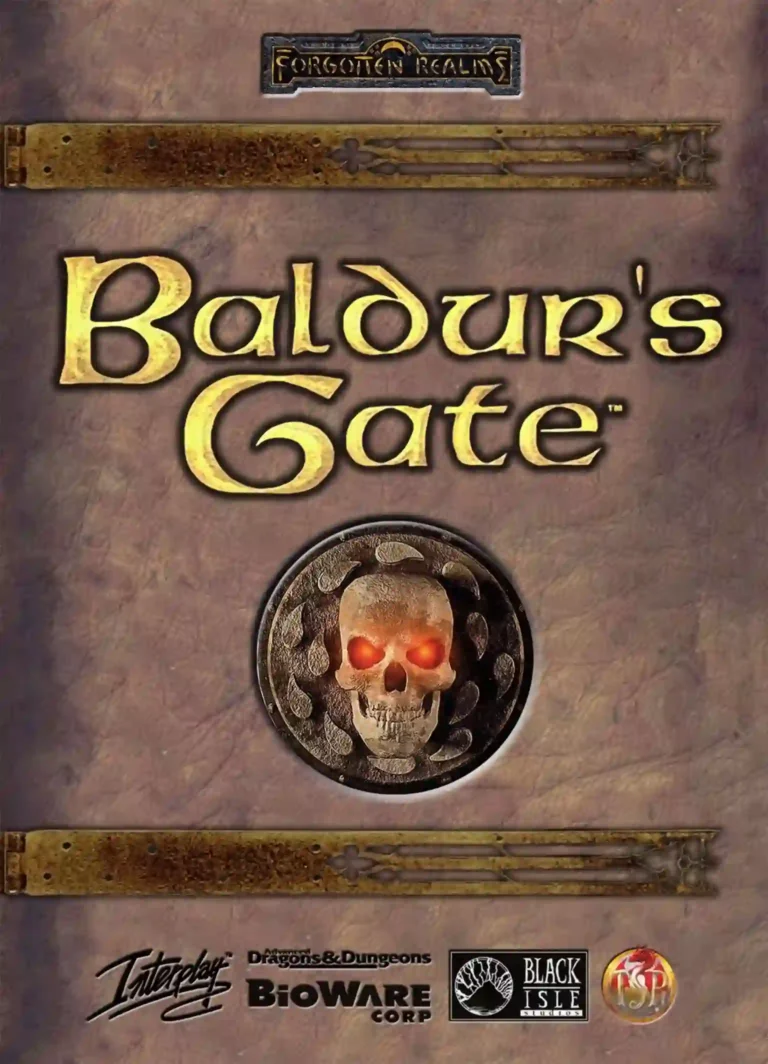
Baldur’s Gate is a 1998 role-playing game developed by BioWare and published by Black Isle Studios, a division of Interplay Entertainment. Released for Windows on December 21, 1998, it was BioWare’s first major PC RPG, the first game to use the Infinity Engine, and the title credited with revitalising computer role-playing games at a moment when the genre was widely considered to be in decline.
Interplay’s forecasts for the game were extremely low: the UK headquarters projected zero sales in Britain; the internal sales goal at BioWare was 200,000 copies worldwide; the German market estimate was “no more than 50,000.” The game began selling at what a CNET Gamecenter reporter described as a “phenomenal rate” almost immediately after release. Over one million players had played it within the first year. It holds a Metacritic score of 91 and spawned a franchise that now spans four primary games and a combined sales total of over 25 million copies.
Technical Specifications
| Attribute | Details |
|---|---|
| Developer | BioWare |
| Publisher | Black Isle Studios / Interplay Entertainment |
| Producer | Ray Muzyka |
| Lead Designer / Writer | James Ohlen |
| Composer | Michael Hoenig |
| Engine | Infinity Engine |
| Platform(s) | Windows · Mac OS |
| Release Date | NA: Dec 21, 1998 · JP: Jan 30, 1999 · EU: Jan 1999 · Mac: Jul 31, 2000 |
| Genre | CRPG, isometric RPG |
| Mode(s) | Single-player · Multiplayer (up to 6 players) |
Candlekeep and the Sword Coast
Baldur’s Gate is set along the Sword Coast — the western seaboard of Faerûn, stretching from the port city of Baldur’s Gate south through farmland and wilderness to the mines of Nashkel — in the Forgotten Realms campaign setting of Advanced Dungeons & Dragons. The protagonist is Gorion’s Ward, a foundling raised in Candlekeep, a great library fortress accessible only to those who bring a book as entry payment, under the care of the mage Gorion.
The game opens with Gorion being killed. A mysterious armoured figure attacks during the night as Gorion attempts to flee Candlekeep with the protagonist, and Gorion dies buying time for their escape. The protagonist wakes alone in the wilderness and must find allies, survive, and discover why they were being hunted.
The investigation leads across a fully explorable map of the Sword Coast — forests, mining settlements, fishing villages, tombs, and eventually the city of Baldur’s Gate itself — uncovering a conspiracy centred on the iron trade. Someone or something has been sabotaging the iron supply across the region, driving the price of weapons and tools to crisis levels. The organisation behind it — and its connection to the protagonist’s past — is the game’s central mystery.
Sarevok and the Bhaalspawn
The antagonist, eventually identified as Sarevok, is a warrior of exceptional power who operates through the Iron Throne merchant organisation. The revelation of what he actually is — and what this means for the protagonist — constitutes the game’s most significant narrative disclosure, and connects Baldur’s Gate to its sequel and, much later, to Baldur’s Gate 3.
Bhaal, the god of murder in the Forgotten Realms pantheon, is dead — killed in a divine conflict. Before his death, knowing what was coming, Bhaal fathered children with mortal women across Faerûn. These children — Bhaalspawn — carry a trace of divine essence within them. Sarevok is a Bhaalspawn. The protagonist is a Bhaalspawn. Sarevok’s plan is to provoke a war, kill other Bhaalspawn, and absorb their essence to elevate himself to godhood — to become the new god of murder.
Sarevok is less elaborately developed than his successor Irenicus in BG2 — his motives are presented through the momentum of the plot rather than through the extended personal interaction that makes Irenicus indelible. He is nonetheless an effective villain: imposing, ruthless, and given weight by the clarity of what he wants and why the protagonist is specifically the obstacle between him and it.
The Companions
Baldur’s Gate has a large recruitable companion roster by the standards of its era — eventually over twenty characters across the base game and its expansion — but the companion system is structurally simpler than what BG2 would introduce. Companions in BG1 have distinct voices and personalities, react to the protagonist’s Reputation score (a numerical measure of how society views the player character, rising with good deeds and falling with crime), and may leave the party if Reputation falls too low or rises too high for their alignment. What they do not do is banter with each other, develop through personal questlines, or change meaningfully in response to the main story’s events. The companion writing revolution that BG2 represented had not yet happened; the characters here are the raw material from which BG2 would later construct something more.
Among those who return in the sequel: Jaheira (a half-elf Fighter/Druid, one of the more assertive presences in BG1, whose larger arc only unfolds in BG2) and her husband Khalid (a gentle, slightly self-deprecating Fighter); Minsc, a ranger of Rasheman who operates with an unshakeable certainty about the moral clarity of any situation and takes tactical advice from his hamster, Boo, whom he identifies as a miniature giant space hamster; Viconia, a dark elf cleric who fled the Underdark and is immediately distrusted by nearly everyone for her heritage; and Edwin Odesseiron, a Red Wizard of Thay whose contempt for everyone around him is expressed in asides that anticipate the muttering internal monologue that becomes his comic signature in BG2.
Imoen, the protagonist’s childhood friend from Candlekeep, is the most narratively central companion — present from the first moments after Gorion’s death and, eventually, revealed to share the protagonist’s heritage in ways the game only begins to develop before handing the thread to BG2.
The Infinity Engine
The engine that powers Baldur’s Gate was not originally designed as an RPG engine. BioWare had been developing a prototype real-time strategy game codenamed Battleground Infinity, and built their engine around that project’s requirements. When that direction was abandoned and the team pivoted to an RPG using the D&D licence Interplay could offer them, the engine was re-engineered for the new purpose. The name Infinity Engine derives from the original project title.
The resulting engine — isometric perspective on pre-rendered 2D backgrounds, pausable real-time combat, support for a party of up to six characters with full AI scripting — became the foundation of the most significant run of CRPGs in the genre’s history. Black Isle Studios licensed the engine from BioWare and used it to produce Planescape: Torment (1999), Icewind Dale (2000), and Icewind Dale II (2002). BioWare used it for BG2 and then moved to the Aurora Engine for Neverwinter Nights. The Infinity Engine’s approach — handcrafted isometric environments, party-based RTWP combat, deeply scripted companion AI — defined what computer RPGs were for the better part of a decade.
Has Baldur’s Gate Aged Poorly?
The Reddit thread “Baldur’s Gate 1 aged poorly and I’m upset about it” is currently the highest-traffic organic result for this game in Google search — appearing simultaneously as the top listing and in the Knowledge Panel. It is the defining question about the original in 2026, and it deserves a direct answer.
The things that have aged are real. Companion depth, by any post-BG2 standard, is thin: characters recruited in BG1 have little dialogue beyond their initial recruitment conversation, make occasional interjections in combat, and leave if Reputation crosses their tolerance threshold. They do not grow, confront their past, or surprise the player with complexity. Anyone who played BG2 before BG1 will find the party noticeably quieter.
Low-level AD&D 2nd Edition combat is punishing in ways that feel more random than tactical. A level 1 wizard with 4 hit points can be killed by a single goblin arrow before the player has had a chance to do anything. The difficulty curve in the earliest hours is steep and unforgiving, and there is no difficulty setting that meaningfully softens it without external modifications.
The early game’s pacing is loose. The first act — wandering the roads south of Candlekeep — gives little narrative urgency until the Nashkel mine storyline crystallises around the player’s wandering. Players accustomed to modern RPG’s on-ramps can find the opening hours directionless.
What has not aged is the Sword Coast itself. Travelling across a large, handcrafted map of wilderness, shoreline, forest, and ruin with an atmospheric Michael Hoenig score and the sense that the world’s problems predate the player’s involvement and will persist after it — this remains distinctive. The game does not explain everything, does not mark every location on the map in advance, and does not require the player to engage with large portions of the world at all. The density of optional content embedded in the exploration is not BG2’s theatrical sidequest variety but a quieter kind of worldbuilding: strange encounters, minor tragedies, and eccentric people found at the edge of the map who have nothing to do with the main story and everything to do with what makes the Sword Coast feel inhabited.
The honest assessment is that BG1 is most rewarding for players who approach it knowing what it is rather than what its sequels became. It is a competent, atmospheric, historically important RPG whose primary limitations are structural rather than incidental — they were addressed in BG2, not patched away.
Why It Still Matters in 2026
Jaheira in Baldur’s Gate 3 knows your name and has memories of a companion she travelled with long ago. Minsc in BG3 was encased in stone and has recently been freed; he speaks of past adventures with a certainty that assumes you were there. Playing Baldur’s Gate (1998) before Baldur’s Gate 3 is not required — BG3 is fully playable and emotionally complete without it — but the appearances of these characters register differently with the weight of twenty-five years of their history behind them.
The Bhaalspawn mythology, the Sword Coast’s political history, and the specific shape of the divine pantheon in Faerûn that gives BG3‘s villain their motivations all have their origins in what the 1998 game established. BG3 was built to stand alone; it was also built by people who knew exactly what it followed.
Tales of the Sword Coast
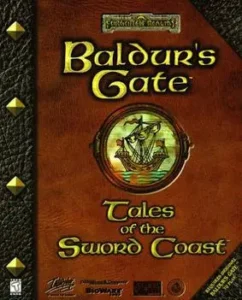
The expansion Tales of the Sword Coast, released May 4, 1999, adds four new areas to the Sword Coast map: the town of Ulgoth’s Beard, the legendary dungeon Durlag’s Tower (a multi-level deathtrap built by a paranoid dwarf lord and among the most celebrated designed dungeons in the series), an Ice Island, and Balduran’s shipwreck. It raises the experience cap modestly. It is included in all current versions of the game and is generally treated as part of the complete BG1 experience rather than optional DLC.
Where to Play
The 1998 original is not commercially available as a standalone product on mainstream storefronts. The Enhanced Edition (covered separately), developed by Beamdog and released in 2012, is the current storefront version on Steam, GOG, iOS, Android, PlayStation, Xbox, and Nintendo Switch. It incorporates all content from Tales of the Sword Coast, adds three new companions, adds the standalone Black Pits arena mode, and makes the technical improvements — widescreen support, interface updates, bug fixes — that bring the 1998 release into workable condition on modern hardware.