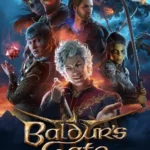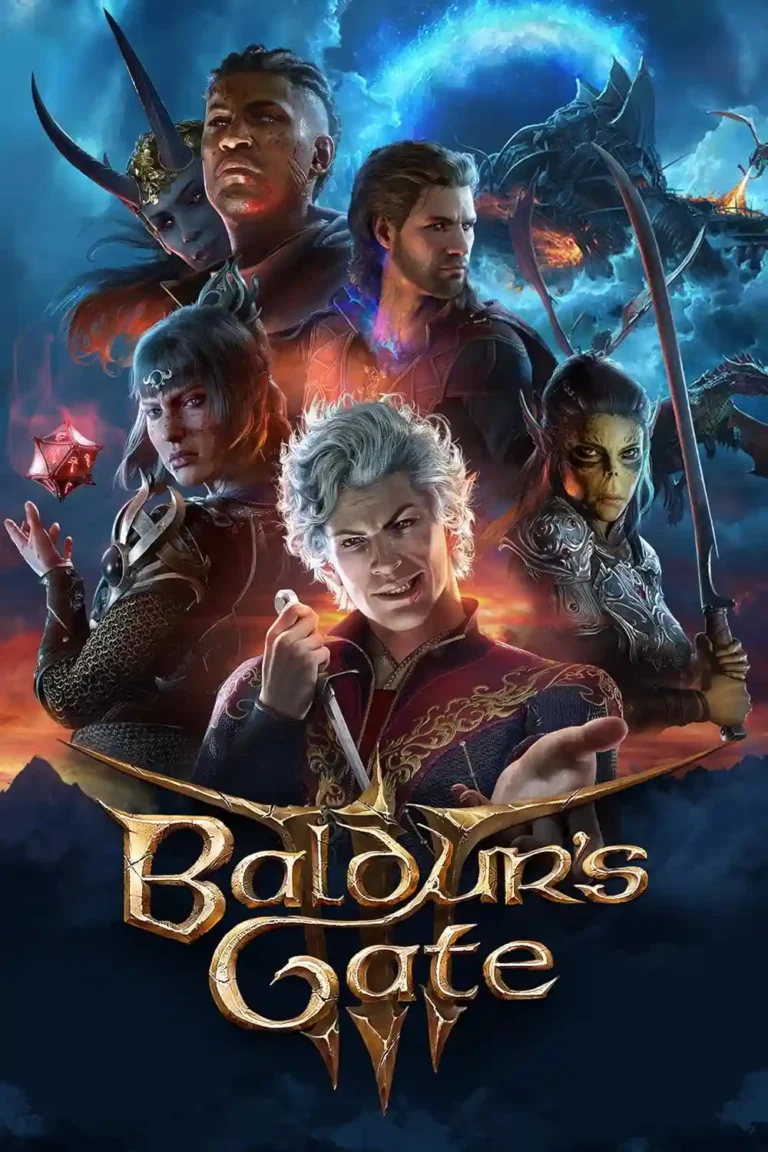
Baldur’s Gate III
 96
★ /10
96
★ /10
 PC,
PC,  PS5,
PS5,  Xbox Series X/S
 Larian Studios
Larian Studios
Larian Studios
Where to buy




Baldur’s Gate 3 is a 2023 role-playing game developed and published by Larian Studios. Following a three-year Early Access period beginning October 6, 2020, it released in full for PC on August 3, 2023, for PlayStation 5 on September 6, 2023, and for Xbox Series X/S on December 8, 2023. It is the third mainline entry in the Baldur’s Gate franchise, the first since Baldur’s Gate II: Throne of Bhaal in 2001, and the most faithful adaptation of Dungeons & Dragons tabletop rules ever committed to a video game.
Baldur’s Gate 3 holds a Metacritic score of 96 on PC and PS5, and a near-perfect 99 on Xbox Series X. It won Game of the Year at The Game Awards 2023, won Best Game at the BAFTA Games Awards 2024, and has sold over 20 million copies worldwide as of December 2025. Two years after its release, it sustains roughly 100,000 concurrent players on Steam most weekends.
Technical Specifications
| Attribute | Details |
|---|---|
| Developer | Larian Studios |
| Publisher | Larian Studios |
| Director | Swen Vincke |
| Composer | Borislav Slavov |
| Engine | Modified Divinity Engine |
| Platform(s) | PC · PS5 · Xbox Series X/S · macOS |
| Release Date | PC: Aug 3, 2023 · PS5: Sep 6, 2023 · Xbox: Dec 8, 2023 |
| Genre | CRPG, Turn-based RPG |
| Mode(s) | Single-player · Co-op (up to 4 players) |
The Forgotten Realms: Setting and Story
Baldur’s Gate 3 is set in Faerûn — the Forgotten Realms campaign setting used by Dungeons & Dragons — in the year 1492 DR, after the events of both Baldur’s Gate (1998) and Baldur’s Gate II (2000). The Sword Coast, the region containing the city of Baldur’s Gate, is the game’s primary geography.
The story opens aboard a nautiloid — a Mind Flayer spacecraft — where the player character has been captured and infected with a Mind Flayer tadpole. The tadpole should transform its host into a Mind Flayer within days; inexplicably, it is not doing so. The nautiloid is attacked, crashes over Faerûn, and the player finds themselves stranded with a group of fellow survivors who share the same inexplicable condition.
Three acts follow. Act 1 covers the wilderness south of Baldur’s Gate — a goblin war, an ancient ruin, an underground Underdark, and the mystery of what the tadpole actually is. Act 2 moves into the Shadow-Cursed Lands: a region consumed by a magical darkness that kills anything that enters it without a light source, surrounding a fortress called Moonrise Towers controlled by a cult called the Absolute that has weaponised the Mind Flayer infection. Act 3 reaches the city of Baldur’s Gate itself, where the scale of what the Absolute is trying to achieve becomes clear.
The nature of the final confrontation, the identities of the figures behind the Absolute, and the choices available in the game’s closing hours are among the most discussed and replayable elements of any RPG released in the last decade. They are not described here.
The Companions
Six primary companions can be recruited in Act 1, each tied to the nautiloid opening, each carrying a story that intersects with the main questline in ways that only fully resolve in Act 3:
Shadowheart is a half-elf cleric of Shar, the goddess of darkness and memory loss. She has gaps in her own memory that she cannot access, carries a relic of enormous value, and her crisis of faith forms one of the game’s most emotionally sustained character arcs.
Astarion is a high elf vampire spawn who spent two centuries enslaved by a vampire lord, during which time he served as a lure to bring victims to his master. He is manipulative, darkly comedic, and — if the player engages closely with his story — capable of genuine change or catastrophic regression. Neil Newbon’s performance won Best Performance at The Game Awards 2023. He is consistently the most popular companion in player surveys by a significant margin.
Gale of Waterdeep is a human wizard and former lover of Mystra, goddess of magic. He carries a magical catastrophe inside his chest — an Orb of Annihilation — that requires a steady diet of magical artefacts to contain and would destroy everything within a large radius if it detonated. He is erudite, vain, genuinely funny, and one of the most requested romance options.
Lae’zel is a Githyanki fighter: a member of the silver-dragon-mounted warrior race that hunts Mind Flayers, who views nearly everyone around her with contempt and is initially the hardest companion to like. Her character arc is one of the game’s most complete if pursued to its conclusion.
Wyll is a human warlock known as the Blade of Frontiers — a heroic monster-hunter with a devil pact he is not fully in control of, whose backstory involves a political betrayal and a moral debt that plays out differently depending on the player’s choices throughout Acts 1 and 2.
Karlach is a tiefling barbarian who escaped the Nine Hells after being sold to a devil by her former employer. An infernal engine in her chest replaced her heart, makes her run extremely hot, and means she physically cannot touch another person without burning them. She is the companion most often cited as a personal favourite by players who complete her story.
D&D 5th Edition: The Rules Beneath
Baldur’s Gate 3 uses Dungeons & Dragons 5th Edition rules as its mechanical foundation — the first major video game to do so. Character creation selects from 12 classes (Barbarian, Bard, Cleric, Druid, Fighter, Monk, Paladin, Ranger, Rogue, Sorcerer, Warlock, Wizard), each with subclasses that unlock at third level, and 11 species, each with stat modifiers and racial abilities drawn directly from the tabletop rulebook. Six core ability scores — Strength, Dexterity, Constitution, Intelligence, Wisdom, Charisma — govern every check, save, and combat roll.
Combat is turn-based and governed by initiative. Every attack, skill check, and saving throw produces a visible dice roll on screen, with the result shown against the relevant difficulty class. Failing a roll does not produce a dead end — the game’s design explicitly constructs different outcomes for failure rather than reverting to a checkpoint. A failed Persuasion check opens a different conversation branch. A failed Lockpick alerts a guard and creates a different problem. The tabletop logic of “what happens next” after a failure is preserved throughout.
The rules also govern things outside combat: the Advantage/Disadvantage system (roll two dice and take the better or worse result), concentration spells that break if the caster takes damage, spell slots that must be rationed between Short and Long rests, and the specific interactions between conditions (poisoned, prone, wet, on fire) that create the game’s most complex environmental situations.
Freedom and Reactivity
The most discussed quality of Baldur’s Gate 3 is not any individual feature but the cumulative density of its interactivity — the degree to which the world responds to what the player does, with whom, and in what order.
The game tracks a vast range of variables across all three acts: choices made in conversations, faction alliances formed, characters saved or killed, items found or missed, and dozens of decisions that seem incidental and surface thirty hours later with consequences. It is possible to miss entire questlines, characters, and mechanics across a single playthrough — not because they are hidden behind missable triggers, but because the game’s scope means different paths through Act 1 lead to genuinely different Acts 2 and 3.
Physically, the world behaves according to consistent rules that can be exploited in ways the design invites: environmental objects can be picked up, thrown, and used as weapons. Bodies of water can be electrified or frozen. Surfaces can be set on fire. Barrels of explosives are an entire tactical vocabulary. NPCs can be shoved off ledges, charmed into fighting each other, or convinced to leave through dialogue — in situations where the “intended” solution was combat. The game has a well-documented culture of players discovering new interactions years after release.
Multiplayer
Baldur’s Gate 3 supports drop-in, drop-out co-op for up to four players across the full campaign. Each player controls their own character independently — they can separate from the party, explore different areas of a map simultaneously, make different dialogue choices in conversations the other players cannot see, and occasionally create consequences for the whole group through unilateral action. The multiplayer implementation was awarded Best Multiplayer at The Game Awards 2023 and is widely cited as the definitive way to play the game with friends.
Larian Studios
Larian Studios was founded in 1996 in Ghent, Belgium, by Swen Vincke, who remains its director and majority shareholder alongside his wife. The studio built its reputation on the Divinity: Original Sin series — DOS 1 (93 Metacritic) and DOS 2 (95 Metacritic) — and approximately tripled in size across Baldur’s Gate 3‘s development, from around 150 developers to over 500 across offices in Ghent, Dublin, Quebec, Barcelona, and Warsaw.
Following BG3‘s commercial success — Larian posted a pre-tax profit of €249 million on revenue of €427 million in 2023 alone — Vincke announced that all employees would receive a share of the profits, described as “life-changing” in amount. Tencent holds a minority stake in the studio; the majority remains privately held.
After release, Larian ended its partnership with Wizards of the Coast and announced there would be no Baldur’s Gate 4, no story DLC, and no expansion to BG3. Vincke later revealed the studio had briefly explored a second D&D project before cancelling it: “Conceptually, all of the ingredients for a really cool game were there except the hearts of the developers.” At The Game Awards 2025, Larian announced their next title: a new game in their own Divinity franchise, built without a licensed IP, with all content human-authored and no generative AI.
Reception: A Sweep of 2023
Baldur’s Gate 3 dominated the 2023 awards cycle in a way that prompted direct comparison to The Witcher 3 (2015) and The Last of Us Part II (2020) as the most complete consensus GotY in recent memory. At The Game Awards 2023, the game won six of nine nominations: Game of the Year, Best RPG, Best Multiplayer, Best Community Support, Best Narrative, and Best Performance (Neil Newbon as Astarion). At the BAFTA Games Awards 2024, it won five: Best Game, Best Music, Players’ Choice, Best Narrative, and Best Supporting Performer (Andrew Wincott as the devil Raphael).
The game’s launch impact on Steam was immediate and extreme. Within days of the August 3 release, it peaked at 875,343 concurrent players — surpassing Dota 2’s concurrent count on that specific day and entering the all-time top 10 most-played games in Steam history. On the launch weekend, players collectively logged 1,225 years of in-game time. Baldur’s Gate 3 accounted for 28% of all player time on Steam on August 6, 2023.
Sales reached 10 million by February 2024, 15 million by late 2024, and 20 million by December 2025 — representing roughly 5 million additional sales in the year after the initial rush, sustained entirely by word of mouth, community engagement, and replayability.
The Game in 2026
No DLC, expansion, or sequel from Larian is planned or in development. The game as shipped across PC, PS5, and Xbox Series X/S — with the patches and accessibility updates applied since August 2023 — is the complete and final version. Larian added official modding support, and the modding community has produced thousands of additional builds, companion mods, and content expansions.
bg3.wiki — the community-run wiki — is among the highest-traffic gaming wikis for a single title on the internet. The subreddit r/BaldursGate3 sustains over 16,000 monthly organic visitors from search alone. Steam concurrent players remain around 100,000 on weekends in mid-2026. The discourse around the game — whether it “raised the bar” for RPGs, whether it will produce a wave of imitators, whether anything Larian does next can match it — is ongoing.
The PAA question Google associates with the game in 2026 is whether Baldur’s Gate 3 is “woke.” It is diverse, inclusive, and allows romantic and sexual content with companions of any gender regardless of the player character’s gender. It is also a game in which you can feed a child to a sentient book, impale a man with his own severed arm, and fail a crucial dice roll at the worst possible moment. Both things are accurate.