 PC
PC Interplay Entertainment
 SEGA Corporation
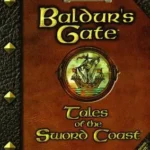
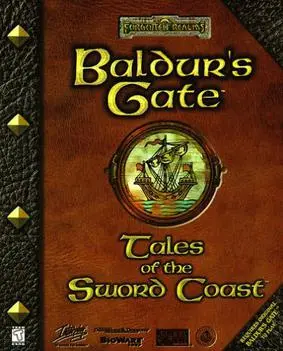
Baldur’s Gate: Tales of the Sword Coast is a 1999 expansion pack for Baldur’s Gate (1998), developed by BioWare and published by Black Isle Studios. Released on May 4, 1999, it requires the base game to play and adds four new areas to the Sword Coast map, a modest raise to the experience cap, new items, and new spells. It does not extend the main story or introduce new companions.
The expansion is not commercially available as a standalone product. It is bundled with the base game in Baldur’s Gate: Enhanced Edition (2012) and all subsequent re-releases, and is treated in the community as an inseparable part of the complete BG1 experience. Its primary lasting reputation rests on a single location: Durlag’s Tower.
Technical Specifications
| Attribute | Details |
|---|---|
| Developer | BioWare |
| Publisher | Black Isle Studios / Interplay Entertainment |
| Designer | James Ohlen |
| Writer | Luke Kristjanson |
| Composer | Michael Hoenig |
| Engine | Infinity Engine |
| Platform(s) | Windows · Mac OS |
| Release Date | NA: May 4, 1999 · EU: May 14, 1999 |
| Requires | Baldur’s Gate (1998) |
| Genre | CRPG expansion |
What the Expansion Adds
Tales of the Sword Coast adds four new areas accessible from the existing Sword Coast map, a 500,000 XP increase to the experience cap (allowing characters to reach slightly higher levels than the base game permitted), and a collection of new items and spells distributed through the new content. The main story of Baldur’s Gate is unaffected — the expansion sits alongside the existing campaign rather than extending or concluding it.
The hub for the new content is Ulgoth’s Beard, a small fishing village on the northern coast that adds a handful of merchants, a few new NPCs with short questlines, and the departure points for the expansion’s three other destinations. It is the least remarkable of the four areas and exists primarily as a gateway.
Durlag’s Tower
The expansion’s centrepiece — and the reason it is still discussed — is Durlag’s Tower: a massive, multi-level dungeon complex built by a dwarven hero named Durlag Trollkiller, whose legend the expansion systematically excavates.
Durlag was a warrior of renown who survived extraordinary battles, including encounters with trolls that earned his epithet. He became consumed by paranoia after his wife, children, and servants were murdered by demons who had disguised themselves as people close to him. In response, he spent years constructing a tower of such elaborate defensive sophistication that nothing could enter it without his authorisation — and then he sealed himself inside with his grief and his mechanisms, and was never seen again.
What the player finds inside is the material expression of that obsession. The tower has traps embedded in nearly every surface — pressure plates, magical triggers, mechanical springs — of a complexity that challenges even well-levelled thieves; parties without dedicated trap-detection will take significant damage just traversing the corridors. The visual design shifts across levels, with illusion magic distorting what the player sees. The deeper levels hold battle horrors (animated armour constructs of increasing power), demon knights of substantial difficulty, and eventually mind flayers in the deepest section.
The lore distributed through journals, ghosts, and found items builds the picture of Durlag’s psychology — a man whose capacity for violence in defence of his family metastasised, after their deaths, into a violence directed at the entire world’s capacity to intrude. The tower as designed communicates this: it is a space built not to be survived but to kill anyone who enters.
Durlag’s Tower has appeared in multiple critical retrospectives of CRPG dungeon design as a reference point for how a contained space can carry thematic weight through its architecture and difficulty rather than purely through narrative text.
The Ice Island and Balduran’s Shipwreck
The other two destinations are shorter and less celebrated.
The Ice Island is reached by ship from Ulgoth’s Beard and involves a wizard conducting dangerous elemental experiments in isolation. The area is compact, the encounters involve ice-themed creatures and constructs, and the questline resolves in a single visit. It provides new items and a moderate challenge but lacks Durlag’s Tower’s density of design.
Balduran’s Shipwreck is set on a remote island that holds the legendary ship of Balduran — the explorer who founded the city of Baldur’s Gate and whose mythology is woven through the setting’s history. The island has been claimed by werewolves, and navigating the social dynamics of a werewolf colony forms the short questline’s structure. The area is atmospheric and its central complication — distinguishing which inhabitants are dangerous — has a mild puzzle quality. Like the Ice Island, it is briefer and less demanding than Durlag’s Tower.
When to Play
The expansion’s areas are designed for a mid-to-late-game party. The practical timing question that appears in both the Reddit and Beamdog forum discussions is answered consistently:
Ulgoth’s Beard can be visited early; the village itself is not dangerous. The Ice Island is appropriate around chapters 3–4, at mid-game levels. Balduran’s Shipwreck works in the same range. Durlag’s Tower is routinely described as requiring a late-game party — levels 8–10 minimum — and even then warrants careful preparation. Attempting it earlier than the game’s fourth chapter is widely advised against. A party that has completed the main game’s Cloakwood sections before engaging with the deeper tower levels will have the most manageable experience.
The expansion does not have a narrative conclusion that ties into the main story, and it can be left until near the end of the base campaign without missing anything story-relevant.
Availability
Tales of the Sword Coast is included in Baldur’s Gate: Enhanced Edition on Steam, GOG, iOS, Android, PlayStation 4, Xbox One, and Nintendo Switch. It is also available in its original DOS form at Archive.org. The original boxed PC release is not available through mainstream storefronts.