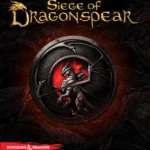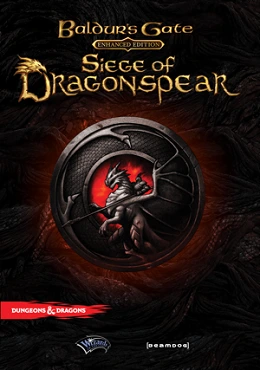
Baldur’s Gate: Siege of Dragonspear
Expansion of Baldur’s Gate: Enhanced Edition 77
★ /10
77
★ /10
 Android,
  iOS (iPhone/iPad),
  Nintendo Switch,
  PC,
PC,  PS4,
PS4,  Xbox One
Where to buy





Baldur’s Gate: Siege of Dragonspear is a 2016 expansion pack developed and published by Beamdog, released for PC on March 31, 2016, and included in console collections from October 2019. It is an original interquel — new content made by Beamdog rather than a port or remaster — bridging the narrative gap between Baldur’s Gate (1998) and Baldur’s Gate II: Shadows of Amn (2000). It is the first new official content in the Baldur’s Gate franchise in more than a decade, and it was launched into one of the more prolonged controversies in CRPG history.
The game received a Metacritic score of 77 from professional critics. The user score was significantly lower, driven by a coordinated review-bombing campaign that Wikipedia’s article on the game describes in those terms. The Reddit post “Siege of Dragonspear is good actually” — a deliberate corrective to the received reputation — is currently the highest-traffic organic result for this game in Google search.
Technical Specifications
| Attribute | Details |
|---|---|
| Developer | Beamdog |
| Publisher | Beamdog |
| Engine | Infinity Engine (Beamdog modifications) |
| Platform(s) | Windows · macOS · Linux · iOS · Android · PS4 · Xbox One · Nintendo Switch |
| Release Date | March 31, 2016 (PC) · October 15, 2019 (Console) |
| Price | $19.99 standalone |
| Requires | Baldur’s Gate: Enhanced Edition |
| Genre | CRPG expansion |
Between Two Games: Setting and Purpose
Baldur’s Gate ends with Gorion’s Ward defeating Sarevok, the Bhaalspawn who threatened to reignite a war across the Sword Coast. Baldur’s Gate II opens with the protagonist already a prisoner in Jon Irenicus’s underground laboratory. What happened in between — how the protagonist went from celebrated hero to captive — was never explained. Beamdog’s expansion fills that gap.
The protagonist, now publicly acknowledged as the hero of Baldur’s Gate, is asked by the city’s dukes to investigate a Crusade — a mass movement of soldiers and zealots marching north through the Sword Coast under a charismatic leader. The Crusade is causing displacement, death, and fear along its route, and its destination and purpose are unclear. The protagonist must pursue it through the settlements of the region, to the crumbling fortress of Dragonspear, and ultimately through a portal into Avernus — the first layer of the Nine Hells.
The expansion ends with the protagonist returning from Avernus, only to be ambushed. In its final scene, the hood of the hooded figure behind the ambush is pulled back. It is Jon Irenicus. Baldur’s Gate II begins.
Caelar Argent
The Crusade’s leader is Caelar Argent, a woman of half-celestial heritage who has assembled thousands of followers through what is initially presented as religious fanaticism. She is one of the more thoughtfully constructed antagonists in the franchise because her motivation, when revealed, is genuinely sympathetic: she is trying to free souls trapped in Avernus — among them people she cares about — and believes the Crusade is the only way to reach the strength and resources to do it.
The moral complexity of her position — a person causing real, undeniable harm in pursuit of a goal that is not itself wrong — gives the expansion’s later sections a weight that distinguishes Caelar from simpler villains. The player’s final confrontation with her has genuine ethical texture: what happens to her is not predetermined by alignment, and the choice the player makes reflects a developed view of whether her cause justifies her methods.
New Companions and the Shaman Class
Siege of Dragonspear introduces four new companions unique to the expansion, none of whom carry forward into Baldur’s Gate II: Enhanced Edition:
Corwin (Schael Corwin) is a human archer and soldier of the Flaming Fist mercenary company — the most narratively fleshed out of the four new companions, with a personal story that intersects meaningfully with the Crusade’s military dimensions.
Glint Gardnersonson is a gnome cleric/thief and the expansion’s primary comic character, a descendant of a long-running in-joke within the broader BG modding community about a family of gnomes with increasingly absurd names.
M’Khiin Grubdoubler is a goblin shaman — a choice of playable race that would have been unusual even in a player character context and is entirely without precedent for a companion in the franchise’s history.
Voghiln the Vast is a skald, a bardic variant that focuses on martial inspiration rather than musical performance, and functions as a straightforward combat-support character.
The expansion also adds the Shaman as a new playable class — a divine spellcaster who summons ancestral spirits and draws on nature-based magic in a style distinct from the Druid. It is the only class added to the Infinity Engine games by Beamdog and becomes available for new character creation in the Enhanced Edition across both games.
The Launch Controversy
Siege of Dragonspear‘s launch on March 31, 2016 coincided with a coordinated effort to flood its reviews with negative scores. Two specific points of complaint drove the campaign:
The first was Mizhena, a cleric character who briefly discloses to the player that she is transgender. Her inclusion was straightforwardly intentional — Beamdog had made representation a stated part of their approach to the Enhanced Editions — and was defended by CEO Trent Oster and by Ed Greenwood, the creator of the Forgotten Realms setting. Within five days of launch, 142 people had submitted zero-score reviews on Metacritic. In the aftermath, Beamdog patched the game’s treatment of Mizhena: the 2.5 update added a complete quest given by her character, and moved the disclosure of her gender identity to after the quest’s completion rather than at first meeting, giving her more narrative grounding before the detail was introduced.
The second was a line delivered by Minsc — a beloved character from the original games — that was interpreted as a joke directed at Gamergate. Beamdog’s own CEO acknowledged that the line was out of character for Minsc and had it removed in a patch.
Separately from the content controversy, the game also launched with significant technical problems — corrupted save files, multiplayer that was nearly non-functional, and difficulty settings that changed randomly between sessions. These were genuine complaints, addressed through multiple patches in the weeks after release, but they were substantially entangled with the review-bomb campaign in ways that made separating the two difficult in contemporaneous coverage.
David Gaider — BioWare’s longtime lead writer for the Dragon Age series, who had recently joined Beamdog — was incorrectly blamed online for the expansion’s content. He publicly clarified that he did not work on Siege of Dragonspear: “While I’d love to take credit/blame for Siege of Dragonspear, I did not work on it.”
Is It Worth Playing?
The Quora question “Should I play Siege of Dragonspear after Baldur’s Gate or just skip to Baldur’s Gate 2?” reflects the practical consideration most players arrive at. The community consensus, as expressed most directly in the “is good actually” Reddit thread that is now the game’s most-trafficked search result:
The expansion is not required to understand Baldur’s Gate II. Nothing in SoD is referenced in ways that leave BG2 incomprehensible without it. But the expansion provides the literal narrative step between BG1’s ending and BG2’s opening, and the final scene — the reveal of Irenicus’s face — is meaningfully more effective if the player has just spent twenty hours reaching it rather than jumping directly from defeating Sarevok to waking in a cage.
The recommended sequence is BG1EE → SoD → BG2EE. The additional twenty to thirty hours between the two main games are not uniform in quality — the new companions are the expansion’s weakest element, and the writing is inconsistent — but the expansion’s best sequences, including the Avernus section and the Caelar confrontation, justify the bridge it provides.
Reception
Professional critics settled around a consensus of mixed-to-decent: 77 on Metacritic, with Destructoid (7/10) and GamesBeat (87/100) on the more positive end, PC Gamer US (71/100) and GameStar (58/100) more critical. Common positives included the ambition of building original Infinity Engine content ten years after the engine was last used, the Avernus section, and Caelar as an antagonist. Common criticisms were uneven writing, the weakness of the new companions relative to the original cast, the launch bugs, and the gap between Siege of Dragonspear‘s voice-acting coverage and what the EE companions had established as an expected standard.
The user score gap between critic and player assessment is one of the largest for any game in this franchise, and it reflects the review-bombing campaign more than it reflects considered player response. Steam’s current aggregate, assessed after the immediate controversy subsided, is more representative of what players who complete the expansion think of it.