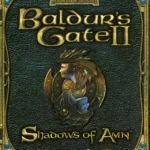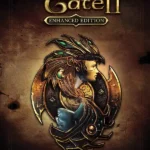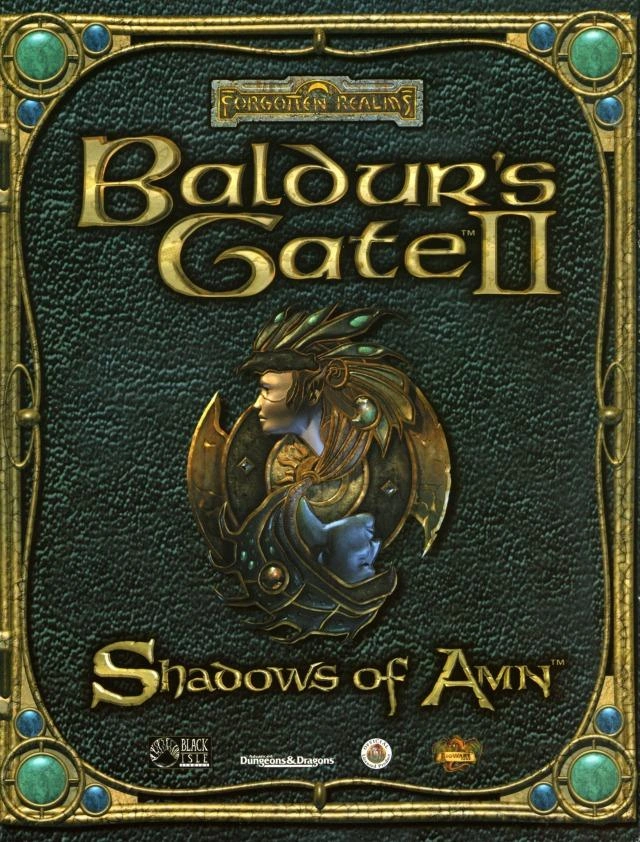
Baldur’s Gate II: Shadows of Amn
 95
★ /10
95
★ /10
 PC
PC
 1C-SoftClub, Black Isle Studios,
  Interplay Entertainment
Where to buy





Baldur’s Gate II: Shadows of Amn is a 2000 role-playing game developed by BioWare and published by Interplay Entertainment, released for Windows on September 21, 2000. It is the direct sequel to Baldur’s Gate (1998), set in the same Forgotten Realms campaign setting using the same Infinity Engine, and continues the story of Gorion’s Ward — the player-created protagonist — after the events of the first game.
It holds a Metacritic score of 95, making it one of the highest-rated PC games ever recorded. It is regularly cited, alongside Planescape: Torment (1999), as the definitive high-water mark of the Infinity Engine era and one of the most influential RPGs ever made. Development began in January 1999 under designers James Ohlen and Kevin Martens, and the game shipped roughly twenty months later with a scope that dwarfed its predecessor in nearly every measurable dimension.
Technical Specifications
| Attribute | Details |
|---|---|
| Developer | BioWare |
| Publisher | Interplay Entertainment (distributed by Black Isle Studios) |
| Directors | James Ohlen, Kevin Martens |
| Composer | Michael Hoenig |
| Engine | Infinity Engine (improved from BG1) |
| Platform(s) | Windows · Mac OS |
| Release Date | NA: Sep 21, 2000 · PAL: Sep 29, 2000 · Mac: Oct 15, 2001 |
| Genre | CRPG, isometric RPG |
| Mode(s) | Single-player · Multiplayer (up to 6 players) |
Opening: Irenicus’s Dungeon and Athkatla
Shadows of Amn opens six months after the conclusion of Baldur’s Gate. The protagonist and their companions — including the childhood friend Imoen, the half-elf Jaheira, and the ranger Minsc — have been captured during travel by the forces of Jon Irenicus, a powerful elven mage whose interest in the protagonist’s bloodline is not yet explained. The game’s first chapter is set inside Irenicus’s vast underground laboratory, where the party manages to escape during an attack on the complex.
On reaching the surface, they find themselves in Athkatla — the capital city of Amn, a southern nation governed by a council of merchant lords, whose authority includes a strict prohibition on the unlicensed use of magic. Irenicus and Imoen are both arrested by the Cowled Wizards, Amn’s magical enforcement body. Imoen is taken to Spellhold, an asylum on a distant island. Irenicus vanishes into the prison system. The protagonist is free — and must raise enough gold to hire the pirates who can take them to Brynnlaw, the island where Spellhold sits.
This structure is the engine of Shadows of Amn‘s second chapter, which is also the game’s largest: the entirety of Athkatla and its surrounding areas, containing enough optional content to occupy forty to sixty hours before the player decides to advance the main story.
Jon Irenicus
Jon Irenicus — voiced by English actor David Warner — is the reason Shadows of Amn is still discussed a quarter-century after release. He is, by wide consensus, one of the finest villain performances in the history of the medium.
Irenicus was once an elven mage of extraordinary ability named Joneleth, who became obsessed with the goddess-figure Ellesime, queen of the elven city of Suldanessellar, and with achieving immortality through forbidden experiments. Ellesime and the city’s elders stripped him of his soul as punishment — removing him from the connection to the Weave of magic and the continuity of elven spiritual life that gives their kind its purpose. What remains of Joneleth is cold, methodical, brilliant, and driven by a grief so absolute it has erased everything else.
His plan involves the protagonist’s Bhaalspawn heritage — the divine essence of the dead god of murder that runs in their blood. He intends to harvest it to reclaim what was taken from him. The game does not present this as simple villainy: Irenicus is a man destroyed by loss and humiliation, pursuing the only path he can conceive of toward restoration. He is also completely without mercy.
David Warner’s performance — patrician, unhurried, contemptuous of everyone around him — is inseparable from the character’s impact. His opening line to the protagonist upon their escape attempt in the dungeon is delivered with the boredom of a man interrupting a mild inconvenience: “Ah, my child — you have managed to open your cage. How bothersome.” Later, after single-handedly destroying the Cowled Wizards who arrest him in Athkatla, he says: “I feel… nothing.” PC Gamer later described Warner’s portrayal as “one of the key reasons why Baldur’s Gate 2 remains such an arresting experience today.”
The Companions
Shadows of Amn assembled the party that would define BioWare’s approach to companion writing for the following two decades.
Jaheira, returning from Baldur’s Gate, is a half-elf Fighter/Druid who has lost her husband Khalid in Irenicus’s dungeon and does not yet know it. Her arc — grief processed through increasingly strained practicality — is the game’s emotional anchor, and the romance available to male protagonists with her is among the most nuanced in the game.
Minsc is a ranger whose defining characteristic in BG1 was cheerful cartoonishness — “Go for the eyes, Boo! Go for the eyes!” — and who is developed in BG2 into something with genuine pathos beneath the comedy. His hamster Boo, declared a miniature giant space hamster, functions as his moral compass and source of tactical advice.
Viconia is a dark elf cleric who fled the Underdark and everything it represents. She is self-protective, sardonic, and deeply mistrustful — and her romance arc (available to male protagonists) is built on the question of whether either party can change enough to sustain something real.
Edwin Odesseiron is a Red Wizard of Thay who is vain, selfish, openly contemptuous of everyone, and has an internal monologue in brackets that runs throughout his dialogue expressing what he’s actually thinking as opposed to what he says. He is the game’s best written evil companion and one of the funniest characters in BioWare’s library.
Yoshimo — a Kensai/Thief who joins the party early as a cheerful, capable pragmatist — has a storyline whose resolution players still describe discovering for the first time as one of the more affecting things the game does. No further details here.
Other companions include the elven Cleric/Mage Aerie, the tiefling bard Haer’Dalis, the gnomish illusionist Jan Jansen (who tells increasingly elaborate and implausible stories about his family at every opportunity), the halfling warrior Mazzy Fentan, the inquisitor paladin Keldorn, and several others, each with personal questlines, banter with other party members, and reactions to the protagonist’s choices.
Shadows of Amn was the first BioWare game to include substantial companion romance storylines — for male protagonists, Jaheira, Viconia, or Aerie; for female protagonists, the cleric Anomen. These were unprecedented in an RPG of BG2’s scale and became the template for companion writing in Dragon Age, Mass Effect, and ultimately Baldur’s Gate 3.
Athkatla: An Embarrassment of Riches
The city of Athkatla and its surroundings constitute one of the densest concentrations of optional content ever put into an RPG. The city is divided into districts — the Slums, the Docks, the Bridge, the Temple, the Government, the Graveyard — each containing faction questlines, independent storylines, and dozens of encounters that have nothing to do with the main quest and everything to do with the world they inhabit. A thieves’ guild coup, a vampire clan, a wizard’s sphere dimension, a Harper storyline, an Amnian noble family in crisis, a serial killer in the slums — these run simultaneously, at whatever order and pace the player chooses.
The scale is overwhelming on first encounter and intoxicating once oriented. The game does not suggest a preferred order, does not lock content behind the others, and does not level-scale most of it — arriving at a location underlevelled and finding it impossible is a real outcome that communicates “come back later” rather than adjusting to match the party.
The Infinity Engine and AD&D 2nd Edition
Shadows of Amn uses BioWare’s Infinity Engine, running on pre-rendered isometric backgrounds at 800×600 resolution (compared to 640×480 in BG1). Combat is real-time with pause (RTWP): the game runs in real time, but pressing the spacebar freezes everything, allowing the player to assess the situation, queue actions for all six party members, and then resume. This is fundamentally different from Baldur’s Gate 3‘s turn-based combat, and produces a different rhythm: managing six spellcasters and fighters simultaneously in a complex fight is a demanding exercise in short-term tactical planning across multiple fronts.
The rules are AD&D 2nd Edition — the edition of Dungeons & Dragons in use in 2000, which differs substantially from the 5th Edition used in BG3. THAC0 (To Hit Armour Class 0) governs attack rolls. Weapon speeds affect the order of attacks within a round. Character kits — specializations unlocked in BG2 that didn’t exist in BG1 — modify class abilities in ways that define different playstyles within the same class. 300 spells are available, up from 130 in the original game.
The Underdark
Following the events at Spellhold, the party is transported to the Underdark — the vast subterranean realm beneath the surface of Faerûn, populated by creatures adapted to life without sunlight. The section that follows is among the most consistently praised stretches in CRPG history: beholders, mind flayers, and kuo-toa at densities the surface world doesn’t produce, a Drow city the party must navigate through deception rather than combat, and an optional encounter with Demogorgon — a demon lord so powerful that fighting him requires specific preparation and carries a significant chance of total party death at any reasonable level.
The Underdark section of BG3‘s Act 1 is a direct reference to this chapter. Several of the specific locations and creature types BG3 places underground are drawn from BG2’s Underdark, including mind flayer colonies and the Drow.
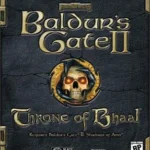
Throne of Bhaal
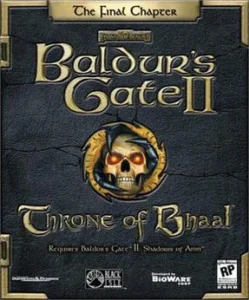
The expansion Throne of Bhaal, released in June 2001, concludes the Bhaalspawn saga. Set partially in Tethyr and partially in the extraplanar Pocket Plane, it raises the level cap from 31 to 40 and introduces epic-level abilities — powers that reflect characters who have grown beyond the normal ceiling of their class. The story resolves the fate of all surviving Bhaalspawn and reaches a conclusion directly determined by choices made throughout both games.
Throne of Bhaal is included in all current versions of Baldur’s Gate II and is generally treated as inseparable from the main game by the community.
Legacy
The influence of Shadows of Amn on subsequent RPGs is difficult to overstate. BioWare carried the companion romance structure, the party banter system, and the personal questline model directly into Neverwinter Nights, Knights of the Old Republic, Dragon Age: Origins, and the Mass Effect series — each iteration refining what BG2 established. David Gaider, who wrote or co-wrote several of BG2’s companions, went on to be the lead writer on Dragon Age.
Jon Irenicus as a villain established a template for the sympathetic-but-irredeemable antagonist — someone whose goals the player can understand and whose tragedy is visible, but who has committed acts that make redemption impossible. Baldur’s Gate 3‘s Raphael, the devil who serves as Act 3’s most memorable antagonist, is in a direct line of descent.
The subreddit r/patientgamers hosts both “Baldur’s Gate 2: worth playing?” and “Baldur’s Gate 2 is unbelievably good” threads as among its most-visited — the first a genuine inquiry from newcomers, the second a spontaneous expression of discovery from players who found out the answer themselves.
Is BG2 Worth Playing in 2026?
The answer is yes, with caveats the SERP makes obvious. The game is approximately forty hours of main story and eighty to a hundred hours if the optional content in Athkatla is engaged. The RTWP combat has a learning curve for players whose CRPG experience is limited to Baldur’s Gate 3‘s turn-based system, and AD&D 2nd Edition’s rules are less intuitive than 5th Edition. The Infinity Engine’s UI is dated by any contemporary standard.
What holds up entirely: Irenicus, the companion writing, the density and quality of the optional quests in Athkatla, the Underdark, and the writing across essentially all of the named companions. The companion banter — short character exchanges triggered by travel and proximity — still sets a standard that many modern RPGs with larger budgets do not match.
The Enhanced Edition (covered separately) addresses most of the accessibility complaints: widescreen support, bug fixes, interface improvements, and four additional companions not in the original. For most new players in 2026, the Enhanced Edition is the practical starting point; this page documents the original release it is built on.