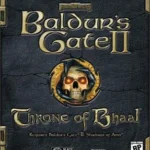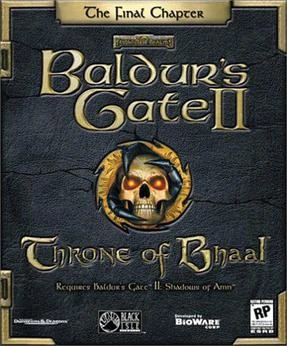
Baldur’s Gate II: Throne of Bhaal
Expansion of Baldur’s Gate II: Shadows of Amn 88
★ /10
88
★ /10
 PC
PC
 Interplay Entertainment
Baldur’s Gate II: Throne of Bhaal is a 2001 expansion pack for Baldur’s Gate II: Shadows of Amn, developed by BioWare and published by Black Isle Studios. Released on June 21, 2001, it concludes the Bhaalspawn saga — the story begun in the original Baldur’s Gate in 1998 — and adds a campaign that raises the level cap from 31 to 40, introduces epic-level abilities for every class, and includes the conclusion of every companion’s arc through the game’s most celebrated feature: its epilogues.
The expansion holds a Metacritic score of 88 — strong for an expansion — but the community’s relationship with it is more complicated. “What are people’s general opinions of Throne of Bhaal?” is simultaneously the second-highest organic result and the Knowledge Panel entry for this game in current search, reflecting an ongoing discussion about whether the conclusion holds up to the saga it concludes.
Technical Specifications
| Attribute | Details |
|---|---|
| Developer | BioWare |
| Publisher | Black Isle Studios / Interplay Entertainment |
| Designers | James Ohlen, Kevin Martens |
| Lead Writer | David Gaider |
| Composer | Michael Hoenig |
| Engine | Infinity Engine |
| Platform(s) | Windows · Mac OS |
| Release Date | June 21, 2001 (NA) |
| Requires | Baldur’s Gate II: Shadows of Amn (bundled in BG2:EE) |
| Genre | CRPG expansion |
After Irenicus: Story and Setup
Throne of Bhaal takes place immediately after the events of Shadows of Amn, with the protagonist having defeated Jon Irenicus and returned from the elven city of Suldanessellar. A new and more personal threat emerges almost immediately.
Melissan — or Amelyssan the Blackhearted — has positioned herself as a protector of Bhaalspawn, gathering the children of the dead god of murder under the premise of sheltering them from destruction. The protagonist discovers that this was a deception: Melissan has been sacrificing the gathered Bhaalspawn one by one, absorbing their divine essence in an attempt to claim the power of Bhaal for herself. She wants to become the new god of murder.
The campaign is structured as a final sprint to confront Melissan — through several siege battles (the expansion introduced large-scale combat with many simultaneous combatants), an extraplanar dungeon complex, and ultimately the Throne of Bhaal itself. At the conclusion, the protagonist must decide what to do with the accumulated essence of a dead god that runs in their own blood — accept it and ascend, destroy it and remain mortal, or something in between. The game offers multiple endings that are shaped by the alignment and choices made throughout the entire saga.
Melissan is a weaker antagonist than Irenicus — a deliberate trade-off, in the sense that the real drama of the expansion is not her but the question of what the protagonist does with what they have become. Most of the discussion about ToB’s story quality turns on whether players find that trade-off satisfying.
Sarevok
The most celebrated character addition in Throne of Bhaal is the ability to recruit Sarevok — the armoured figure who killed Gorion at the opening of the original Baldur’s Gate in 1998, and the game’s central villain. He is dead at the start of Throne of Bhaal, existing in a spectral form in the Pocket Plane (the extraplanar base the protagonist gains access to), and can be restored to life if the protagonist grants him a fragment of their own Bhaalspawn essence — at a cost to themselves.
What follows is determined by how the restoration is conducted. Sarevok can be given memories of the protagonist’s life, with all its ambiguity, which initiates a genuine arc toward something other than pure destructiveness. He can be left with only his own memories, which makes him functional as a companion but unchanged in character. He has full companion dialogue, banter with other party members, and a questline that extends into the expansion’s later stages. Playing him as a companion — particularly one who is reconsidering what brought him to where he is — is routinely cited as one of the expansion’s most memorable elements.
Watcher’s Keep
The expansion includes Watcher’s Keep, a massive standalone dungeon that is technically accessible from Shadows of Amn (entering it before the end of SoA is possible) but is designed for the higher levels that Throne of Bhaal makes available. It consists of five levels of escalating difficulty, each with its own design theme and boss encounter, centred on the premise that a godlike entity of enormous destructive power is imprisoned at the Keep’s core, and that several factions — including a devil, a mage order, and a githzerai outpost — have staked positions in the levels above, each believing they are successfully containing what lies below.
Watcher’s Keep is praised for the same qualities as Durlag’s Tower in Tales of the Sword Coast: environmental storytelling through architecture and notes, escalating difficulty calibrated for the system’s highest levels, and a final encounter that tests the party at the edge of what AD&D 2nd Edition can produce. For many players, it is the high point of the expansion.
High-Level Abilities and Epic Combat
One of Throne of Bhaal‘s defining mechanical additions is the High Level Ability (HLA) system — special powers that become available once characters reach certain experience thresholds above the original game’s cap. Each class has its own HLA tree: mages can access Improved Alacrity, which allows spells to be cast without consuming game time; fighters gain Whirlwind Attack, which multiplies attacks dramatically for one round; thieves unlock Use Any Item, which removes all class and race restrictions on equipment.
The HLA system takes the game firmly into power-fantasy territory — parties at level 35+ can produce combat sequences that would be mechanically impossible at the levels SoA occupies, and the difficulty of the expansion is calibrated to require this power. Some players find this satisfying; others find the resulting combat more chaotic than tactical. The Infinity Engine was designed for levels 1–20 and shows strain at 30+, and the opponent scaling required to challenge high-level parties produces encounters that are visually overwhelming.
The Endings and Companion Epilogues
The question of what the protagonist does with the essence of Bhaal at the expansion’s conclusion produces several distinct endings — including the ability to become the new god of murder, to destroy the essence and return to a fully mortal existence, or outcomes in between, shaped by alignment and specific choices made during the final sequence. The dark ending is fully playable and played as a genuine power-fantasy conclusion rather than a punitive fail-state.
What follows the endings is what the community most consistently cites as Throne of Bhaal‘s legacy: companion epilogues. Each companion who has travelled through the saga receives a short prose passage describing what happens to them after the story concludes. Jaheira’s epilogue, Minsc’s, Viconia’s, Yoshimo’s (if the player allowed events that made his arc possible) — these few paragraphs each, describing what becomes of these people after the world-changing events they participated in, constitute the emotional payoff for a saga that has been running since 1998 for some players.
The epilogues do not resolve cleanly in every case. Several are bittersweet. Some are ambiguous. They are proportionate to the games that preceded them, which is to say they are restrained in their sentiment and honest about the kind of world these characters live in.
Is Throne of Bhaal Worth Playing?
Both the Reddit thread “What are people’s general opinions of Throne of Bhaal?” and the Beamdog forum thread “Is Throne of Bhaal worth playing?” reflect a consistent evaluative question from players who have finished Shadows of Amn and are deciding whether to continue. The community answer is yes, with calibration:
Throne of Bhaal is not a stronger game than Shadows of Amn. The story does not reach the heights of the Irenicus arc. The locations are less varied. The combat can become difficult to manage at epic levels if the party composition was built for SoA rather than ToB.
What it is, unambiguously, is the conclusion. The companion epilogues happen here. Sarevok’s arc happens here. The question of what kind of person the protagonist has chosen to be across three games (or four, if Siege of Dragonspear was played) finds its answer here. Players who skipped it have not finished the saga.
Reception and Availability
Throne of Bhaal holds an 88 on Metacritic — among the highest scores for any expansion pack in the RPG genre. Critics praised the scale of the final battles, the Watcher’s Keep dungeon, Sarevok’s character work, and the emotional weight of the endings and epilogues.
As with Tales of the Sword Coast, the expansion is not available as a standalone digital product. It is bundled with Baldur’s Gate II: Enhanced Edition on Steam, GOG, iOS, Android, PlayStation 4, Xbox One, and Nintendo Switch, and treated as an integral part of the complete BG2 experience rather than optional DLC.