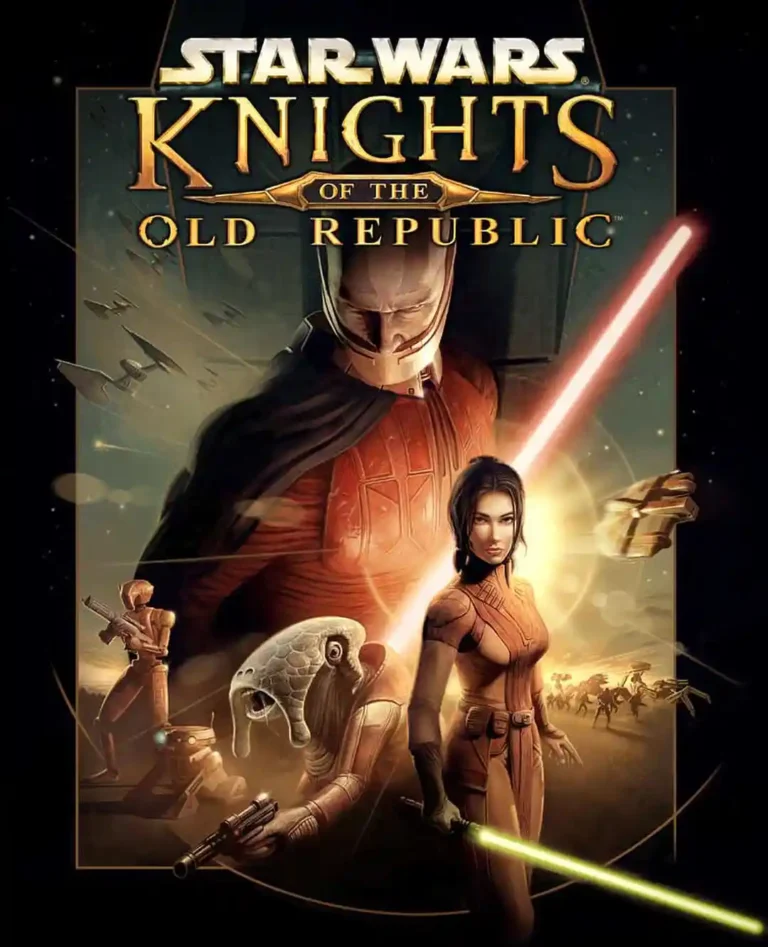
Star Wars: Knights of the Old Republic
 94
★ /10
94
★ /10
 Android,
  iOS (iPhone/iPad),
  Nintendo Switch,
  PC,
PC,  Xbox
Xbox
 Aspyr Media, Disney, LucasArts, Lucasfilm Games
Where to buy




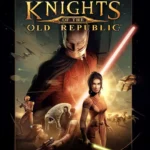
Star Wars: Knights of the Old Republic (commonly abbreviated as KOTOR) is a 2003 role-playing game developed by BioWare and published by LucasArts. Originally released for Xbox on July 15, 2003, with a PC version following in November 2003, it is set 4,000 years before the events of the Star Wars films — placing it far outside any established film or television continuity — and follows a custom protagonist uncovering their connection to the greatest Sith Lord the galaxy has ever known.
The game received a Metacritic score of 93 on Xbox and 92 on PC, was named Game of the Year by multiple publications for 2003, and is widely considered one of the finest RPGs ever made. It is also — following the announcement of Star Wars: Fate of the Old Republic at The Game Awards 2025 — the game that Casey Hudson, its original director, has described as “one of the defining experiences” of his career and the direct inspiration for his return to Star Wars.
Note: the search term “kotor” also returns results for Kotor, a walled coastal city in Montenegro. This page is about the game.
Technical Specifications
| Attribute | Details |
|---|---|
| Developer | BioWare |
| Publisher | LucasArts |
| Director | Casey Hudson |
| Lead Writer | Drew Karpyshyn |
| Composer | Jeremy Soule |
| Engine | Odyssey Engine |
| Platform(s) | Xbox (2003) · PC (2003) · macOS (2004) · iOS (2013) · Android (2014) · Nintendo Switch (2021) |
| Release Date | Xbox: July 15, 2003 · PC: Nov 19, 2003 |
| Genre | Role-playing |
| Mode | Single-player |
The Old Republic: Setting and Premise
Knights of the Old Republic inhabits a corner of the Star Wars universe that the films never touch. In 3,956 BBY — four millennia before Luke Skywalker destroys the Death Star — the Republic is at war with the Sith Empire of Darth Malak, a former Jedi apprentice who turned to the dark side alongside his master Darth Revan. Revan waged and seemingly won a war against the Republic years earlier, only to disappear under mysterious circumstances. Now Malak has resumed the conquest, and the Republic is losing.
The player controls a Republic soldier who survives the destruction of a warship under attack by Malak’s forces and ends up entangled with a young Jedi named Bastila Shan, whose rare ability to amplify others’ connection to the Force may be the only remaining strategic advantage the Republic possesses. The investigation into Malak’s plans, and into the Sith’s ancient source of power, forms the backbone of a story that unfolds across nine planets and approximately forty hours of gameplay.
What separates the story from standard Star Wars fare is what lies at its center. The game builds toward a revelation about the protagonist’s identity that recontextualizes everything that has come before — widely regarded as one of the finest narrative twists in the history of the medium, and a plot development that players in 2026 are still describing as having hit them “out of nowhere” despite the game being over twenty years old.
Character Creation, Classes, and the D20 System
KOTOR is a full RPG built on a modified version of the Star Wars Roleplaying Game ruleset published by Wizards of the Coast — itself derived from Dungeons & Dragons 3rd Edition. Players allocate ability scores, choose from three initial character classes (Soldier, Scoundrel, or Scout), distribute skill points, and select Feats that define combat and non-combat competencies. After the prologue, the character is trained as a Jedi and gains access to Force powers and lightsaber combat.
Combat in KOTOR is real-time in presentation but turn-based in mechanics. Characters attack automatically at intervals governed by their statistics; the player’s role is to select abilities, position characters, and queue actions rather than control individual button inputs. This is a point of friction for players accustomed to action-RPG or shooter conventions — the game looks like it should play like an action game, but it functions like a tabletop simulation. Several widely shared accounts of players who quit KOTOR in the first two hours and returned to find it among their favorite games speak almost universally to this initial barrier, and to the game opening up dramatically once the Jedi training sequences on Dantooine are reached.
The Party and Companions
KOTOR assembles a party of up to nine companions over the course of the campaign, with three active in any combat encounter. They span the range of character archetypes the setting affords: Bastila Shan is a confident, occasionally arrogant Jedi whose idealism strains against growing complications; Carth Onasi is a veteran soldier with deep-seated trust issues; Canderous Ordo is a Mandalorian mercenary who approaches ethics as a purely tactical question; Mission Vao and her Wookiee companion Zaalbar represent the street-level side of the galaxy far, far away.
The standout companion — and one of the most celebrated characters in the franchise across any medium — is HK-47, a protocol droid with a secondary function as an assassination unit. HK-47’s defining characteristic is his transparent enthusiasm for killing, expressed through elaborate euphemistic vocabulary (“meatbag” being his preferred term for organic life), and his complete contempt for the diplomatic functions he is nominally built for. His conversations have an almost satirical quality — a send-up of the C-3PO archetype — and he remains funny, character-consistent, and narratively useful throughout the game.
Light Side, Dark Side, and the Alignment System
KOTOR implements a Light Side / Dark Side alignment system that tracks the cumulative moral weight of the player’s decisions throughout the game. Dialogue choices, quest resolutions, and how the player treats NPCs all push the alignment meter toward one pole or the other. As alignment shifts, Force power selections become constrained: Light Side characters gain access to healing and defensive abilities while losing access to Force Lightning and the more aggressive offensive powers, and vice versa.
Unlike Mass Effect‘s Paragon/Renegade system (which KOTOR directly influenced), the alignment in KOTOR has visible consequences on the protagonist’s physical appearance: a high Dark Side character visibly deteriorates, developing pallor and yellowing eyes in the style of Emperor Palpatine. Both paths are fully playable, with different dialogue options, different faction relationships, and a substantially different ending sequence.
Where to Play in 2026
The original KOTOR is available on PC via Steam and GOG, on iOS, Android, and Nintendo Switch. The Xbox version remains playable on Xbox One and Series consoles through backward compatibility. There is no native PS5 or PS4 release of the original game pending the remake.
The Switch version released in November 2021 is generally considered the best portable option, including all original content with touch-screen and controller support. The PC version benefits from years of community modding — the unofficial KOTOR Community Patch addresses hundreds of bugs in the base game and is broadly considered essential, while restoration mods return cut content that didn’t make the 2003 release.
The Remake, FOTOR, and Where the Franchise Stands
The KOTOR universe is currently in an unusually active state, with two separate projects in development simultaneously.
The KOTOR Remake was announced at the PlayStation Showcase in September 2021, initially developed by Aspyr Media. After an internal presentation in 2022 that was described as disappointing, development transferred to Saber Interactive and its subsidiary Mad Head Games. As of March 2026, Saber CCO Tim Willits confirmed to IGN that the game is “still in development,” adding that the team wants to ensure “when we do show it, it’s something that people are going to be really excited about.” No release date, no screenshots, and no gameplay footage have been released. The project was originally announced as a timed PS5 exclusive; current platform plans have not been officially clarified. A KOTOR II remake, codenamed “Juliet,” has also reportedly been discussed internally.
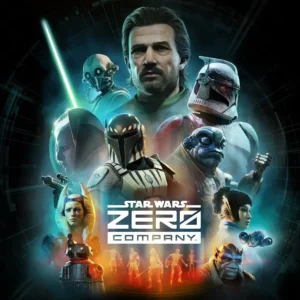
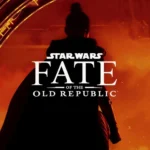
Star Wars: Fate of the Old Republic (FOTOR) was announced at The Game Awards on December 11, 2025. It is a new single-player narrative action RPG developed by Arcanaut Studios in collaboration with Lucasfilm Games, directed by Casey Hudson — who directed the original KOTOR in 2003 and went on to direct the Mass Effect trilogy. Hudson explicitly described FOTOR as a spiritual successor to KOTOR, not a remake or sequel, set in the Old Republic era with an original story. Arcanaut Studios was founded in July 2025, and the game is in early development; Hudson has stated it will release before 2030, though industry observers consider that timeline optimistic.
Reception and Legacy
KOTOR won Game of the Year at the 2004 BAFTA Games Awards and the 2004 Interactive Achievement Awards, among dozens of other end-of-year accolades for 2003. It is the game most credited with demonstrating that a licensed Star Wars RPG could stand alongside the best games of its generation rather than serving as a promotional tie-in, and its influence on BioWare’s subsequent output — Jade Empire, Mass Effect, Dragon Age — is direct and acknowledged.
In 2024, a survey commissioned around the announcement of Fate of the Old Republic found that KOTOR I and KOTOR II ranked as the most popular Star Wars games among the franchise’s fanbase — a position they have held, with minimal competition, for over two decades. The Revan storyline remains the piece of the expanded Star Wars universe fans most consistently cite when discussing what they want modern Star Wars storytelling to aspire to.
Casey Hudson’s decision to leave BioWare, found a new studio, and make FOTOR his next game is, in context, the clearest possible statement about what KOTOR means to the people who made it.