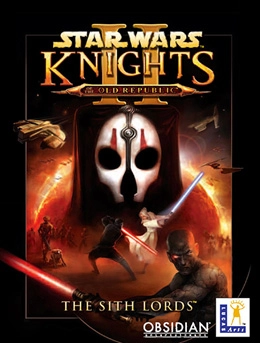
Star Wars: Knights of the Old Republic II: The Sith Lords
 86
★ /10
86
★ /10
 Android,
  iOS (iPhone/iPad),
  Nintendo Switch,
  PC,
PC,  Xbox
Xbox
 Aspyr Media, Obsidian Entertainment
Aspyr Media, LucasArts, Lucasfilm Games
Aspyr Media, Obsidian Entertainment
Aspyr Media, LucasArts, Lucasfilm Games
Where to buy




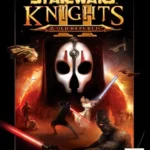
Star Wars: Knights of the Old Republic II: The Sith Lords is a 2004 role-playing game developed by Obsidian Entertainment and published by LucasArts. It was Obsidian’s debut title as a studio — founded by former Black Isle employees following Interplay’s collapse — and was given fourteen months to produce a sequel to one of the highest-rated RPGs ever made. The result is one of the most philosophically ambitious games in the Star Wars franchise and, simultaneously, one of the most visibly unfinished.
Released for Xbox on December 6, 2004, and PC in February 2005, it earned Metacritic scores of 85 and 83 respectively — lower than the original, and lower than it deserved, given the condition in which it shipped. In its patched and restored form, many consider it the superior game.
Technical Specifications
| Attribute | Details |
|---|---|
| Developer | Obsidian Entertainment |
| Publisher | LucasArts |
| Lead Designer / Writer | Chris Avellone |
| Composer | Mark Griskey (with retained tracks by Jeremy Soule) |
| Engine | Odyssey Engine |
| Platform(s) | Xbox (2004) · PC (2005) · iOS (2015) · Android (2015) · Nintendo Switch (2022) |
| Release Date | Xbox: Dec 6, 2004 · PC: Feb 8, 2005 |
| Genre | Role-playing |
| Mode | Single-player |
The Exile and the Last Jedi War
The Sith Lords is set five years after the events of the original KOTOR, in a galaxy that has moved from one crisis to the next. The Jedi Order has been nearly exterminated — not destroyed in battle, but hunted and killed by an unknown force until almost none remain. Three Sith Lords — Darth Nihilus, Darth Sion, and Darth Traya — are identified as the architects of this extinction. The Republic is exhausted, recovering from two consecutive galactic wars, and has no institutional capacity to respond.
The player controls the Exile: a Jedi Knight who fought in the Mandalorian Wars under Revan’s command, used a Jedi technique to survive a battle that should have killed them, and was subsequently exiled from the Order for reasons the game slowly excavates. The Exile is unique in the Star Wars universe in that they severed their own connection to the Force — deliberately cut themselves off from it — and exist at the game’s outset as a wound in the galaxy, someone around whom Force-sensitive people unconsciously form a bond.
This is not a detail. It is the architecture of everything that follows.
Kreia
Kreia — who becomes the Exile’s mentor, companion, and eventual antagonist under the name Darth Traya — is the reason The Sith Lords is studied and debated in ways that most other Star Wars games are not.
Kreia is an elderly former Jedi Master, then fallen Sith, then something harder to categorize. Her relationship with the Force is one of deep hatred: she views it not as a source of wisdom or power but as a tyrant, a predetermined determinism that removes agency from everyone who touches it, reducing them to instruments of balance. She wants to kill it. She is teaching the Exile to survive without it. Whether she is doing this because she loves the Exile or because she needs them to complete her own plan, or both, is never resolved with finality.
Most of the game’s dialogue with Kreia consists of her unpicking the assumptions behind the player’s choices, regardless of whether they make Light Side or Dark Side decisions. The game’s design is explicitly structured to ensure that no choice the player makes is comfortable. Charity in Nar Shaddaa triggers her disapproval. Cruelty does too. She is looking for something from the Exile that isn’t represented on either alignment meter. Her presence makes The Sith Lords the only major Star Wars game that uses the license to actively interrogate the ideology it is based on — questioning whether the Jedi Order deserved to survive, whether the Force is benevolent, and whether the Exile’s existence represents a flaw in the galaxy or the only honest response to it.
Chris Avellone and the Deconstruction of the Force
Chris Avellone, who served as lead designer and lead writer, came to KOTOR II from Black Isle Studios — where he had worked on Fallout 2, Planescape: Torment, and Icewind Dale — and brought a sensibility shaped by games that treated moral philosophy as a design challenge rather than a backdrop.
His approach to The Sith Lords was to use the fourteen months available to deconstruct the foundational logic of Star Wars lore. Why do the Jedi prohibit attachment? What does it mean to be “strong in the Force” as a virtue? What happens to the galaxy when the war between Jedi and Sith is treated not as a moral contest but as an ecosystem that both sides perpetuate to maintain their own relevance?
Avellone has discussed these questions in interviews over two decades. The game’s treatment of Darth Nihilus — a Sith Lord who consumed Force-sensitive life to sustain himself, created by a wound in the Force identical to the one the Exile carries — represents the same premise as the Exile’s existence taken to its destructive extreme. The game asks whether the Exile will become what Nihilus became or find another path, without ever resolving which path is correct.
The Influence System
The sequel’s most significant mechanical addition over KOTOR 1 is the Influence system. Each companion tracks a numerical relationship with the Exile, and that relationship deepens or erodes based on every interaction — dialogue choices, companion-specific conversations, and how the Exile behaves in missions they witness. High influence unlocks complete character histories, personal questlines, and in several cases allows the player to train companions as Jedi or guide them toward the dark side.
Low influence is not a failure state; it produces different conversations and different character resolutions. A party member whose influence remains low throughout the game will simply never open up, and the player will never know what was there. The system made replay more consequential than in the original KOTOR, where companion content unlocked on a fixed schedule.
Fourteen Months: The Rushed Development
Obsidian Entertainment was founded in 2003 by veterans of Black Isle Studios. The Sith Lords was their first project. LucasArts contracted them to deliver a full KOTOR sequel in approximately fourteen months — a schedule that would have been difficult for an experienced, fully-staffed studio, and was brutal for a team in its first year of existence.
A compounding problem: Obsidian was not permitted to play or review the original KOTOR until their contract was signed, because the game had not yet shipped. They had to write their initial pitch for a sequel to a game they had never seen. When KOTOR 1 was released partway through development, the team had to absorb it on the fly and revise work they had already produced.
The consequences are visible throughout the shipped game. The planet Korriban is a fraction of its planned scope. The Nar Shaddaa droid factory questline — in which HK-47 solo-pilots a mission to shut down a manufacturing plant producing counterfeit HK droids — was abandoned at roughly 80% completion. The game’s climax on Malachor V was so heavily cut that the ending, as shipped, is incoherent without prior knowledge of what was intended. Multiple character arcs conclude mid-scene or not at all.
Chris Avellone has been direct about the cause: “There would have been substantial penalties had we not made that date.” Obsidian made the date. The game shipped.
The Restored Content Mod
The The Sith Lords Restored Content Modification (TSLRCM) is a fan-made mod assembled primarily by the modders Zbyl2 and DarthStoney, first released in 2009. It reconstructs missing content from assets still present in the game’s files — unused voice recordings, incomplete quest scripts, unfinished dialogue trees — and integrates them into a coherent playthrough. Key restorations include the HK Factory mission, the Jedi Masters’ confrontation on Dantooine in its full form, significant Nar Shaddaa content, and a revised, substantially more comprehensible Malachor V sequence.
TSLRCM is available on the Steam Workshop and is broadly considered mandatory for any PC playthrough. The modding community treats the question “should I use TSLRCM?” as answered — yes, on a first playthrough or any subsequent one.
The mod’s existence prompted Aspyr Media, when porting KOTOR II to Nintendo Switch in June 2022, to announce a planned free DLC that would bring TSLRCM to console for the first time. This did not happen. In June 2023, Aspyr cancelled the DLC without explanation; Aspyr’s co-CEO later stated in court filings that “a third party objected” and prevented the release — widely interpreted as referring to Lucasfilm Games. A class action lawsuit was filed by Switch purchasers who had bought the game specifically for the promised DLC. Aspyr offered affected customers a redemption code for other Star Wars titles, including the Steam version of KOTOR II — which does support the mod. The lawsuit was filed and does not appear to have reached resolution. In late 2025, fan modders independently ported TSLRCM to the Switch version via unofficial means, but this requires console modification to install.
Where to Play in 2026
The PC version via Steam or GOG is the recommended platform, with TSLRCM installed from Steam Workshop. This is the most complete and stable version of the game.
The Nintendo Switch version lacks official TSLRCM support and launched with a game-breaking save glitch; multiple subsequent patches have improved stability, but the experience remains inferior to PC. The iOS and Android mobile versions are older Aspyr ports without mod support.
Reception, Legacy, and What Comes Next
The Sith Lords earned scores roughly ten points below the original KOTOR across review publications, with critics noting the unfinished state of the ending and the volume of apparent bugs and cut content. The lower scores are a direct consequence of the shipping condition, not of the game’s design. In subsequent years, as the TSLRCM restored much of the missing content and critical reassessment accumulated, the consensus shifted substantially. The game’s MauLer community thread — a forum devoted to long-form analytical criticism — draws more organic search traffic than the game’s original launch reviews, suggesting the audience engaging with KOTOR II in 2026 is primarily interested in its ideas rather than its technical execution.
The broader franchise context has become increasingly relevant. As noted in the KOTOR page, a remake of the first game is in development at Saber Interactive / Mad Head Games under the internal codename for the sequel (“Juliet” per court testimony from a Lucasfilm VP). Star Wars: Fate of the Old Republic, announced at The Game Awards 2025 and directed by KOTOR 1‘s Casey Hudson at his new studio Arcanaut, is explicitly described as a spiritual successor to both games. A planned third game by Obsidian — set to follow Revan into the Unknown Regions — was cancelled by LucasArts in 2005 during company restructuring, and the story it would have told has never been resolved in any medium.
The Exile’s story ended here, unfinished. The galaxy Avellone built around Kreia and the wound in the Force remains one of the most unusual and uncompromising things the Star Wars license has ever produced.