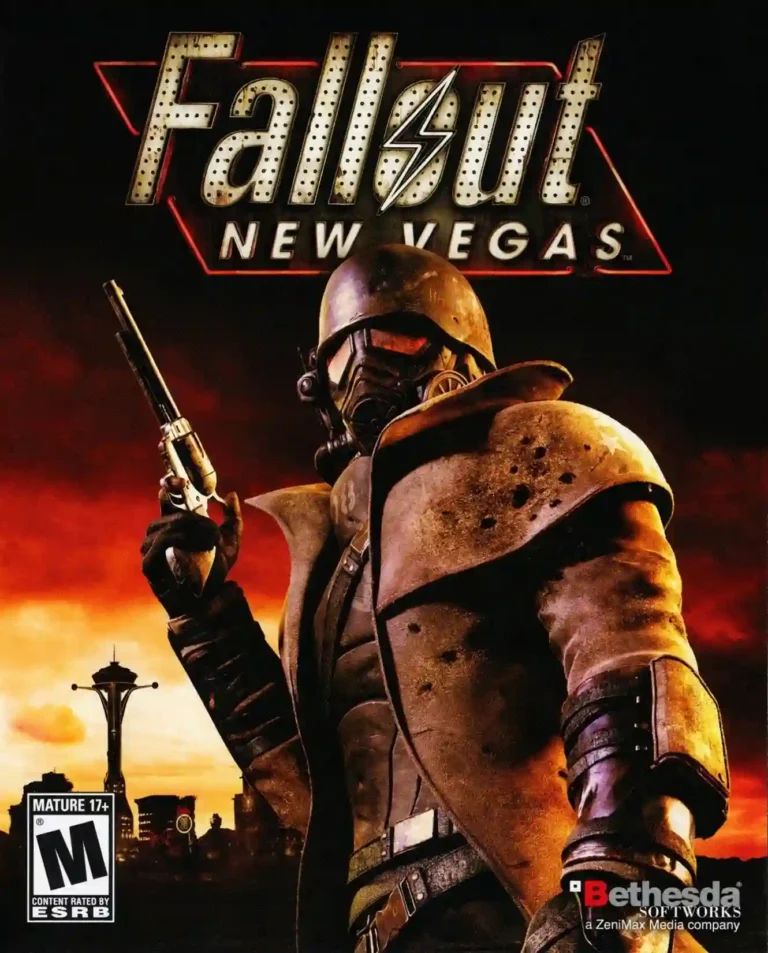
Fallout: New Vegas
 84
★ /10
84
★ /10
 PC
PC PS 3
PS 3 1C-SoftClub
 Bethesda Softworks


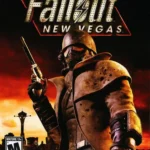
Fallout: New Vegas is a 2010 action role-playing game developed by Obsidian Entertainment and published by Bethesda Softworks. Released for PC, PlayStation 3, and Xbox 360 on October 19, 2010, it was built on the Gamebryo engine — the same technology used in Fallout 3 (2008) — and developed in approximately eighteen months by a studio whose founding members included veterans of the original Black Isle Fallout games.
It holds a Metacritic score of 84 on PC and Xbox 360. It is widely considered the finest game in the modern Fallout series. The gap between those two facts is where most of the interesting conversation about New Vegas happens.
Technical Specifications
| Attribute | Details |
|---|---|
| Developer | Obsidian Entertainment |
| Publisher | Bethesda Softworks |
| Director | Josh Sawyer |
| Lead Writer | John Gonzalez (with Chris Avellone) |
| Composer | Inon Zur |
| Engine | Gamebryo |
| Platform(s) | PC · PlayStation 3 · Xbox 360 |
| Release Date | October 19, 2010 (NA) |
| Genre | Action RPG, Open world |
| Mode | Single-player |
The Mojave Wasteland
New Vegas is set in the Mojave Desert in 2281 — 204 years after the nuclear war, and four years after the events of Fallout 3. The Nevada wasteland survived the Great War better than most of the American east coast: the bombs were intercepted or deflected, the city of Las Vegas remained largely intact, and the infrastructure around Hoover Dam — which provides electricity and controlled access to the Colorado River — has made the region a geopolitical prize. The game’s geography runs from the small frontier town of Primm in the south through the Mojave Wasteland to the outskirts of New Vegas and the Strip, with the Nevada desert stretching east to the Utah border and the Colorado River.
The setting is drier in tone than Fallout 3‘s bombed-out Washington D.C., and more directly engaged with the question of governance: who controls the Mojave, what kind of society they would build, and at what cost.
The Courier and the Platinum Chip
The player character is the Courier, a delivery person shot in the head at the beginning of the game and left for dead in a grave near Goodsprings, Nevada. They are revived by a town doctor and a Securitron robot named Victor. The delivery they were carrying — a platinum chip of uncertain purpose — was taken by the man who shot them: Benny, a sharp-dressed casino owner with ambitions exceeding his loyalty.
Pursuing Benny takes the Courier into New Vegas and the orbit of its controlling power: Mr. House, a pre-war industrialist who anticipated the nuclear war, used his own rockets to intercept the worst of the missiles aimed at Nevada, and has been running New Vegas as an independent city-state from inside the Lucky 38 casino for two centuries, sustained by life support technology and served by an army of Securitron robots. The platinum chip turns out to be the key that upgrades that army. Who gets the chip determines who gets New Vegas.
Four Factions, Four Endings
The game’s central choice — and the reason New Vegas is still discussed with a depth most modern RPGs don’t generate — is which faction the Courier supports in the coming battle for Hoover Dam. Each represents a coherent ideological position, each has genuine strengths and weaknesses the game takes seriously, and each produces a distinct ending:
The New California Republic is a democratic republic expanding east from California, now overextended, bureaucratically sclerotic, and struggling to supply its troops in the Mojave. Its individual members are often decent people serving an institution that has grown too large and too corrupt to function well. The NCR ending is the most “conventional” — order restored, governance returning — with an honest acknowledgment that much of what the NCR does is extract and deplete.
Caesar’s Legion is a totalitarian slave empire modelled on classical Rome, led by Edward Sallow, a former Mormon missionary who became a warlord, renamed himself Caesar, and has been systematically conquering tribal groups across the Southwest. Brutal, efficient, and contemptuous of the weak. Its ending is the most visibly ugly for the wasteland and the most internally consistent in its logic.
Mr. House offers a third option: an independent New Vegas, controlled by a pre-war genius who argues that neither the NCR’s democracy nor the Legion’s order can produce what the wasteland actually needs, which is rapid technological recovery driven by a single competent intelligence — his own. His ending is the most honest in its power dynamics and the most unsettling in its implications.
Yes Man enables the Courier to take New Vegas for themselves, deploying Mr. House’s infrastructure under their own direction. The ending’s ambivalence is deliberate: a single person’s benevolence or self-interest will determine what the Mojave becomes, with no checks except the Courier’s own values.
The game does not indicate which is correct. The writing makes a genuine case for all four. Communities have been arguing about the optimal choice for fifteen years.
The Writing: Companions and Quests
New Vegas is built with an Obsidian writing team whose prior work included Fallout 2, Planescape: Torment, Knights of the Old Republic II, Neverwinter Nights 2, and Alpha Protocol. The companion roster and side quest design reflect this pedigree:
Arcade Gannon is a doctor and closeted member of a secret enclave, whose personal quest involves confronting inherited guilt over his organisation’s crimes. He is openly gay, treated with the same characterisation care as any other companion, and was widely noted at release as a rare example of non-stereotypical LGBTQ+ representation in a mainstream game.
Veronica Santangelo is a Brotherhood of Steel scribe with a personal quest about what it means to stay loyal to an institution that has abandoned its reason to exist. She references a past relationship with a woman without the game making it the defining fact about her.
Boone, Cass, Raul, Lily, and the other companions each carry personal histories and quests that reward engagement and have no obvious analogue in Bethesda-developed Fallout entries.
The side quest writing operates at the same level: the Powder Gangers, the Jacobstown super mutant refugee community, the Followers of the Apocalypse’s dilemmas about medicine and complicity, the individual towns and their specific resource problems — each is written as a coherent small society with its own internal logic rather than a backdrop for shooting.
The Four DLCs
The four expansion packs are considered among the best RPG DLC packages released in the past two decades:
Dead Money strips the Courier of all equipment and drops them into the Sierra Madre, a casino constructed before the war and never opened, now sealed inside a toxic cloud with holographic security guards that cannot be destroyed. It is a survival horror survival challenge, frequently cited for its difficulty and defended for its exceptional writing about addiction and obsession.
Honest Hearts takes the Courier into Zion Canyon, where tribal groups are caught between a Legion incursion and a messianic figure called the Burned Man. It is the shortest of the four and the most atmospheric, with a distinct visual palette and a character — Joshua Graham, the Burned Man — who became one of the most discussed characters in the franchise.
Old World Blues sends the Courier to Big Mountain, a pre-war think tank whose scientists had their brains replaced with computers and have continued conducting experiments without oversight for two centuries. It is the comedic DLC — absurdist in setup, sharp in execution, and containing some of the best incidental dialogue in the game.
Lonesome Road provides the personal backstory that the main game declines to give the Courier, involving a figure named Ulysses who has been tracking the Courier’s history and wants a confrontation at the end of the world. It is the thematically heaviest of the four and the most directly connected to the main game’s plot threads.
Eighteen Months
Bethesda contracted Obsidian to develop New Vegas in approximately eighteen months — a timeline confirmed by Chris Avellone in a 2017 interview. Fallout 3 had taken several years; New Vegas needed to ship for holiday 2010, and that left eighteen months from contract signing to gold master.
The game shipped with a volume of bugs that compromised the experience enough to affect review scores. Quest triggers broke. Companions fell through geometry. Critical narrative sequences were interrupted by engine errors. A patch cycle improved stability significantly, but the launch state was the product of insufficient QA time rather than insufficient design — the structure beneath the instability was more coherent and more ambitious than Fallout 3‘s, and the game’s subsequent reputation reflects the structure rather than the bugs.
Modders produced community patches that fixed several hundred additional bugs beyond Bethesda’s official patch support, and PCGamingWiki’s New Vegas entry documents the recommended technical configuration for a stable 2026 playthrough.
One Metacritic Point
In March 2012, following a round of layoffs at Obsidian after the cancellation of an unannounced project, Chris Avellone disclosed the contract terms under which New Vegas had been developed: “FNV was a straight payment, no royalties, only a bonus if we got an 85+ on Metacritic, which we didn’t.”
The game scored 84 on PC and Xbox 360, and 82 on PS3. Obsidian missed the bonus threshold by a single point. The game had generated $300 million in revenue within its first month of release and shipped five million copies. Bethesda declined to comment.
The disclosure became one of the most-cited examples in the industry’s ongoing discussion about Metacritic score-tied compensation — specifically, what it means to make contractual development bonuses contingent on aggregate scores from a fixed group of reviewers, and who bears the risk when that number comes in at 84 rather than 85.
Mods, the Fan Remake, and the TV Show
New Vegas on PC has an exceptionally active modding community. The Things to Know block for this game includes a GameSpot article specifically about the best mods, reflecting how central modding is to the current experience. The Yukichigai Unofficial Patch (YUP) addresses bugs the official patches left; Tale of Two Wastelands merges Fallout 3 and New Vegas into a single playable experience using the latter’s engine.
Fallout 4: New Vegas is a fan-made total conversion project rebuilding the game inside Fallout 4‘s Creation Engine. In development since 2017, with no release date announced as of mid-2026, it is one of the most ambitious fan projects in the medium and its YouTube channel draws traffic from people searching for the original game — a sign of sustained anticipation.
The Amazon Prime Video Fallout series returned interest to the game when its second season was announced as being set in New Vegas. The Bethesda gear store’s 15th anniversary bundle product drawing nearly 5,000 monthly organic visitors reflects the renewed commercial activity around the game in late 2025.
Reception and Legacy
Fallout: New Vegas holds a Metacritic score of 84 and is discussed as the best modern Fallout game by most of the people who make lists of the best modern Fallout games. The gap is real and attributable: the buggy launch, the 82 on PS3 (the platform with the most reviewers), and the direct comparison to Fallout 3 — which launched two years earlier with more QA time — produced a critical consensus that did not capture what the game was in its finished, patched state.
Josh Sawyer has described the design philosophy of New Vegas as “the Courier serves the world, not the world serves the Courier” — meaning the factions and communities exist with their own priorities and the player’s power comes from choosing which of those to support, not from being the inevitable saviour. That philosophy is what distinguishes New Vegas from the Bethesda model and why the debate about which ending is correct has not resolved in fifteen years.
Wikipedia draws nearly 30,000 monthly organic visitors to the New Vegas page — the highest for any game in the Fallout franchise and higher than several newer entries. The r/fnv subreddit draws nearly 9,000 monthly visitors from search alone. The game released in 2010. The conversation has not ended.