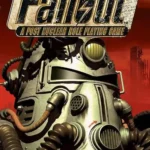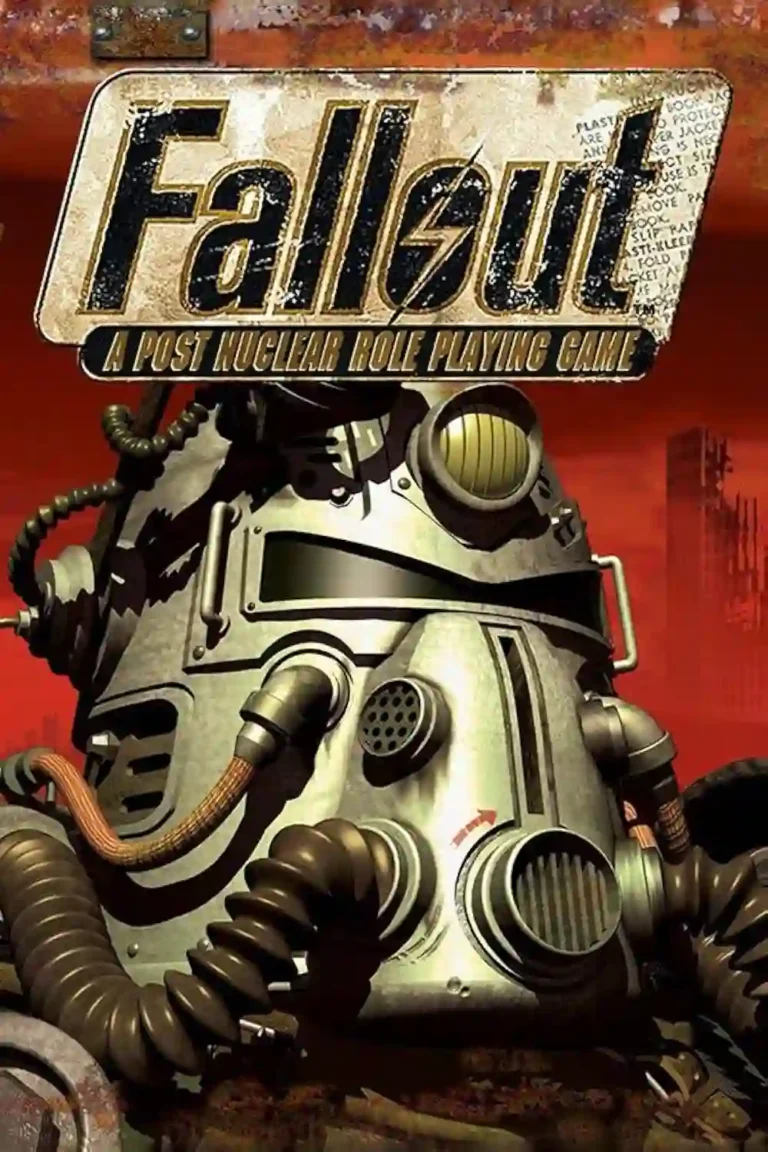
Fallout: A Post Nuclear Role Playing Game
 89
★ /10
89
★ /10
 PC
PC
 1C-SoftClub,
  Bethesda Softworks,
  Interplay Entertainment



Fallout: A Post Nuclear Role Playing Game is a 1997 role-playing game developed and published by Interplay Productions. Released on September 30, 1997, it is the first entry in the Fallout franchise, created by Tim Cain and Leonard Boyarsky at Interplay, and the game whose opening narration gave the series its defining statement: “War. War never changes.”
That line — written by Tim Cain, his only writing credit on the first game — is quoted in every subsequent mainline entry. The rest of the game shares its directness.
Note: Searching “Fallout 1” may surface results for Fallout 1st — Bethesda’s $12.99/month subscription service for Fallout 76. These are unrelated. This page covers the 1997 game.
Technical Specifications
| Attribute | Details |
|---|---|
| Developer | Interplay Productions |
| Publisher | Interplay Productions |
| Producer | Tim Cain |
| Lead Designer | Christopher Taylor |
| Artists | Leonard Boyarsky · Jason D. Anderson |
| Composer | Mark Morgan |
| Engine | Fallout engine (proprietary) |
| Platform(s) | MS-DOS · Windows · Mac OS |
| Release Date | September 30, 1997 (NA) |
| Current Availability | Steam · GOG · Epic Games Store · Xbox |
| Genre | CRPG, Turn-based RPG |
| Mode | Single-player |
Vault 13 and the Vault Dweller
The game is set in Southern California in 2161 — 84 years after a nuclear exchange between the United States and China obliterated most of the surface world on October 23, 2077. The player character is the Vault Dweller, a resident of Vault 13, one of a network of underground shelters built by the Vault-Tec corporation to house a fraction of the American population. The vault’s water chip — the component that controls the water purification system — has broken. Without a replacement, the vault has approximately 150 days of water remaining.
The Overseer sends the Vault Dweller to the surface to find a replacement. It is the Vault Dweller’s first time outside.
The Water Chip — and What They Actually Find
The water chip quest is the game’s inciting event and its first structural layer, but the more significant discovery comes once the Vault Dweller begins moving through the post-war California landscape. The Wasteland is not simply lawless — it is under threat. Super mutants, created through exposure to a mutagenic retrovirus called FEV (Forced Evolutionary Virus), are attacking settlements, capturing humans, and dragging them into facilities for transformation. Their numbers are growing. Their organisation implies a command structure.
That command structure has a name: The Master. Born as a scientist named Richard Moreau, he fell into a vat of FEV and survived — partially merged with the computer he landed in, psychically gifted in ways the virus cannot explain, and committed to a vision of human evolution that involves replacing humanity with super mutants. He believes the next step of human development is forced. He runs his operation from a facility called the Cathedral.
The game has two objectives, then: find the water chip, and stop the Master’s army before it overwhelms the surface. The Vault Dweller did not know about the second one when they left.
The 150-Day Timer
The 150-day in-game clock is the mechanic that most determines a new player’s experience of Fallout. It counts down from the moment the Vault Dweller surfaces, and if it reaches zero, Vault 13’s water supply fails and the game ends in defeat. The timer is mentioned in the briefing but not surfaced during play — there is no permanent visible countdown in the HUD.
For players who proceed directly toward the main quest with moderate side exploration, 150 days is generally sufficient. For players who explore extensively, experiment with the world, or become lost in optional content, it is not. Community guides recommend tracking the current day through the character screen and being aware of approximately where 75 days falls in the main quest progression. Several of the most detailed posts about the game in current search are specifically about the timer — including one of the AI Overview sources for this query.
The timer was controversial at the time and has been reassessed since as a design choice with genuine narrative purpose: the vault will die if the player wastes time, and that urgency is the correct emotional frame for a mission the Vault Dweller was sent on because there was no one else.
The Master
The Master is the game’s primary antagonist and one of the more philosophically interesting villains in the franchise’s history. He does not want to rule the surface world or accumulate power for its own sake. He has a theory: humanity’s post-war chaos is unsustainable, and only a species-level transformation — replacing homo sapiens with something hardier, more unified — can produce a stable civilisation. Super mutants are his answer. He is patient, intelligent, and genuinely believes this is correct.
The most celebrated optional resolution in the game involves confronting the Master not in combat but in conversation — specifically, presenting him with scientific evidence that all super mutants are sterile. His plan is self-defeating: the species he intends to propagate cannot reproduce. When the Vault Dweller demonstrates this with sufficient Intelligence stat and relevant knowledge, the Master recognises the logical consequence of his own work, declares his cause lost, and destroys himself.
The option to win by being right about biology instead of being strong enough to shoot the boss was not common in 1997. It remains uncommon.
SPECIAL: A Last-Minute Invention
Fallout was designed from 1994 to early 1997 using the GURPS (Generic Universal Roleplaying System) ruleset, licensed from Steve Jackson Games. The entire attribute and skill architecture was built around GURPS. In early 1997 — months before the game was scheduled to ship — Steve Jackson Games revoked the license, citing the game’s extreme violence as incompatible with what they wanted their brand associated with.
The development team, under Tim Cain, created a new system. The result was SPECIAL: Strength, Perception, Endurance, Charisma, Intelligence, Agility, Luck. Seven attributes, a complementary skill system built around them, and a perk system that offered specific character-building choices at level-up. The system was developed quickly and under pressure, and it became the foundation of every Fallout game for the next three decades — carried forward through Fallout 2, Tactics, Fallout 3, New Vegas, Fallout 4, and Fallout 76. Tim Cain, on his YouTube channel (launched 2023), recently shared the original GURPS attribute list that the team had been using — the system that would have been Fallout before the licence fell through.
Dogmeat
In a junkyard east of the Hub, a dog is found beside the body of its dead owner. If the Vault Dweller is wearing a leather jacket, the dog recognises a resemblance to the owner and can be recruited as a companion. The dog has no name in dialogue; the fandom named him Dogmeat, after the Mad Max 2 dog (Fallout’s designers were heavily influenced by the Australian post-apocalyptic film series). He can die in combat and does not respawn. He has no quest, no backstory, and no dialogue. He follows the player and bites enemies.
Dogmeat appears in Fallout 2 (a different dog), Fallout 3 (where he is recruitable from Scrapyard as a puppy), and Fallout 4 (where he is the player’s most prominent companion and cannot be permanently killed). Each version is technically a different dog with the same name; the community treats them as a continuous entity.
Where the Team Went
After shipping Fallout, the core creative team scattered in ways that continued to shape RPG development:
Tim Cain, Leonard Boyarsky, and Jason D. Anderson left Interplay to found Troika Games in 1998, which produced Arcanum: Of Steamworks and Magick Obscura (2001) and The Temple of Elemental Evil (2003) before closing. Boyarsky later joined Blizzard, where he and Cain directed Diablo III.
The remaining team formed the core of Black Isle Studios, which shipped Fallout 2 (1998) — in roughly one third of the development time of the original, a feat Tim Cain has described as “enormously impressive” — and later Planescape: Torment, Icewind Dale, and Baldur’s Gate (as publisher/distributor), before closing in 2003.
GamesRadar’s oral history of the franchise (published December 2025) notes that Fallout “was always seen as a B project” at Interplay — not the company’s flagship, not the guaranteed success. Its trajectory from internal B-tier assignment to the foundation of a franchise now generating billions of dollars is one of the more striking reversals in the industry’s commercial history.
Is Fallout Worth Playing in 2026?
The AI Overview for this query draws primarily from newcomer tip threads and patient gamer retrospectives — both from players arriving at the original Fallout after exposure to the franchise through Fallout 4, New Vegas, or the Amazon Prime Video Fallout television series. The consistent community answer: yes, with specific expectations managed.
The game is an isometric turn-based RPG with a 1997 interface. Its presentation requires adjustment from players whose primary reference point is Fallout 3 or 4. The 150-day timer creates genuine urgency. The first hour is the steepest part of the learning curve; the Vault 13 tutorial segments and the early Hub navigation are where new players most frequently stall.
What holds up without qualification: the writing, the tonal range, the SPECIAL system’s flexibility, the Master’s optional resolution, and the feeling that every character choice has been taken seriously by the people who wrote the dialogue for every character choice. Tim Cain has noted in recent YouTube discussions that the team wanted players to be able to play as someone with very low Intelligence — and so they wrote unique, limited dialogue for every conversation a character with very low Intelligence could have in the entire game. That is the level of commitment the original Fallout brought to role-playing as a design principle.
Where to Find It
The GOG version is the most stable on modern Windows systems and is available without DRM. Steam’s version is also functional. The game is also available on Xbox. A community-produced fan patch (the Fallout 1.2 Unofficial Patch) is recommended for most playthroughs to address remaining bugs from the original release.
Reception
Contemporary reviews were highly positive: Computer Gaming World, GameSpot, and PC Gamer all placed it among the best PC games of 1997. The game sold approximately 600,000 copies in its initial commercial period — enough to validate a sequel but not the numbers Interplay had hoped for, contributing to the “B project” assessment that persisted at the company level.
Its reputation in the twenty-eight years since has expanded considerably, driven by the cumulative effect of a franchise that has returned to its original premises repeatedly and by a community that distinguishes between what Bethesda made Fallout into and what it began as. For players interested in that distinction, the original game is still where it started.
Fallout news
More news
Xbox CEO Says 'We Will Not Survive' Without New IPs

Xbox CEO Asha Sharma Says the Brand Is "Not for Sale"
Starfield Dev: The Game Needed Far More People to Match Its Vision

Steam Gross Revenue Tops $15 Billion in First Eight Months of 2026