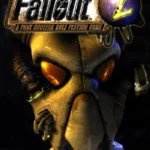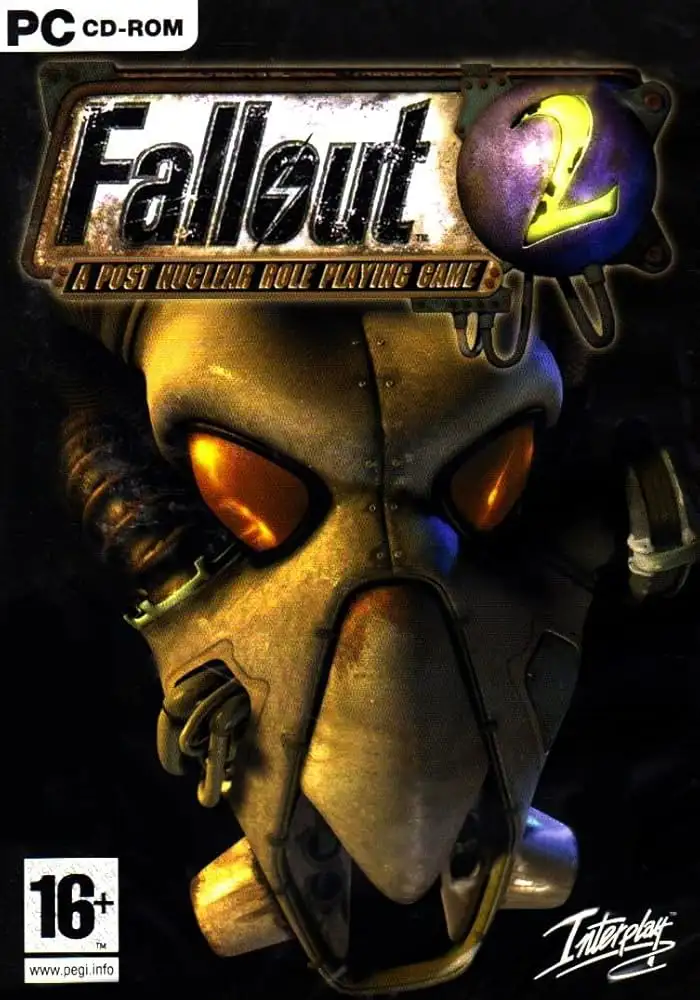
Fallout 2: A Post Nuclear Role Playing Game
 86
★ /10
86
★ /10
 PC
PC
 1C-SoftClub,
  Interplay Entertainment



Fallout 2: A Post Nuclear Role Playing Game is a 1998 role-playing game developed by Black Isle Studios and published by Interplay Entertainment. Released for PC on October 29, 1998 — the same year as Baldur’s Gate, Metal Gear Solid, and The Legend of Zelda: Ocarina of Time — it is the direct sequel to Fallout (1997) and the largest game Black Isle shipped before the studio’s collapse in 2003.
It was lead designed by Chris Avellone, who went on to write Planescape: Torment, Knights of the Old Republic II, and Fallout: New Vegas. It features same-sex marriage, graphic drug addiction, human trafficking, and a city built entirely around organised crime. It is available on Steam, GOG, and Epic. One of the People Also Ask results for this game is “What happens after you hit the 13 years time limit?”
Technical Specifications
| Attribute | Details |
|---|---|
| Developer | Black Isle Studios |
| Publisher | Interplay Entertainment |
| Director | Feargus Urquhart |
| Lead Designer | Chris Avellone |
| Composer | Mark Morgan |
| Engine | Fallout engine (revised from Fallout 1) |
| Platform(s) | MS-DOS · Windows |
| Release Date | October 29, 1998 (NA) |
| Current Availability | Steam · GOG · Epic Games Store · Xbox |
| Genre | CRPG, Turn-based RPG |
| Mode | Single-player |
Arroyo and the Chosen One
Fallout 2 takes place in 2241 — eighty years after the first game — in the tribal village of Arroyo, founded by the descendants of the Vault Dweller whose story ended Fallout. The village is dying. The drought has failed the crops, the water purifier has broken down, and the village Elder tells the player character — the Chosen One, the Vault Dweller’s grandchild — that only a G.E.C.K. (Garden of Eden Creation Kit, a terraforming device intended to allow vault dwellers to rapidly restart civilisation) can save the village.
The Chosen One is sent into the wasteland to find it.
What follows is the largest isometric RPG of its generation, covering Northern California in its post-nuclear incarnation: desert towns, ruined cities, tribal communities, corporate vault enclaves, Chinese-descended survivors, and the scattered remnants of the pre-war United States government — the Enclave — operating from an offshore oil rig with plans for the wasteland that the player eventually confronts.
The Timer: 13 Years
The game places a real-time limit on the main quest. If the Chosen One does not find the G.E.C.K. within 13 years of game time, Arroyo is destroyed by the Enclave and an ending is triggered that reflects this failure. The timer is one of the game’s least-prominent mechanics — it is mentioned in the opening briefing but not actively surfaced during play — and many new players discover it by accident, either finding the village destroyed mid-game or reading about it in a PAA result after finishing.
The 13-year limit is generous enough that players who are not significantly distracted by side content will complete the main quest well within it. Players who spend extensive time on optional quests, companions, and exploration — which Fallout 2 provides in enormous volume — may approach or exceed it without anticipating the consequence. Community guides consistently recommend noting the timer and checking progress around the five-year mark if engaging deeply with the game’s optional content.
What Fallout 2 Added
The original Fallout was constructed under severe time pressure; Fallout 2 had more development time and a larger team, and the difference is apparent in the volume and density of content. The sequel contains more locations, more quests, more companion options, and substantially more optional content than the original — to the point where completing every major quest in a single playthrough requires careful planning, since some factions and outcomes are mutually exclusive.
Several mechanical additions distinguish the game from its predecessor:
Vehicles: The Chosen One can locate and repair an Highwayman, a pre-war car, and use it to fast-travel across the world map with fuel. Finding and maintaining the car is an optional but substantial investment.
Marriage: The Chosen One can marry various NPCs in the game, with relationship mechanics that play out differently depending on the character’s gender and skills. Fallout 2 allowed same-sex marriage in 1998 — quietly, without announcement, as a natural consequence of writing optional romance into the game without restricting it by character gender.
Companion depth: Companions in Fallout 2 have more personality and more reactive dialogue than those in the first game. John Cassidy — a gruff older man with a heart condition who joins the player in Vault City — is the father of Rose of Sharon Cassidy, who appears in Fallout: New Vegas more than a decade later.
The Locations
Fallout 2‘s world map covers a region of Northern California and Oregon, with each major settlement representing a distinct post-nuclear social model:
The Den is a lawless town built on drug addiction and human trafficking — the first major settlement most players reach, and the one that establishes the game’s tonal range. It contains children who can pickpocket the player, a slaver operation, and an almost total absence of functional governance.
New Reno is the game’s most expansive single location: a post-nuclear Las Vegas operating under the control of four crime families (the Bishops, the Mordinos, the Salvatores, and the Wrights) who compete for control of the city’s drug trade, prostitution, boxing, and political influence. The player can work for any of them, play them against each other, or pursue a career in the city’s underground boxing circuit. Myron, a teenager who synthesized Jet (the wasteland’s primary stimulant, directly referenced in later games), can be recruited here.
Vault City is a closed community of vault descendants who have retained pre-war technology and consider themselves superior to the surrounding wasteland population, enforcing strict citizenship requirements and maintaining slaves indirectly through contractor relationships. Its internal politics and the player’s options for influencing or destabilising it represent some of the game’s most coherent political writing.
Broken Hills is a small mining settlement where humans and super mutants coexist under a fragile agreement, used by the game to explore what post-war coexistence looks like when both parties have grudging economic incentives to make it work.
San Francisco contains the Shi — descendants of a Chinese submarine crew who have built an insular, technology-focused community — and Navarro, a hidden Enclave base that provides access to advanced equipment and serves as the game’s primary intelligence-gathering location before the final confrontation.
The Dark Humour and Adult Content
Fallout 2 is the franchise entry most frequently cited for its tonal range, which extends from genuinely dark content to deliberately absurdist comedy to references that the developers inserted with minimal filter. The game includes:
A talking deathclaw community in Broken Hills who have developed intelligence through mutation and are attempting to assimilate into wasteland society. Their questline is played straight rather than for comedy.
A Corsair holodisk in one location that contains an early use of the phrase “Let’s go, baby!” in a context that is irrelevant to anything else in the game, inserted by a developer as a personal reference.
A companion option involving a robot, a ghoul, and a party member who can be equipped in a specific outfit and gain unique combat bonuses from it that are not explained in any in-game documentation and must be discovered by experimentation.
The Cat’s Paw magazine, a recurring prop-item, which is an in-universe adult publication used as a skill book for one specific skill. Its presence in the game is consistent and unremarked-upon.
The game’s dialogue options contain some of the franchise’s most extreme choices — including options to be actively complicit in slavery, to take Jet dependency that degrades the character’s health over time, and to pursue endings that are not simply “bad” but represent specific varieties of moral failure.
The Restoration Project
The Fallout 2 Restoration Project (RP), also known as the Unofficial Fallout 2 Patch (in more recent versions), is a community-produced modification that restores content cut from the shipped game, fixes hundreds of bugs, and integrates additional quests and dialogue that existed in the game’s data but were never activated. It is widely considered essential for first-time players and has been the recommended configuration for PC playthroughs for over a decade.
The GOG version of Fallout 2 is the most technically stable current purchase, running on modern Windows systems with minimal configuration. The Steam version requires slightly more setup. Archive.org hosts the original game files for those who want to access it directly. For any of these, the Restoration Project is the recommended first installation step.
Is Fallout 2 Worth Playing in 2026?
The Reddit discussion “Is Fallout 2 worth getting into?” and the GameRant article “Fallout 2 Worth Playing 2025” — both visible in the current search results — reflect a consistent wave of new players arriving from the Fallout television series and working backward through the franchise.
The honest assessment the community offers: Fallout 2 is a more demanding game than either Fallout 3 or New Vegas, requires engagement with a genre that has been largely displaced in the mainstream by the action-RPG format, and has dated mechanics including random encounter frequency and turn-based combat that modern players may find unfamiliar. It is also significantly larger, more richly written, and more willing to engage with difficult material than either of those successors.
The Fallout TV show drew players toward Fallout 3 and Fallout 4 by proximity to their tone and setting. Fallout 2 is for players who found those and wanted to understand where the writing tradition came from — why New Vegas is the way it is, who wrote it, and what they were building on. The answer is largely here.
Reception
Fallout 2 received highly positive contemporary reviews — GameSpot gave it 9.0/10, PC Gamer 94/100, and several other publications placed it among the best RPGs of 1998. Formal Metacritic aggregation for 1998 PC games is incomplete, as the service launched in 2001 and retrospective collection is partial. The game shipped with a notable number of bugs, many of which the community has since patched, and was criticised at the time for its uneven tone and some rushed late-game areas — both attributable to development timeline constraints.
Its reputation in the two decades since has grown rather than diminished, and it holds a particular position among Chris Avellone’s early work: the game that demonstrated what the combination of mechanical depth, tonal fearlessness, and political engagement could do in the RPG format, before he carried those principles into Planescape: Torment and the games that followed.
Fallout news
More news
Xbox CEO Says 'We Will Not Survive' Without New IPs

Xbox CEO Asha Sharma Says the Brand Is "Not for Sale"
Starfield Dev: The Game Needed Far More People to Match Its Vision

Steam Gross Revenue Tops $15 Billion in First Eight Months of 2026