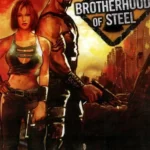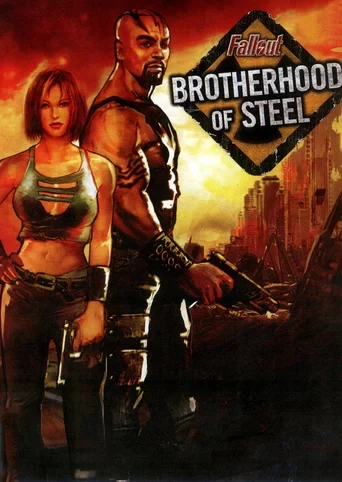
Fallout: Brotherhood of Steel
 66
★ /10
66
★ /10
 PS 2
PS 2 Xbox
Xbox Interplay Entertainment
Fallout: Brotherhood of Steel is a 2004 action role-playing game developed and published by Interplay Entertainment for PlayStation 2 and Xbox. Released on January 13, 2004, it was the first Fallout game released on home video game consoles — and the last Fallout game Interplay released before selling the franchise rights to Bethesda Softworks. Bethesda has since declared the game non-canonical.
It received Metacritic scores of 59 on PS2 and 64 on Xbox. Its soundtrack features metalcore music composed in part by progressive metal musician Devin Townsend. Nuka-Cola does not appear in the game; it is replaced by product-placement energy drink Bawls Guarana. A text string in the game’s files, discoverable by extracting the PS2 executable, reads “OUT OF FUCKING MEMORY.”
Technical Specifications
| Attribute | Details |
|---|---|
| Developer | Interplay Entertainment |
| Publisher | Interplay Entertainment |
| Producer | Chuck Cuevas |
| Designer | Chris Pasetto |
| Composers | Craig Stewart Garfinkle · Devin Townsend |
| Platform(s) | PlayStation 2 · Xbox |
| Release Date | NA: January 13, 2004 · EU: April 2, 2004 |
| Genre | Action RPG, Hack-and-slash |
| Mode(s) | Single-player · 2-player local co-op |
| Availability | Physical only (PS2/Xbox) · No digital re-release |
Carbon, Texas: Setting and Story
The game takes place in 2208, in the Texas wasteland — specifically in Carbon and Los, two settlements of no great importance to anyone, and a Vault-Tec Corporate Vault that serves as the third act location. The year 2208 places the story after Fallout (2161) and Fallout 2 (2241), in a region the mainline games never visit.
The player character is a Brotherhood of Steel Initiate, dispatched to Carbon to find several Brotherhood Paladins who have gone missing in the area. In Carbon, they find the town under increasing pressure from raiders, discover that the Mayor has been selling the city’s residents out, and work their way through the local crisis and into the wider conflict behind it. The story progresses through Linear zones rather than an open world — the three locations (Carbon, Los, the Vault) are accessed in sequence with no backtracking.
A notable cameo: the Vault Dweller from Fallout 1 appears in the game, having apparently wandered from California to Texas in the intervening decades. Rhombus, a Brotherhood Elder from the first game, also appears. Neither appearance is treated with the weight the characters hold in the mainline games, and both have been treated by the community as evidence of the game’s unsystematic approach to the franchise’s continuity.
Three Initiates
Players choose one of three Brotherhood of Steel Initiates at the start of the game:
Cain is a ghoul — a mutated human who has survived the nuclear war’s radiation effects at the cost of his appearance, with accelerated aging and the general social position of “not trusted by most people.” He is the most experienced of the three and the one with the most backstory in the game’s minimal characterisation.
Cyrus is a human soldier, straightforward in design and function, representing the closest thing to a conventional action game protagonist among the three options.
Nadia is a woman with speed and agility as her comparative advantages, oriented toward faster, lighter combat approaches than Cyrus’s raw combat focus.
Each character levels up through combat and can develop skills and perks in a lightweight version of the Fallout SPECIAL framework.
What Kind of Game It Is
Fallout: Brotherhood of Steel is not a role-playing game in any meaningful sense of the term. It is a hack-and-slash action game in the structure of Baldur’s Gate: Dark Alliance (2001) — which was itself built for the same console audience — with Fallout aesthetics applied to corridors of enemies to be shot with increasingly powerful weapons found along the way. GameSpot’s 2004 review described it accurately as a game that “could easily be described as a hack-and-slash action game were it not for the fact that you’ll use shotguns and laser rifles instead of swords and axes.”
There is no open world. There are no meaningful dialogue choices. There is no speech skill. Character progression exists in a simplified form. The gameplay loop is: enter area, clear enemies, advance, repeat. Two players can do this simultaneously in split-screen co-op, which is the most commonly cited positive aspect of the game in retrospective discussion — it is a reasonable way to spend a few hours if both players have low expectations and access to a couch.
The Soundtrack and Bawls Guarana
The decision to score Fallout: Brotherhood of Steel with metalcore and heavy metal rather than 1940s and 1950s pop songs was the game’s most visible tonal departure from the franchise. The mainline Fallout games build their atmosphere around the dissonance between cheerful pre-war Americana music and the nuclear devastation it plays over. The 2004 game replaces this with aggressive modern metal composed partly by Devin Townsend, a Canadian musician known for progressive metal and bands including Strapping Young Lad. The music is competent as metal; it has nothing to do with what Fallout sounds like.
The Bawls Guarana product placement — an energy drink brand inserting itself into the post-nuclear wasteland in place of the franchise’s iconic Nuka-Cola — was noted in multiple reviews as one of the game’s more inexplicable decisions. GameSpot’s review specifically called out “excessive product placement for a certain caffeinated soda.” Nuka-Cola does not appear anywhere in the game.
Non-Canon Status
Fallout: Brotherhood of Steel was confirmed as non-canonical by Bethesda Softworks after they acquired the franchise. Todd Howard stated that the events of the game are not considered to have occurred in the continuity of Fallout 3. An Interplay employee had previously noted, prior to the acquisition, that the game was not intended as a canonical continuation of the original games even at the time of its development.
The franchise’s community has universally accepted this position. The game is not referenced in any subsequent Fallout title, and no character, location, or event from it has been carried forward into the canonical timeline.
Interplay’s Last Fallout
Fallout: Brotherhood of Steel was produced during Interplay Entertainment’s severe financial decline. The game was resource-constrained, developed under commercial pressure, and shipped in a state that its review scores reflect. Interplay sold the Fallout franchise rights to Bethesda Softworks in 2007, making this the last Fallout title produced under the original publisher’s ownership — the final entry in a run that began with the first game in 1997.
The context of Interplay’s collapse is visible in the product: recycled assets from earlier games used as texture maps, the Bawls Guarana placement (a revenue consideration), the absence of the careful world-building that distinguished the franchise, and the fundamental mismatch between the game and what the franchise’s audience expected of a Fallout release.
The Cancelled Sequel
Fallout: Brotherhood of Steel 2 was in development before being cancelled — a consequence of the first game’s poor commercial performance and Interplay’s inability to fund further development. What is known of the sequel suggests it would have continued the Texas setting and expanded the story begun in the first game. It was never completed or released.
Availability and Reception
The game is not available digitally. Physical copies for PS2 and Xbox are available through Amazon, eBay, and retro gaming retailers, typically at low prices consistent with a game that sold modestly in 2004 and has not attracted collecting premiums. There is no announced re-release or remaster.
User scores on Metacritic are 2.8 on PS2 and 5.1 on Xbox — lower than the already-low critical scores, reflecting the response of Fallout fans who found the game’s departures from the franchise’s identity difficult to accept at any quality level. The game occupies a specific position in the franchise’s history as an example of what happens when a licence is deployed without the creative framework that gave it value, under commercial conditions that precluded the time needed to build an alternative.