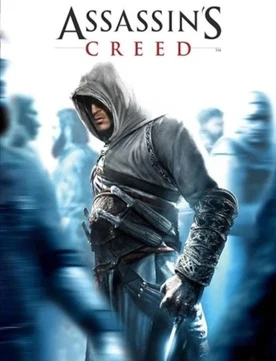
Assassin’s Creed
 81
★ /10
81
★ /10
 PC
PC PS 3
PS 3 Xbox 360
 ak tronic Software & Services GmbH,
  Akella,
  Ubisoft



Assassin’s Creed is a 2007 action-adventure stealth video game developed by Ubisoft Montreal and published by Ubisoft. It is the inaugural title in what would become one of the most successful and prolific franchises in gaming history. The game introduced players to a unique blend of historical fiction, science fiction, and parkour-based traversal, setting the foundation for the open-world formula that would dominate the industry for over a decade.
The narrative utilizes a dual-timeline structure. In the modern day (2012), a bartender named Desmond Miles is kidnapped by Abstergo Industries, a shadowy megacorporation. He is forced into a machine called the “Animus,” which decodes and renders the genetic memories of his ancestors. Through the Animus, Desmond relives the life of Altaïr Ibn-La’Ahad, a disgraced Master Assassin operating in the Holy Land during the Third Crusade in 1191. Stripped of his rank after a botched mission, Altaïr must assassinate nine prominent figures across the cities of Jerusalem, Acre, and Damascus to redeem himself, uncovering a massive conspiracy involving the Knights Templar and a powerful artifact known as the Piece of Eden.
Gameplay
Assassin’s Creed revolutionized open-world movement with its free-running mechanics, allowing players to scale almost any building in the environment seamlessly. The game emphasized “social stealth”—hiding in plain sight rather than sticking to the shadows.
Key gameplay mechanics include:
- Parkour and Traversal: By holding down the “high profile” button, Altaïr automatically sprints, vaults, and climbs over obstacles and up buildings. This fluidity of movement was highly innovative at the time and culminated in the iconic “Leap of Faith”—diving off towering viewpoints into small carts of hay to instantly hide or descend quickly.
- Social Stealth: Players can blend in with crowds of scholars, sit on benches, or gently push through civilians to avoid drawing the attention of city guards. If detected, the player must break the guards’ line of sight and find a hiding spot.
- The Assassination Loop: The core gameplay loop requires players to enter a city and visit the local Assassin Bureau. From there, Altaïr must complete a series of investigation missions (eavesdropping, pickpocketing, interrogating, or completing tasks for informants) to gather intelligence on his target. Once enough info is gathered, the player executes the assassination and must flee a city-wide alert to return to the Bureau.
- Counter-Based Combat: When forced into open conflict, combat relies heavily on defensive timing. Players lock onto enemies and wait for them to strike, pressing a button at the exact right moment to perform a lethal counter-kill with a sword, dagger, or the iconic, retractable Hidden Blade.
- Eagle Vision: A sixth sense that highlights the environment, color-coding NPCs to show enemies (red), allies (blue), hiding spots (white), and assassination targets (gold).
Development and Legacy
Development of Assassin’s Creed began shortly after the release of Prince of Persia: The Sands of Time (2003). Originally conceptualized by creative director Patrice Désilets as a Prince of Persia spin-off titled Prince of Persia: Assassins, the game featured the player controlling an Assassin tasked with protecting a young prince. Ubisoft executives felt the game strayed too far from the core identity of the Prince of Persia brand, prompting the team to rework it into an entirely new intellectual property centered around the historical Hashashin order.
To handle the ambitious scope of the game—which required rendering massive, historically accurate cities populated by hundreds of independent, AI-driven NPCs—Ubisoft Montreal built a brand new proprietary engine named Scimitar (which would later be renamed the Anvil engine). The development team, famously led in the public eye by producer Jade Raymond, heavily researched the architecture and history of the Third Crusade to ensure the cities felt authentic.
Upon its release in November 2007, Assassin’s Creed was a massive commercial success and a major showcase for the power of the newly released PlayStation 3 and Xbox 360 consoles. Critics praised its groundbreaking parkour, stunning visuals, and intriguing sci-fi/historical narrative. However, the game was also widely criticized for its highly repetitive mission structure and the lack of variety in the investigation phases leading up to the assassinations. Despite these flaws, its success proved the viability of the concept, leading to the widely celebrated 2009 sequel, Assassin’s Creed II, which smoothed out the rough edges and cemented the franchise as an industry juggernaut.
Key Features:
- Revolutionary Parkour — Experience total freedom of movement as you scale the towering domes of Jerusalem, Acre, and Damascus using a fluid, automated climbing system.
- The Hidden Blade — Utilize the signature weapon of the Assassin Brotherhood to execute high-profile targets instantly or eliminate guards quietly from the crowds.
- Historical Tourism — Explore meticulously researched, bustling medieval cities populated by dynamic crowds that react to your actions and behavior.
- Social Stealth — Hide in plain sight by blending with scholars, sitting on benches, and breaking line of sight to evade pursuing guards.
- The Animus Narrative — Uncover a sprawling, centuries-spanning conspiracy that bridges the ancient conflict of the Third Crusade with a modern-day corporate dystopia.
Release Platforms:
- PlayStation 3 — November 13, 2007
- Xbox 360 — November 13, 2007
- Microsoft Windows (PC) as Director’s Cut Edition — April 8, 2008