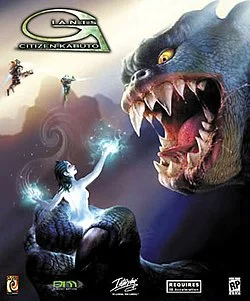
Giants: Citizen Kabuto
 85
★ /10
85
★ /10
 PC
PC PS 2
PS 2 Interplay Entertainment


Giants: Citizen Kabuto is a brilliantly bizarre 2000 action-strategy hybrid developed by Planet Moon Studios and published by Interplay Entertainment.
If you look at the pedigree of the developers—Planet Moon was formed by the original creators of MDK who had just left Shiny Entertainment—the game’s DNA makes perfect sense. Released in the exact same window as Sacrifice, Giants is another wildly experimental, genre-defying masterpiece of the early 2000s. It flawlessly blended third-person shooting, base-building real-time strategy, and sheer kaiju-sized destruction, all wrapped in a deeply cynical, hilarious layer of British Monty Python-esque humor.
Asymmetrical Gameplay: The Three Factions
The absolute brilliance of Giants lies in its campaign structure and multiplayer, which features three entirely distinct factions that play like they belong in completely different video games.
As you progress through the single-player story, you take control of each faction sequentially:
- The Meccaryns (The Meccs): A squad of heavily armed, beer-guzzling, British-accented space marines who crash-land on the planet while en route to a vacation in “Majorca.” Playing as the Meccs is a traditional third-person shooter experience mixed with RTS base-building. You utilize jetpacks to navigate the massive, rolling hills, snipe enemies, and eventually build sprawling fortresses complete with anti-air turrets and barracks.
- The Sea Reapers (Delphi): The native rulers of the planet are tyrannical, magic-wielding aquatic beings. You play as Delphi, the rebellious Sea Reaper princess. Her gameplay completely ditches the guns and jetpacks in favor of high-speed melee combat, bows, and devastating magic. She can cast spells to summon massive tornados, freeze enemies, or instantly teleport across the map.
- Kabuto: The titular giant. Created by the Sea Reapers as a biological weapon, Kabuto broke free and became an uncontrollable force of nature. Playing as Kabuto turns the game into a Godzilla simulator. You have no base and no weapons. You are a massive, lumbering monster that physically crushes buildings underfoot, wrestles enemy monsters, and heals by literally picking up enemy soldiers and eating them alive. Furthermore, you can lay eggs to spawn smaller, AI-controlled Kabuto offspring to swarm your enemies.
The RTS Economy: Smarties and Vimps
While the combat is heavily action-oriented, the economy of Giants is deeply weird and incredibly charming.
To build bases or acquire advanced magic, you must rescue the Smarties—an indigenous race of cheerful, big-headed, utterly defenseless creatures. Once you build a pub to keep them happy, the Smarties will happily work for you. However, they require sustenance. To feed them (and to power your base), you must hunt Vimps, which are bizarre, grazing alien cow-creatures. You shoot the Vimps, physically pick up their chunks of meat, and carry them back to your Smartie workers to fuel your war machine.
Development, Graphics, and Legacy
Upon its release in December 2000, Giants: Citizen Kabuto was an absolute system-melter. It was one of the very first PC games to heavily utilize Hardware Bump Mapping, which gave the massive, sprawling alien landscapes, rippling water, and character models an unprecedented level of texture and depth. Because the maps were so gigantic to accommodate Kabuto’s size and the Meccs’ jetpacks, it required an incredibly powerful graphics card to run smoothly.
Critically, the game was adored. Reviewers praised the hilarious voice acting, the genuinely gorgeous art direction, and the sheer chaotic fun of the asymmetrical multiplayer. However, much like Sacrifice, its high system requirements and bizarre genre-blending meant it struggled commercially, failing to become the massive blockbuster Interplay hoped for.
It was later ported to the PlayStation 2 in 2001, though the console version had to slightly downgrade the massive environments and famously censored Delphi’s original character model. Today, Giants is remembered as an absolute cult classic, a shining example of the wildly creative risks developers were taking at the turn of the millennium.
Key Features:
- Wildly Asymmetrical Warfare — Play as jetpack-toting marines, a spell-casting sea princess, or a city-crushing, enemy-eating giant monster.
- Hilarious Narrative — Enjoy a genuinely funny, fully voice-acted campaign filled with sharp British humor and absurd situations.
- Action-RTS Hybrid — Seamlessly blend third-person shooting with base-building by rescuing Smarties and hunting Vimps to fund your army.
- Groundbreaking Visuals — Experience a 2000 graphical powerhouse that pushed the boundaries of PC hardware with massive draw distances and early bump-mapping technology.
- Cult Classic Preservation — Easily accessible today, fully preserved and optimized for modern Windows hardware on digital storefronts.
Release Platforms:
- Microsoft Windows (PC) — December 7, 2000 (Currently available on GOG.com).
- macOS — 2001
- PlayStation 2 — December 2001