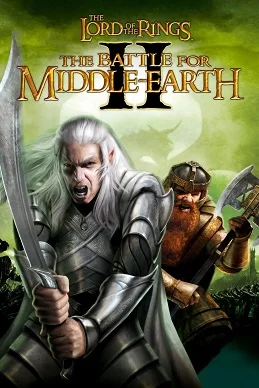
The Lord of the Rings: The Battle for Middle-earth II
 79
★ /10
79
★ /10
 PC
PC Xbox 360
 EA Los Angeles
 Electronic Arts
The Lord of the Rings: The Battle for Middle-earth II is the massive, critically acclaimed 2006 sequel to EA’s cinematic RTS hit. Developed by EA Los Angeles, this sequel represents a fascinating shift in licensing. While the first game was strictly bound to Peter Jackson’s film trilogy, EA successfully acquired the rights to J.R.R. Tolkien’s original books for the sequel.
This allowed the developers to pull double duty: they maintained the iconic, sweeping visual and audio style of the movies (including the actors’ likenesses and Howard Shore’s music) while introducing characters, locations, and conflicts that were entirely absent from the films. Instead of rehashing the journey of the Fellowship, the game’s campaign focuses entirely on the War in the North, showcasing the simultaneous, brutal battles fought by the Elves and Dwarves against Sauron’s northern forces.
Gameplay and Mechanical Overhauls
BFME II made massive, sweeping changes to the core mechanics of the original game, shifting away from cinematic restrictions to embrace traditional, deeply competitive RTS gameplay.
Key mechanical changes and innovations include:
- Free-Form Base Building: The highly divisive “fixed node” building system of the first game was completely scrapped. Players could now build any structure, anywhere on the map, and construct massive, sprawling custom fortress walls.
- The New Economy: To replace the fixed camps, the game introduced a proximity-based resource system. You build resource structures (like Farms or Mine Shafts), and their output is dictated by how much open, unobstructed land is around them, forcing players to expand across the map rather than turtling in one spot.
- Create-A-Hero: A massive new feature that allowed players to design their own custom champion. You could create an Elven archer, a massive Mountain Troll, or a corrupted Wizard, carefully selecting their armor, colors, and customizing a massive skill tree of magical powers to unleash in multiplayer skirmishes.
- War of the Ring Mode: Pulling heavy inspiration from the Total War franchise, this mode offered a turn-based grand strategy map of Middle-earth. Players moved armies across territories like pieces on a board game, and when two armies clashed, you could seamlessly drop down into the traditional RTS engine to fight the battle in real-time.
- Naval Combat: For the first time, players could take the war to the seas, building Corsairs of Umbar or majestic Elven warships to bombard coastlines and transport massive armies across water maps.
The Factions
Because the lore was expanded, the faction roster was completely overhauled. Gondor and Rohan were combined into a single faction to make room for three brand-new armies:
- Men of the West: A versatile, well-rounded faction merging the heavy defenses of Gondor with the devastating cavalry of Rohan.
- The Elves: The ultimate “glass cannon” faction. They possess the highest-damage archers in the game (utilizing devastating Silverthorn arrows) and stealth cloaks, but their infantry is incredibly fragile. They rely heavily on healing magic and summoning Ents for siege damage.
- The Dwarves: Slow, incredibly heavily armored, and built for siege warfare. They utilize a massive underground tunnel network, allowing their entire army to instantly teleport between mine shafts across the map.
- The Goblins: A brand-new evil faction built around speed, poison, and monstrous creatures. They swarm the map with cheap Spider Riders, massive Cave Trolls, and Fire Drakes, and their basic infantry can uniquely scale fortress walls without needing siege ladders.
- Mordor & Isengard: Both returning evil factions received heavy updates, including new units like the terrifying Half-Troll Marauders and the Corsairs of Umbar, who utilized firebombs to burn down enemy structures.
The Campaign: The War in the North
The campaign completely steps away from Aragorn, Frodo, and Gandalf. Instead, the “Good” campaign follows the legendary Elven warrior Glorfindel and the Dwarf Glóin (Gimli’s father) as they desperately defend the Elven sanctuaries of Rivendell and Lothlórien, ultimately marching to relieve the Siege of Erebor (The Lonely Mountain).
The “Evil” campaign allows players to command Sauron’s northern vanguard, led by the terrifying Mouth of Sauron and the massive Dragon, Drogoth, as they systematically burn down the northern kingdoms and slaughter the Elves and Dwarves.
Development and Legacy
Released in February 2006, BFME II was a massive success, praised for heavily deepening the strategic mechanics while retaining the unparalleled atmosphere of the franchise. It was also notable for receiving an impressive Xbox 360 port, which pioneered a highly intuitive “radial menu” system that proved console RTS games could actually work without a mouse and keyboard.
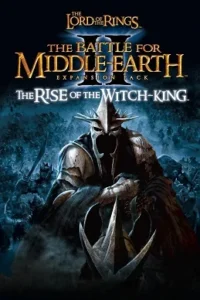
Later that year, EA released a massive expansion pack: The Rise of the Witch-king, which added the brand-new Angmar faction and a campaign focused on the ancient fall of Arnor.
Tragically, BFME II suffers the exact same fate as its predecessor. Due to EA losing the Lord of the Rings license in 2008/2009, the game was permanently pulled from all storefronts. It is pure abandonware. However, just like the first game, it is kept fiercely alive today by a massive, dedicated modding community. Through fan-run servers, HD patches, and legendary total-conversion mods (like Age of the Ring and Edain), BFME II remains one of the most widely played “dead” strategy games on the internet.
Key Features:
- Free-Form Strategy — Build massive fortresses anywhere on the map and manage a dynamic, proximity-based resource economy.
- The War in the North — Experience a brand-new narrative focusing on the spectacular battles between the Elves, Dwarves, and Goblins.
- Grand Strategy — Conquer the entire continent in the “War of the Ring” mode, blending turn-based board game mechanics with real-time tactical battles.
- Create-A-Hero — Forge your own legendary champion, customizing their race, appearance, and devastating magical abilities.
- A Thriving Legacy — Join a massive, passionate community that continues to patch, balance, and heavily mod this legendary 2006 abandonware today.
Release Platforms:
- Microsoft Windows (PC) — February 28, 2006
- Xbox 360 — July 5, 2006
- (Currently abandonware; unavailable on digital storefronts but widely accessible via community-driven launchers).