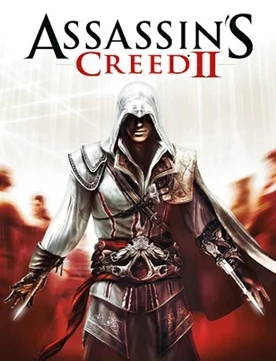
Assassin’s Creed II
 86
★ /10
86
★ /10
 PC
PC PS 3
PS 3 Xbox 360
 ak tronic Software & Services GmbH,
  Akella,
  Ubisoft


Assassin’s Creed II is a 2009 action-adventure stealth video game developed by Ubisoft Montreal and published by Ubisoft. Serving as the direct sequel to the 2007 original, it is widely considered one of the greatest and most important video games ever made. Assassin’s Creed II took the promising but flawed blueprint of its predecessor and polished it to near-perfection, dramatically expanding the scope of the world, deepening the narrative, and introducing a protagonist who would become the undeniable face of the franchise.
The modern-day narrative immediately follows the events of the first game. Desmond Miles escapes from the Abstergo facility with the help of undercover Assassin Lucy Stillman. They retreat to a hideout where Desmond enters a new, upgraded Animus (the Animus 2.0). Here, he experiences the genetic memories of a new ancestor: Ezio Auditore da Firenze. Set during the height of the Italian Renaissance in the late 15th century, the story begins with a young, carefree Ezio witnessing the betrayal and public execution of his father and brothers. Driven by a desire for vengeance, Ezio discovers his family’s hidden Assassin heritage and embarks on a decades-long quest across Italy, hunting down the powerful Templar conspirators responsible, led by the ruthless Rodrigo Borgia.
Gameplay
Assassin’s Creed II retained the core pillars of parkour, stealth, and melee combat, but overhauled almost every underlying system to provide a vastly more varied and engaging experience. The highly repetitive mission structure of the first game was entirely scrapped in favor of a bespoke, cinematic narrative campaign.
Key gameplay mechanics include:
- The Dual Hidden Blades: Ezio is famously equipped with two Hidden Blades, allowing him to perform spectacular double assassinations from stealth or during combat. Furthermore, the blade was upgraded so Ezio did not have to sacrifice a finger to wield it, and it could now be used defensively in open combat.
- Expanded Economy and Customization: A massive new addition was the game’s economy. Players can loot bodies and find treasure chests to earn florins. This money is used to purchase new armor (which increases health), weapons, artistic paintings, and dyes to customize Ezio’s robes.
- Villa Monteriggioni: Ezio inherits a dilapidated town and villa. Players must invest their earned money into upgrading the town’s shops, brothels, and infrastructure, which in turn generates a passive income for Ezio to collect over time.
- Leonardo da Vinci’s Inventions: The famous polymath serves as Ezio’s quartermaster and close friend, decoding ancient Codex pages to build new tools, including poison blades, a hidden gun, and famously, a flyable glider for specific missions.
- Notoriety System: Rather than guards forgetting about Ezio instantly, the game features a persistent notoriety meter. As Ezio commits crimes, guards become more suspicious. Players must actively lower their notoriety by tearing down wanted posters, bribing heralds, or assassinating corrupt officials.
- Hiring Factions: To aid in social stealth, Ezio can hire groups of courtesans (to distract guards), mercenaries (to fight them), or thieves (to lure them away).
Development and Legacy
Following the success of the first game, Ubisoft Montreal began development on the sequel with a clear mandate: fix the repetition. Creative director Patrice Désilets and producer Sébastien Puel focused heavily on building a more vibrant, living world. The historical setting of Renaissance Italy provided a stark contrast to the dusty, war-torn environments of the Crusades. The development team meticulously recreated landmarks like the Duomo in Florence and the canals of Venice, filling the cities with rich color and bustling crowds.
A significant focus was placed on the protagonist. While Altaïr was stoic and fully formed as a Master Assassin from the start, the writers crafted Ezio as a charismatic, deeply flawed, and highly relatable character whose growth players witness over a span of 23 years. The game’s emotional core was further elevated by an unforgettable, sweeping orchestral soundtrack composed by Jesper Kyd, featuring the iconic track “Ezio’s Family.”
Released in November 2009, Assassin’s Creed II was universally acclaimed. It was praised for its vast improvements in mission variety, its stunning realization of Renaissance Italy, and its gripping, character-driven story. It was a massive commercial success, selling millions of copies and cementing Assassin’s Creed as Ubisoft’s flagship franchise. The game’s overwhelming popularity led to two direct narrative sequels—Brotherhood (2010) and Revelations (2011)—completing the legendary “Ezio Trilogy.”
Key Features:
- The Birth of a Legend — Play as Ezio Auditore, witnessing his transformation from an arrogant noble to a legendary Master Assassin.
- Renaissance Italy — Explore beautifully recreated, massive cities including Florence, Venice, Forlì, and the Tuscan countryside.
- Villa Management — Rebuild the ruined town of Monteriggioni, managing an economy to fund your war against the Templars.
- The Dual Hidden Blades — Execute dynamic double assassinations and utilize new tools crafted by Leonardo da Vinci.
- Varied Mission Design — Experience a highly cinematic, bespoke narrative filled with unique assassination setups, tailing missions, and high-speed chases.
Release Platforms:
- PlayStation 3 — November 17, 2009
- Xbox 360 — November 17, 2009
- Microsoft Windows (PC) — March 4, 2010
- Mac OS X — October 2010
- PlayStation 4 / Xbox One (Included in The Ezio Collection) — November 15, 2016
- Nintendo Switch (Included in The Ezio Collection) — February 17, 2022