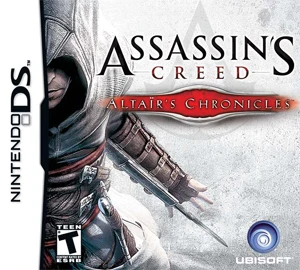
Assassin’s Creed: Altaïr’s Chronicles
 58
★ /10
58
★ /10
 Android
 iOS (iPhone/iPad)
 Nintendo DS
 Ubisoft
Assassin’s Creed: Altaïr’s Chronicles is a 2008 action-adventure video game developed by Gameloft and published by Ubisoft. Released shortly after the massive success of the original Assassin’s Creed, it serves as a direct prequel to the 2007 console game. Originally designed for the Nintendo DS and later ported to various mobile operating systems, the game was the franchise’s first foray into the handheld market.
Set in the year 1190, one year prior to the events of the original game, the story strips away the modern-day sci-fi elements entirely; there is no Animus and no mention of Desmond Miles. Instead, players strictly follow the historical narrative of Altaïr Ibn-La’Ahad. Tasked by the Assassin leader, Al Mualim, Altaïr must journey across the Middle East—visiting cities like Jerusalem, Acre, Damascus, and Tyre—to locate a powerful artifact known as “The Chalice” before it falls into the hands of the Knights Templar.
Gameplay
Due to the technical limitations of the Nintendo DS and early mobile hardware, Altaïr’s Chronicles heavily modified the open-world formula of its console big brother. The game plays as a linear, level-based 3D platformer and action-brawler rather than a sprawling sandbox.
Key gameplay mechanics include:
- Linear Traversal: While Altaïr can still perform his signature parkour (climbing walls, swinging from poles, and running across rooftops), the environments are strictly linear obstacle courses rather than open cities. The platforming requires precise jumping and timing, often dodging environmental hazards.
- Simplified Combat: Combat is heavily streamlined, featuring light and heavy attacks, blocks, and a basic combo system. Altaïr has access to a familiar arsenal, including his sword, throwing knives, bombs, and the iconic Hidden Blade.
- Touchscreen Mini-Games: On the Nintendo DS and mobile devices, the game utilized touchscreen inputs for specific Assassin tasks. Pickpocketing requires players to carefully drag an item out of a target’s pouch using the stylus without touching the sides, while interrogations involve a rhythm-based mini-game to pressure targets into talking.
- Stealth Elements: While combat is frequent, players are encouraged to use stealth. Sneaking up behind enemies allows Altaïr to perform instant, quiet assassinations with his Hidden Blade.
Development and Legacy
To bring the demanding Assassin’s Creed universe to handhelds, Ubisoft partnered with Gameloft, a premier developer of mobile and portable games (and a sister company to Ubisoft at the time). Gameloft utilized fully 3D rendered character models and environments, which was relatively ambitious for the Nintendo DS in 2008.
While the game was praised for its impressive graphics on handheld hardware and for expanding the lore of Altaïr, it received mixed reviews regarding its gameplay. Critics felt the combat was repetitive and the platforming could be clunky due to the game’s fixed camera angles. Furthermore, the voice acting (which was notably absent from the DS version but added in later mobile ports) was widely criticized for its poor quality.
Despite its flaws, Altaïr’s Chronicles was a commercial success and proved that the Assassin’s Creed IP could survive on portable platforms. It paved the way for a long lineage of handheld and mobile spin-offs, including Assassin’s Creed: Bloodlines for the PSP and Assassin’s Creed II: Discovery for the DS. Today, the game is largely inaccessible to modern players, as it was delisted from mobile storefronts (like the iOS App Store and Google Play) years ago, relegating it to the status of a nostalgic, retro curiosity for hardcore franchise completionists.
Key Features:
- A Pure Historical Prequel — Experience a story focused entirely on Altaïr and the Third Crusade, unburdened by the modern-day Animus storyline.
- Handheld Parkour — Navigate 3D platforming environments designed specifically for portable gaming sessions.
- Touchscreen Investigations — Utilize the DS stylus or mobile touchscreens to actively pickpocket informants and interrogate Templar agents.
- Varied Arsenal — Master a variety of weapons, including the sword, crossbow, explosive bombs, and the stealthy Hidden Blade.
- Expanded Middle Eastern Settings — Explore areas not seen in the original game, including the coastal city of Tyre and the Templar stronghold of Aleppo.
Release Platforms:
- Nintendo DS — February 5, 2008
- iOS — April 23, 2009
- webOS — Early 2010
- Android — September 2010
- Symbian / Windows Phone — 2010 / 2013