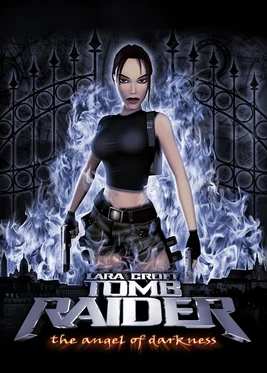
Tomb Raider: The Angel of Darkness
 52
★ /10
52
★ /10
 PC
PC PS 2
PS 2

Tomb Raider: The Angel of Darkness (often referred to as Tomb Raider VI) is a 2003 action-adventure game developed by Core Design and published by Eidos Interactive. Intended to be a massive, revolutionary leap into the PlayStation 2 generation, the game instead became one of the most infamous cautionary tales in gaming history. Plagued by a disastrously rushed development cycle, it stands as the darkest, most ambitious, and ultimately final Tomb Raider game ever developed by the franchise’s original creators.
The story takes a sharp turn away from isolated jungles and ancient tombs, plunging into a gritty, gothic urban thriller. After surviving her apparent death in Egypt, a deeply hardened and traumatized Lara Croft visits her former mentor, Werner Von Croy, in Paris. During an argument, Lara is knocked unconscious. She wakes up to find Von Croy brutally murdered and the French police storming the apartment. Framed for the crime, Lara goes on the run. To clear her name, she delves into the Parisian criminal underworld, eventually uncovering a terrifying conspiracy involving a 15th-century secret society (the Cabal), an immortal serial killer known as the Monstrum, and the resurrection of the Nephilim—an ancient, biblical race of human-angel hybrids.
Gameplay
The Angel of Darkness attempted to completely reinvent the classic formula, introducing stealth, RPG mechanics, and character interactions. Unfortunately, due to the rushed development, many of these systems felt incredibly half-baked or broken at launch.
Key gameplay mechanics and additions include:
- RPG Progression: The most controversial addition was a localized strength system. Lara starts the game physically weakened. To push heavy blocks, pry open doors, or make long jumps, players must find specific objects to interact with to trigger an “I feel stronger now” prompt, upgrading her leg or upper-body strength.
- The Stamina Meter: Lara is now governed by a stamina meter (specifically a grip meter). When hanging from ledges or shimmying, the meter rapidly depletes. If it runs out, Lara drops, adding immense stress to the platforming sections.
- Dialogue Trees: Lara can now interact with NPCs in large, semi-open city hubs. Players must navigate dialogue trees to gather information, bribe bouncers, or acquire items. Choosing the wrong dialogue option can actually lead to Lara being arrested or killed.
- Stealth and Melee: Gunplay is heavily downplayed in the first half of the game. Instead, Lara can press flat against walls, peek around corners, perform stealth takedowns, and engage in hand-to-hand combat (kicks and punches) against security guards and police.
- Kurtis Trent: For the first time in the franchise, Lara is not the only playable character. In the second half of the game (set in Prague), players take control of Kurtis Trent, an ex-Legionnaire and demon hunter. While canonically possessing telekinetic powers and a deadly bladed disc called the Chirugai, his actual gameplay is largely restricted to clunky shooting and puzzle-solving.
- The Control Scheme: The game attempted to adapt the classic grid-based “tank controls” to the analog sticks of the PS2. The result was incredibly heavy, sluggish movement that made navigating tight spaces and performing precise jumps deeply frustrating.
Development and Legacy
The development of The Angel of Darkness was a nightmare. Core Design spent three years struggling to adapt to the complex architecture of the PlayStation 2. The game suffered from massive scope creep; the original vision included branching storylines, a fully simulated Parisian economy, and deep magical combat for Kurtis. However, Eidos Interactive mandated that the game must launch alongside the 2003 movie Lara Croft: Tomb Raider – The Cradle of Life.
To meet the immovable deadline, Core Design brutally gutted the game. Entire mechanics, narrative arcs, and massive hub environments were deleted at the last second. When the game launched in June 2003, it was heavily panned by critics for its devastating bugs, abysmal framerate, and clunky controls. The catastrophic reception damaged the brand so severely that Eidos immediately fired Core Design—the studio that had invented Lara Croft—and handed the entire franchise over to American developer Crystal Dynamics (who would successfully reboot the series in 2006 with Tomb Raider: Legend).
Despite its tragic history, The Angel of Darkness has developed a massive, fiercely passionate cult following. Fans highly praise its dark, mature storyline, its phenomenal gothic art direction, and arguably the greatest soundtrack in the franchise’s history (composed by Peter Connelly and performed by the London Symphony Orchestra).
For over two decades, the game was notoriously difficult to play on modern hardware. However, in February 2025, the game was finally given a second chance as part of Aspyr’s Tomb Raider IV-VI Remastered collection. This release brought the game to modern consoles with drastically improved performance, modernized analog controls (finally fixing the sluggish movement), and high-resolution textures, allowing fans to experience the ambition of Core Design’s final TR game as smoothly as possible.
Key Features:
- A Dark Gothic Thriller — Trade ancient ruins for the rainy streets of Paris and the snowy courtyards of Prague in a mature, murder-mystery storyline.
- Dual Protagonists — Play as both a hardened, fugitive Lara Croft and the mysterious, demon-hunting Kurtis Trent.
- RPG and Stealth — Navigate branching dialogue trees, upgrade your physical strength to access new areas, and utilize stealth takedowns.
- Orchestral Masterpiece — Experience a soaring, hauntingly beautiful musical score recorded at Abbey Road Studios.
- The 2025 Remaster — Play the definitive version of the game (Tomb Raider IV-VI Remastered), featuring highly requested modernizations that fix the game’s notorious control and performance issues.
Release Platforms:
- PlayStation 2 — June 20, 2003 (Europe) / June 17, 2003 (North America)
- Microsoft Windows (PC) — July 4, 2003 (Europe) / July 1, 2003 (North America)
- Mac OS X — December 2003
- PlayStation 4 / PlayStation 5 / Xbox One / Xbox Series X|S / Nintendo Switch / PC (Tomb Raider IV-VI Remastered) — February 14, 2025