Tomb Raider III: Adventures of Lara Croft
 76
★ /10
76
★ /10
 PC
PC PS 1
PS 1Where to buy

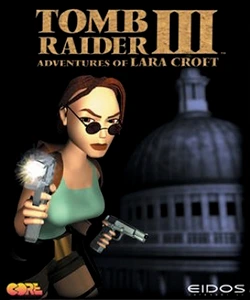
Tomb Raider III: Adventures of Lara Croft is a 1998 action-adventure game developed by Core Design and published by Eidos Interactive. Releasing during the absolute peak of “Lara Mania,” this third installment is widely recognized as the most sprawling, mechanically complex, and notoriously punishing game in the original PlayStation 1 trilogy.
The narrative kicks off in the jungles of India, where Lara discovers the Infada Stone, an artifact linked to an ancient meteorite that crashed into Antarctica millions of years ago. She is soon approached by Dr. Mark Willard, a Scottish scientist who reveals that there are three other artifacts crafted from the same meteorite scattered across the globe. Hired to recover them, Lara embarks on a massive, highly varied expedition that takes her from a high-security compound in the Nevada desert (Area 51) to the rainy rooftops of London, the cannibal-infested islands of the South Pacific, and finally, the frozen, mutant-filled wastes of Antarctica.
Gameplay
Tomb Raider III pushed the classic grid-based engine to its absolute limits, introducing more organic-looking environments and demanding a much higher level of platforming precision from the player.
Key gameplay mechanics and additions include:
- Expanded Acrobatics: Lara’s moveset was significantly expanded to deal with the complex level design. She can now sprint (governed by a stamina meter) to outrun traps and perform a rolling dive, drop to her knees to crawl through tight tunnels, and perform “monkey swings” to traverse overhead bars and grates.
- Non-Linear Progression: For the first time in the series, the campaign offers a degree of open-endedness. After completing the mandatory opening levels in India, the player can choose to play through the Nevada, London, and South Pacific chapters in any order they wish before the final convergence in Antarctica.
- The Nevada Trap: The non-linear structure features a legendary catch. In the Nevada chapter, Lara is arrested and stripped of all her weapons and ammunition. Savvy players quickly learned they had to play Nevada first so they wouldn’t lose the massive arsenal they built up in the other locations.
- Brutal Save System: The game is infamous for its crushing difficulty. The PC version allowed players to save anywhere, but the PlayStation 1 version brought back the controversial “Save Crystals” from the first game. However, instead of being fixed locations, the crystals were collectible items that went into your inventory, forcing players to constantly hoard them and strategically decide when a checkpoint was worth spending a crystal.
- New Vehicles and Hazards: The game introduces highly varied vehicle sections, including a high-speed quad bike, an underwater propulsion unit (UPV), a deadly minecart ride, and a notoriously difficult-to-steer kayak. Players also had to manage new environmental hazards, such as an exposure meter in the freezing waters of Antarctica.
Development and Legacy
Following the massive success of Tomb Raider II, Core Design was once again locked into a grueling, one-year development cycle by Eidos Interactive to get a new game out for the 1998 holiday season. To achieve the game’s more naturalistic look, the developers overhauled the underlying code to support triangular polygons rather than just square blocks, allowing for much more complex geometry, architectural curves, and varied terrain.
Upon release, Tomb Raider III was another massive commercial success, selling over 6 million copies worldwide. However, the critical reception was slightly more divided than its predecessors. While reviewers praised the massive environments, improved lighting, and weather effects, many criticized the game’s absolutely brutal difficulty, cryptic puzzles, and maze-like level design, which often required an official strategy guide to navigate without intense frustration.
Like its predecessors, the game received a standalone PC expansion pack, The Lost Artifact (1999), which concluded the meteorite storyline. In early 2024, the complete game and its expansion were beautifully modernized and released for current-generation platforms as part of Aspyr’s highly acclaimed Tomb Raider I-III Remastered collection, which notably allows console players to bypass the punishing Save Crystal system.
Key Features:
- Unforgiving Difficulty — Survive the most complex, trap-laden, and labyrinthian levels of the classic PS1 era, designed specifically to challenge veteran players.
- New Traversal Mechanics — Sprint past rolling boulders, monkey-swing across deadly chasms, and crawl through hidden ventilation shafts.
- Choose Your Path — Dictate your own globe-trotting itinerary by choosing the order in which you tackle the London, Nevada, and South Pacific chapters.
- Heavy Arsenal — Obliterate enemies with powerful new weapons, including the Desert Eagle, the MP5 submachine gun, and a devastating Rocket Launcher.
- The 2024 Remaster — Experience the definitive version of the game (Tomb Raider I-III Remastered), featuring drastically improved graphics, modernized analog controls, and the inclusion of The Lost Artifact expansion.
Release Platforms:
- PlayStation — November 20, 1998 (Europe) / November 24, 1998 (North America)
- Microsoft Windows (PC) — November 20, 1998 (Europe) / November 24, 1998 (North America)
- Mac OS — 1999
- PlayStation 4 / PlayStation 5 / Xbox One / Xbox Series X|S / Nintendo Switch / PC (Tomb Raider I-III Remastered) — February 14, 2024