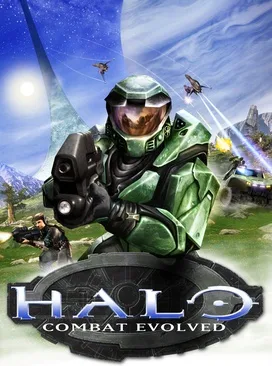
Halo: Combat Evolved
 97
★ /10
97
★ /10
 PC
PC Xbox
XboxWhere to buy

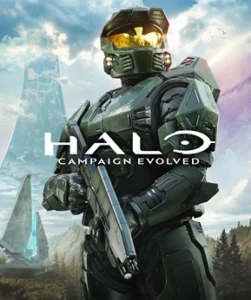
Halo: Combat Evolved is a 2001 first-person shooter developed by Bungie and published by Microsoft Game Studios, released November 15, 2001 as a launch title for the original Xbox. It holds a Metacritic score of 97 based on 68 critic reviews — “universal acclaim,” and still one of the highest-rated games ever released on any platform. This is the original: not Halo: Combat Evolved Anniversary, the 2011 graphical remaster that runs on the same underlying 2001 engine, and not Halo: Campaign Evolved, the 2026 ground-up remake built in Unreal Engine 5. All three share a near-identical name and search results blur them together constantly; this entry covers the game Bungie actually shipped in 2001.
It’s difficult to overstate what this game did for its console. Microsoft entered the market in 2001 against an entrenched PlayStation 2 and a well-regarded GameCube, with no first-party pedigree and no killer app. Halo: Combat Evolved became that app almost overnight, and twenty-five years later it’s still the reference point every subsequent Halo release, remaster, or remake gets measured against.
Technical Specifications
| Attribute | Details |
|---|---|
| Developer | Bungie |
| Publisher | Microsoft Game Studios |
| Project Lead | Jason Jones |
| Lead Writer | Joseph Staten |
| Art Director | Marcus Lehto |
| Composers | Martin O’Donnell · Michael Salvatori |
| Engine | Blam! (built in-house by Bungie) |
| Original Release | November 15, 2001 (Xbox, North America) · March 14, 2002 (PAL) |
| Also released on | Windows (Sept 30, 2003, ported by Gearbox Software) · Mac OS X (Dec 2003, ported by Westlake Interactive) · Xbox 360 (Dec 2007, digital re-release) |
| Metacritic | 97 (“Universal acclaim,” 68 critics) |
| Genre | First-person shooter |
| Mode(s) | Single-player campaign (10 missions) · Multiplayer (split-screen and System Link, up to 16 players; no online play at launch) |
From RTS to FPS: How Halo Found Its Genre
Bungie began work on what would become Halo in 1997, shortly after finishing Myth: The Fallen Lords. The project, internally codenamed “Armor,” started life as a real-time strategy game in the vein of Myth, then shifted to third-person before eventually settling on first-person as Bungie’s art director Marcus Lehto and project lead Jason Jones chased the “visceral, connected” feeling that came from seeing the action directly through a character’s eyes. The game — still untitled days before its public reveal — was shown to Apple CEO Steve Jobs by Bungie executive Peter Tamte, who used old contacts from his time at Apple to get the meeting; Jobs was impressed enough to debut the game himself at the 1999 Macworld Expo. A branding firm had suggested calling it “Covenant,” but Bungie artist Paul Russell pitched an alternative that stuck: Halo.
Everything changed again in 2000, when Microsoft acquired Bungie outright specifically to secure the game as a flagship launch title for its unannounced Xbox console, pulling what had been a PC and Mac project onto brand-new hardware. The team relocated from Chicago to Redmond, and the transition to Xbox is what finally locked the game into the first-person perspective it shipped with.
The Game That Sold a Console
Microsoft launched the Xbox in November 2001 against Sony’s dominant PlayStation 2 and Nintendo’s GameCube, with no first-party track record to speak of. Halo: Combat Evolved became the reason people bought the console anyway. It crossed one million units sold in North America within four months of launch — the fastest a game had ever hit that mark on a sixth-generation console — and continued climbing well past six million copies worldwide over the following years, a number that would eventually be dwarfed by its own sequels but was extraordinary for a new studio’s new IP on a first-generation console.
Master Chief, Cortana, and the Ring
The story follows Master Chief, a cybernetically augmented supersoldier, and his AI companion Cortana, fleeing the destruction of the human colony Reach aboard the UNSC Pillar of Autumn. Pursued by the alien theocracy known as the Covenant, the ship crash-lands on a massive ring-shaped megastructure the Covenant call “Halo” — a discovery that at first looks like a lucky escape and quickly turns into something far worse. Buried inside the ring is the Flood, a parasitic organism that both humans and the Covenant have every reason to keep contained, and an ancient AI caretaker, 343 Guilty Spark, whose real intentions for the ring are not what either side assumes.
The Ten Missions
The campaign is built from ten missions — Pillar of Autumn, Halo, Truth and Reconciliation, The Silent Cartographer, Assault on the Control Room, 343 Guilty Spark, The Library, Two Betrayals, Keyes, and The Maw — and its reputation was never perfectly uniform even at launch. The Silent Cartographer and the climactic Warthog escape sequence in The Maw are still cited as some of the best level design of their era, while The Library‘s repetitive Flood corridors and Two Betrayals‘ backtracking through earlier environments were the two most consistent criticisms in contemporary reviews — criticisms Bungie itself was aware of, and which Halo Studios explicitly targeted for rework a quarter-century later in Halo: Campaign Evolved.
Two Weapons, Regenerating Shields, and a New Kind of Console Shooter
Halo: Combat Evolved didn’t invent the console first-person shooter, but it’s the game most credited with proving one could work as well as a mouse-and-keyboard shooter on a controller, thanks to a dual-analog control scheme that became the industry default almost overnight. It paired that with design decisions that were unusual for the genre at the time: a strict two-weapon limit instead of a full arsenal, a recharging energy shield layered over a smaller health pool instead of a straightforward health bar, and vehicle combat — the Warthog jeep, Ghost, Banshee, and Scorpion tank — built directly into campaign missions rather than treated as a novelty. Covenant AI squads that flanked, retreated, and called for backup gave firefights a sense of unpredictability that reviewers at the time repeatedly singled out as a step beyond anything else available on a console.
Sixteen-Player LAN Parties
Halo shipped before Xbox Live existed, so its multiplayer ran entirely on split-screen and System Link — linking up to four consoles together for matches of up to 16 players. That constraint accidentally created one of the defining PC-gaming-adjacent social rituals of the early 2000s: the Halo LAN party, with groups hauling Xbox consoles and CRT televisions to a single location to play together, a scene that later gaming culture would look back on nostalgically once online play made it largely unnecessary. The game also developed a small but genuine competitive scene once tournament organizers picked it up, running until Halo 2 took over as the series’ esports title at the end of 2004.
Reception and Awards
Critical reception was close to unanimous. IGN and EGM both scored it a perfect or near-perfect mark and named it their 2002 Game of the Year; Official Xbox Magazine and the Academy of Interactive Arts & Sciences did the same, with the AIAS additionally awarding it Outstanding Achievement in Visual Engineering. Edge magazine’s review called it the most important console launch title ever made. The consistent throughline across reviews was less any single feature than the sense that Bungie had built a shooter that finally felt tailor-made for a controller rather than compromised by one.
From Xbox to Everywhere: Ports and Re-releases
A Windows port arrived in September 2003 courtesy of Gearbox Software, followed by a Mac OS X version from Westlake Interactive that December — both added extra multiplayer maps, weapons, and vehicles absent from the Xbox original, but dropped split-screen and campaign co-op entirely, since neither PC nor Mac hardware at the time supported it the way console hardware did. A standalone multiplayer-only release, Halo Custom Edition, followed in 2004 and became the foundation of the game’s long-running PC modding scene. Xbox 360 owners got a digital re-release in December 2007 via Xbox Originals, and the original engine got its first real overhaul with Halo: Combat Evolved Anniversary in November 2011, which let players hot-swap between 2001-era and remastered visuals on the fly. That remaster was later folded into Halo: The Master Chief Collection, first on Xbox One in 2014 and then on PC from 2019 onward, which remains the easiest legitimate way to own the original campaign today.
Legacy
Halo: Combat Evolved‘s influence is hard to separate from the console shooter genre as it exists now — the two-weapon limit, regenerating shields, and console-native dual-stick aiming it popularized became genre-standard conventions that outlived the game itself by decades. It also launched a media franchise well beyond the games: novels that hit the New York Times bestseller list, comics, an animated anthology, and eventually a live-action television adaptation. Its 25th anniversary in 2026 became the occasion for Halo: Campaign Evolved, a full ground-up remake built in Unreal Engine 5 — notable not just as a remake, but as the first Halo release ever to appear on a PlayStation console.
Where to Play It Today
The original 2003 Gearbox PC port has been unsupported for years — GameSpy’s matchmaking servers shut down in 2014, and the storefronts that used to sell it have largely moved on — so it isn’t a practical way to play the game today. The legitimate modern option is Halo: The Master Chief Collection on Xbox, PC (Steam or the Xbox app), and Xbox Game Pass, which bundles the original 2001 campaign together with the 2011 Anniversary remaster and lets you switch between classic and updated visuals at will. Anyone who wants the fully rebuilt, modern take instead now has Halo: Campaign Evolved on Xbox, PC, or — for the first time in series history — PlayStation 5.
Trailer
View on Videos
Halo: Campaign Evolved | Cinematic Story Trailer
DLC & Expansions 1
Halo news
More news
Activision Takes Over Halo as Microsoft Guts Halo Studios
Halo Cinematic Director Promoted and Laid Off in the Same Week

Xbox Heads to Tokyo Game Show 2026 for 25th Anniversary Showcase

PlayStation Dropped Physint Over Budget and Profitability Fears