Halo 2
 95
★ /10
95
★ /10
 PC
PC Xbox
Xbox Xbox One
 Microsoft Game Studios
Where to buy

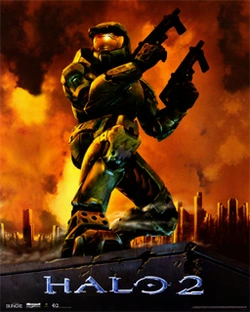
Halo 2 is a 2004 first-person shooter developed by Bungie and published by Microsoft Game Studios, released November 9, 2004 for the original Xbox. It holds a Metacritic score of 95 based on 91 critic reviews — “universal acclaim” — and generated over $125 million in sales on its first day alone, a record at the time for any entertainment product, video game or otherwise. This entry covers the original 2004 release; the remastered campaign bundled into Halo: The Master Chief Collection, Halo 2: Anniversary, is covered separately below and has its own page.
It’s also, by Bungie’s own later admission, a game that shipped without the ending it was supposed to have. Understanding Halo 2 means understanding both things at once: one of the best-reviewed shooters ever made, built on top of a production that nearly didn’t finish in time.
Technical Specifications
| Attribute | Details |
|---|---|
| Developer | Bungie |
| Publisher | Microsoft Game Studios |
| Project Lead | Jason Jones |
| Lead Writer | Joseph Staten |
| Design Lead | Jaime Griesemer |
| Composers | Martin O’Donnell · Michael Salvatori |
| Engine | Blam! (substantially rebuilt from Combat Evolved) |
| Original Release | November 9, 2004 (Xbox, worldwide) |
| Also released on | Windows Vista (2007, “Halo 2 for Vista”) · Remastered as Halo 2: Anniversary, part of Halo: The Master Chief Collection (Xbox One 2014, PC 2020) |
| Metacritic | 95 (“Universal acclaim,” 91 critics) |
| Genre | First-person shooter |
| Mode(s) | Single-player campaign (split-screen co-op) · Multiplayer (Xbox Live online matchmaking, System Link, split-screen) |
A Troubled, Overstuffed Development
After Halo: Combat Evolved‘s success, Bungie set out to build a sequel that fixed everything the original couldn’t do: online play, a bigger arsenal, vehicle boarding, and a story that took the setting beyond a single ring. The ambition outran the schedule almost immediately. Every other project at the studio, including an unrelated game codenamed Phoenix, was cancelled and folded into the Halo 2 team. The campaign was rethought from scratch and remained effectively unplayable for over a year while resources went into building the new online multiplayer instead. An entire planned multiplayer mode, an ambitious large-scale mode internally called “Warfare,” was cut wholesale, and a small side project by designer Max Hoberman quietly became the entire shipping multiplayer suite instead. Design lead Jaime Griesemer later told Edge magazine that the core issue was simply a lack of polish time at the end of the cycle — there wasn’t a single design failure, just not enough runway left to finish everything that had been planned.
Master Chief and the Arbiter
The campaign splits its focus between two playable characters: Master Chief, returning from the first game, and a new character known only as the Arbiter — a disgraced Covenant Elite, voiced by Keith David, serving a corrupt religious hierarchy he’s slowly realizing he can’t trust. Bungie and Microsoft kept the Arbiter’s existence a closely guarded secret ahead of release, going as far as barring reviewers from discussing him in previews, which meant most players first learned they’d be playing as a former enemy only once the game was already in their hands. It was a structurally unusual choice for 2004 — asking players to sympathize with, and eventually root for, a character introduced as the first game’s antagonist faction — and it became one of the more talked-about design decisions of the game’s launch.
The Cliffhanger That Wasn’t Supposed to Happen
The campaign ends abruptly, mid-conflict, with neither Master Chief’s nor the Arbiter’s story resolved. At launch, Bungie described this as an intentional artistic choice. It wasn’t. The studio had planned a full third act reuniting both characters on Earth to confront the Covenant’s ruling Prophets directly, and cut it entirely under the same time pressure that gutted the multiplayer mode. Writer Joseph Staten reportedly hoped the resulting cliffhanger would land the way The Empire Strikes Back‘s did; in practice, with no confirmed Halo 3 yet announced, it read to most players as an unfinished story rather than a deliberate pause. Bungie staffer Frank O’Connor later described the ending more bluntly, admitting the team “drove off Thelma & Louise style” rather than sticking the landing. The studio wouldn’t publicly confirm the cut ending for years, and pieces of what the intended finale actually contained have only trickled out gradually since, largely through former staff interviews and leaked storyboards.
Dual-Wielding and a Deeper Arsenal
Mechanically, Halo 2‘s biggest addition was dual-wielding: certain smaller weapons could be held one in each hand for double the firepower, at the cost of being unable to melee or throw grenades without dropping one. Vehicle boarding was new too, letting players leap onto enemy-piloted Warthogs, Ghosts, and Banshees mid-fight and fight for control rather than simply shoot vehicles from a distance. The weapon and vehicle roster expanded significantly, though several more ambitious additions — new Warthog variants, an all-terrain vehicle — were among the casualties of the game’s crunch and never made it to release.
Xbox Live and the Birth of Console Esports
Where Combat Evolved was limited to split-screen and System Link, Halo 2 shipped built around Xbox Live, which had launched a year earlier without a true killer app to justify it. That changed the moment Halo 2 arrived: its online matchmaking, party system, and clan support became reference points other console shooters spent years trying to catch up to. The game also became the backbone of early console esports, anchoring the Major League Gaming circuit for years — the Halo 2 competitive scene alone eventually generated more than $1.6 million in prize money across dozens of tournaments, with players like Tom “OGRE2” Ryan and David “Walshy” Walsh becoming among the first recognizable names in console competitive gaming.
I Love Bees: Marketing as Event
Halo 2‘s launch marketing became nearly as culturally significant as the game itself. I Love Bees, an alternate reality game built by 42 Entertainment, disguised itself as a hacked beekeeping blog and sent thousands of participants to answer ringing payphones across the world at specific times to piece together an audio drama tied to the Halo universe. Millions of people visited the site over its run, and the campaign is still cited today as one of the formative examples of viral, community-driven game marketing — a template studios were still copying more than a decade later. Between the ARG buzz and pre-order demand, Halo 2 became the most pre-ordered game in history at the time, generating over $125 million in first-day sales.
Reception
Critics were close to unanimous. GameSpot called it an exceptional shooter delivering thrilling, memorable moments across its campaign, co-op, and online modes, while flagging the campaign itself as unusually short with a disappointing story beat at the very end — a near-universal caveat once reviewers worked out how to describe the ending without spoiling it outright. Game Informer went further, calling it the best console shooter to date. Multiplayer was the least contested part of any review: nearly every outlet singled out Xbox Live matchmaking as a genuine leap forward for the genre, one that mattered as much for the industry as it did for the game.
Other 2004 Chaos: The Leak
Five weeks before release, a French-language build of the game was leaked online and spread rapidly across file-sharing networks. Microsoft moved quickly to contain it and threatened legal action against distributors, but the leak became one of the first high-profile examples of a major console launch being undermined by piracy ahead of release — a preview of problems the industry would spend the following decade trying to solve.
Halo 2: Anniversary (2014)
For the tenth anniversary, 343 Industries commissioned a considerably more ambitious remaster than 2011’s Halo: Combat Evolved Anniversary had been. Saber Interactive rebuilt the campaign’s assets and re-recorded its sound effects, Certain Affinity remastered the multiplayer maps, and — most visibly — Blur Studio produced 58 minutes of entirely new, pre-rendered CGI cinematics using motion-captured performances, replacing the original’s in-engine cutscenes outright. Composer Kazuma Jinnouchi rearranged the original O’Donnell/Salvatori score for a live recording by the San Francisco Symphony, and two new bookend cutscenes were added specifically to connect the story forward to Halo 5: Guardians. It launched as part of Halo: The Master Chief Collection on Xbox One in November 2014, with a PC version following in May 2020. Reception was positive but more divided than the original’s had been — praise for the cinematics and remastered presentation was consistent, while some reviewers and long-time players felt the underlying 2004 level design and campaign length hadn’t aged as gracefully as the visual overhaul around it.
Legacy
Halo 2‘s influence runs in two directions that don’t often overlap: it’s the game that proved Xbox Live was worth building a business around, and it’s also the game whose unresolved ending became a genuine point of tension between a studio and its audience, years before “we’ll explain it in the sequel” became a familiar and often distrusted promise in game marketing. Dual-wielding and vehicle boarding shaped how the rest of the series — and a generation of console shooters — approached combat variety, and the competitive scene it kicked off helped establish console esports as something worth taking seriously at all.
Where to Play It Today
Xbox Live support for the original Xbox version ended in 2010, so the 2004 disc no longer has working online multiplayer. The practical way to play Halo 2 today is Halo: The Master Chief Collection on Xbox, PC (Steam or the Microsoft Store), or Xbox Game Pass, which includes Halo 2: Anniversary with a toggle between the 2004 originals and the 2014 remastered visuals and cutscenes, plus fully supported modern online matchmaking.