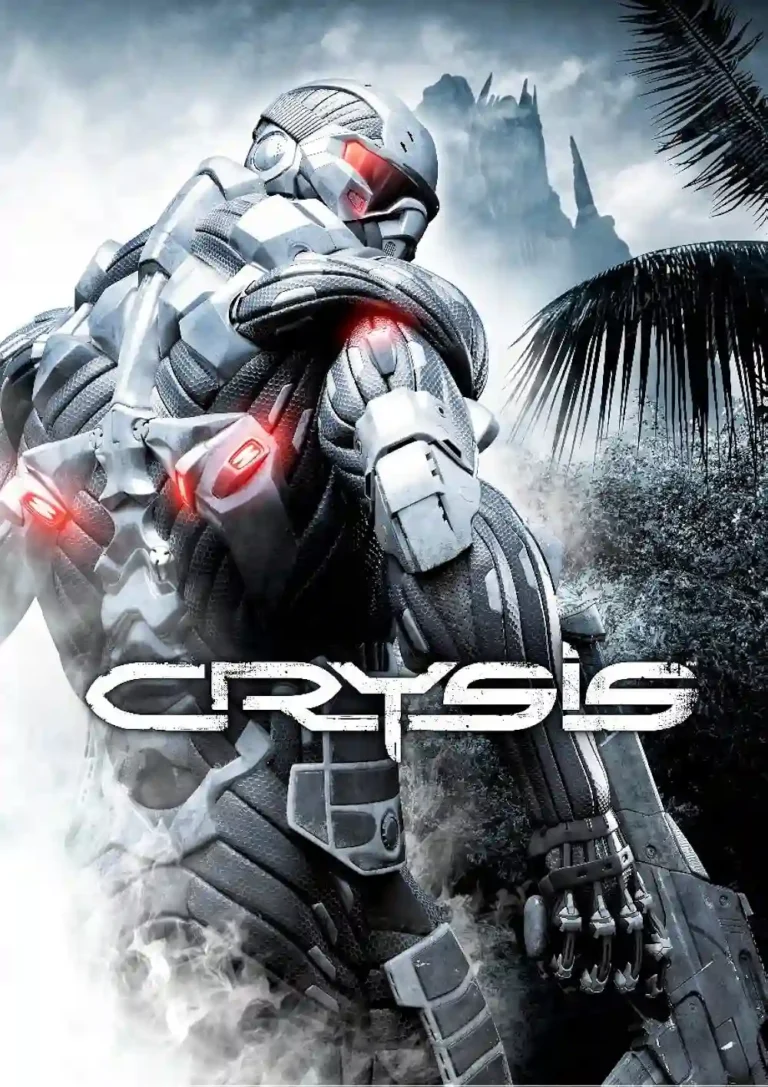
Crysis
 91
★ /10
91
★ /10
 PC
PC PS 3
PS 3 Xbox 360
 1C-SoftClub
 Electronic Arts

Crysis is a 2007 first-person shooter developed by Crytek and published by Electronic Arts, released November 13, 2007 for Windows. It holds a Metacritic score of 91 — “universal acclaim” — and collected multiple Game of the Year awards, but its cultural footprint runs far beyond review scores: this is the game behind “But can it run Crysis?”, the most famous hardware benchmark question in PC gaming history, coined because the game’s demands were so far ahead of available hardware that mainstream PCs took the better part of a decade to catch up to its maximum settings.
It’s also a game with an unusually turbulent storefront history — delisted from Steam as a standalone purchase since 2021, briefly unbuyable there entirely in 2025, and currently sold only as part of a bundle — which makes the “where to play” question for a nineteen-year-old shooter less trivial than it sounds. The full story is covered in its own section below.
Technical Specifications
| Attribute | Details |
|---|---|
| Developer | Crytek |
| Publisher | Electronic Arts (2007–2013) · Crytek (2020–present) |
| CEO / Director | Cevat Yerli |
| Composer | Inon Zur |
| Engine | CryEngine 2 (among the first DirectX 10 engines) |
| Release | November 13, 2007 (Windows, NA) · November 16, 2007 (EU) |
| Also released on | Xbox 360, PS3 (Oct 2011, remastered console port on CryEngine 3, single-player only) |
| Remaster | Crysis Remastered (2020, PC/consoles/Switch, developed with Saber Interactive) |
| Standalone Expansion | Crysis Warhead (September 2008) |
| Metacritic | 91 (“Universal acclaim”) |
| Genre | First-person shooter, sandbox |
| Mode(s) | Single-player · Multiplayer (original GameSpy-era servers long defunct) |
From Far Cry to Lingshan
Crytek made its name with 2004’s Far Cry — a tropical-island shooter whose publishing rights stayed with Ubisoft when the German studio moved on. Crysis was, in a sense, Crytek’s answer to its own first game: another lush island sandbox, this time built on the brand-new CryEngine 2, one of the first engines designed around Microsoft’s DirectX 10 framework. The technical statistics Crytek promoted at the time read like deliberate provocation — over a million lines of code, more than a gigabyte of texture data, up to 85,000 active shaders — and CEO Cevat Yerli later acknowledged the top graphics settings were intentionally calibrated for hardware that wouldn’t exist for years after release. The engine’s showpieces included subsurface scattering for realistic light through jungle foliage, researched partly through on-location photography in Haiti.
Nomad, North Korea, and the Ceph
Set in August 2020 — thirteen years in the future at release — the story follows Nomad, a US Delta Force operative inserted onto the fictional Lingshan Islands after North Korean forces seize the archipelago around a mysterious archaeological discovery. The mission starts as a hostage rescue and turns into first contact: buried inside the island’s mountain is an ancient alien structure, and its occupants — the Ceph — do not stay buried. The final act flash-freezes half the island into an alien-terraformed ice sphere, trading the open jungle sandbox for a considerably more linear fight that contemporary reviewers consistently flagged as the game’s weakest stretch, even while scoring the overall package among the year’s best.
The Nanosuit
The game’s defining system is the Nanosuit, a military exoskeleton with four switchable modes: Armor absorbs damage, Strength powers up melee, jumps, and steadier aiming, Speed enables sprinting bursts, and Cloak renders Nomad temporarily invisible. Combined with genuinely open encounter design — most objectives can be approached from any direction, by stealth, vehicle, or frontal assault — the suit turned every firefight into a small tactical puzzle, and it’s the reason retrospectives consistently argue Crysis deserves to be remembered as a great sandbox shooter rather than just a graphics benchmark. Weapons could also be customized on the fly through an attachment system — silencers, scopes, grenade launchers — that was notably ahead of its time in 2007.
“But Can It Run Crysis?”
The meme deserves its own section because it outlived the game’s own commercial moment. At launch, hitting playable framerates at high settings required top-shelf hardware like Nvidia’s GeForce 8800 GTX, and even that couldn’t touch maximum settings smoothly. The phrase “But can it run Crysis?” emerged within months of release and became the default sarcastic response to any new PC hardware announcement for the next decade — a running joke tech reviewers leaned into by using the game as an actual benchmark long after its release, and one that still gets dusted off today whenever new GPUs launch. It’s a rare case of a game’s system requirements becoming more famous than its plot.
Reception
Critics landed on near-universal acclaim: a 91 on Metacritic, IGN and others scoring it among 2007’s best, and multiple Game of the Year awards, with the visuals, the nanosuit’s tactical flexibility, and the open-ended encounter design drawing the most consistent praise. The recurring criticisms were the aliens — widely considered less interesting to fight than the human forces of the game’s first half — and, of course, performance, with many players simply unable to run the game the way its screenshots promised. Sales reflected that hardware barrier: initial numbers were solid rather than spectacular for such an acclaimed release, though the game passed three million copies over the following years as PCs caught up to it.
Warhead, Consoles, and the Sequels
A standalone expansion, Crysis Warhead, followed in September 2008, retelling the same island’s events from the perspective of Sergeant “Psycho” Sykes with notably better optimization than the base game. A remastered console port of the original campaign, rebuilt on CryEngine 3, brought the game to Xbox 360 and PS3 in October 2011 — single-player only. The mainline sequels moved to New York: Crysis 2 (2011) and Crysis 3 (2013) traded the island sandbox for a more directed urban structure and a streamlined “Nanosuit 2.” After a long dormancy, Crysis Remastered (2020, with Saber Interactive) and the full Remastered Trilogy (2021) brought the series to modern platforms including Switch, and Crytek officially confirmed a new mainline entry — announced as Crysis 4, working title since changed — in January 2022, which remains in development without a release date as of this writing.
The On-Again, Off-Again Steam Delisting
Buying the original Crysis on Steam has been a moving target for years. The standalone version was delisted in October 2021, around the Remastered Trilogy’s launch, leaving the Crysis Maximum Edition bundle — which packages it with Warhead — as the only way to get it. In June 2025, EA quietly removed that bundle too, briefly making the original impossible to buy on Steam at all and prompting a wave of coverage about digital preservation. The bundle has since returned to sale just as quietly, restoring the pre-2025 situation: the original can’t be bought on its own, but remains available through Maximum Edition. Existing owners kept access throughout; the episode mostly served as a reminder of how fragile storefront availability can be for older games, and it’s part of why EA also added the original to GOG’s Preservation Program in October 2025.
Where to Play It Today
The original 2007 Crysis can be bought today in three places: on Steam, only as part of the Crysis Maximum Edition bundle with Warhead (the standalone listing remains retired); on GOG, DRM-free and covered by the store’s Preservation Program, which guarantees it stays functional on modern systems — the most future-proof way to own the untouched original; and through the EA app or EA Play subscription. Crysis Remastered and the Remastered Trilogy are sold separately on all major storefronts. Note that the original’s multiplayer has been defunct since GameSpy’s shutdown in 2014; every version of the game today is effectively single-player only.