MDK
 PC
PC PS 1
PS 1 1C-SoftClub, Playmates Interactive, Shiny Entertainment
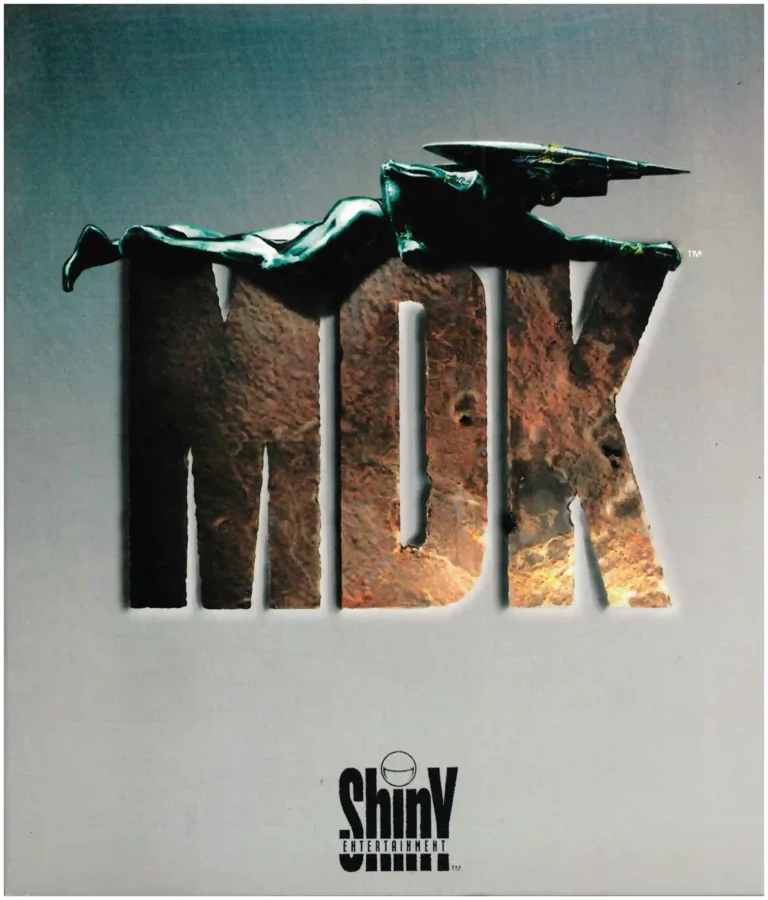
MDK is a 1997 third-person shooter developed by Shiny Entertainment, released for Windows in the spring of 1997 (March in the UK, May 5 in North America), with a Mac port by Shokwave that summer and a PlayStation port that November by Neversoft — two years before that studio made Tony Hawk’s Pro Skater. Playmates Interactive published in North America, Shiny itself in Europe. Reviews were broadly positive — praising the level design, the sardonic humor, the technical wizardry, and above all one mechanic — and the game sold past 400,000 copies within a year, half a million by 2000, enough for Interplay to commission a sequel immediately.
That one mechanic deserves top billing: MDK’s sniper mode is the ancestor of every scoped zoom in modern shooters — a first-person, magnified precision view summoned at will in 1997, when the idea of zooming into an enemy across a map was genuinely novel. Its second legend is technical: Shiny’s custom engine ran its sweeping alien vistas in pure software rendering on a bare Pentium, no 3D accelerator required, at a moment when the industry was betting everything on new GPU hardware.
Technical Specifications
| Attribute | Details |
|---|---|
| Developer | Shiny Entertainment (its first PC game) |
| Publishers | Playmates Interactive (NA) · Shiny Entertainment (EU) |
| Concept & Design | Nick Bruty (also writer and co-artist) |
| Producers | David Perry · Scott Herrington |
| Music | Todd Dennis · Tommy Tallarico (producer) |
| Engine | Custom software renderer (built by ~6 programmers in about a year; no GPU required) |
| Release | Windows: March–May 1997 · Mac: June 1997 · PlayStation: November 1997 (port by Neversoft) |
| Sales | 400,000+ by mid-1998 · ~500,000 by 2000 |
| Sequel | MDK2 (2000, BioWare) |
| Genre | Third-person shooter |
| Mode(s) | Single-player |
A Janitor Against the Minecrawlers
Earth is being strip-mined alive by Minecrawlers — alien harvesting vehicles the size of cities, flattening everything in their path. The only resistance: the orbiting station Jim Dandy, home to possibly-insane inventor Dr. Fluke Hawkins, his robotic dog Bones, and his janitor — Kurt Hectic, stuffed reluctantly into the skin-tight Coil Suit and dropped onto each Minecrawler to fight through to its control center, assassinate the pilot, and ride home. The tone is pure Shiny: deadpan absurdity in the Earthworm Jim lineage, from the World’s Smallest Nuclear Explosion in the arsenal to a hero whose surname the designers lifted from Mike Leigh’s 1993 film Naked — “What is it like in your head? Hectic?”
Ribbon Chute, Sniper Head
Each level is a self-contained infiltration: Kurt skydives through flak in the game’s signature freefall sequences, deploys his ribbon parachute to glide across the Minecrawlers’ interiors, chain-guns through arenas — and at any moment snaps into sniper mode, his helmet unfolding into a scoped cannon with up to 100x magnification, loading special rounds from sniper grenades to homing bullets. Minigames, bombing runs, and one-off gags (riding a bomb, surfing on air currents) break up the run-and-gun, and the whole campaign moves with an inventiveness reviews of the era struggled to compare to anything. The two evergreen criticisms were the mirror of that generosity: at six Minecrawlers it’s short, and the story exists mostly as a delivery system for jokes.
What Does MDK Stand For?
The question that has followed the game for nearly thirty years has no official answer — by design. Internally it began as “Murder Death Kill,” softened during development when merchandising concerns arose (alternatives like “Mighty Dude Kurt” were floated), and Shiny ultimately shipped the acronym unexplained, letting “Max, Dr. Fluke, Kurt” and a dozen other backronyms flourish. The ambiguity outlived the studio: it remains the first question in every retrospective, and the game’s fan wiki is literally named after one of the guesses.
Legacy
Interplay wanted MDK2 immediately; Bruty — wary of rushing a sequel after his Earthworm Jim experience — had already left to found Planet Moon Studios and build Giants: Citizen Kabuto, so the follow-up went to a young BioWare, whose MDK2 arrived in 2000. A third game was announced by Interplay in 2007 and never materialized, and a planned animated series died on the vine — leaving the original as the purest expression of one of the 1990s’ most inventive one-offs: the game that taught shooters to zoom.
Where to Play It Today
MDK is sold on GOG — where it’s been since September 2008, part of the store’s launch-era catalog, tweaked for modern Windows — and on Steam, both for a few dollars and routinely discounted lower. There is no remaster; the PS1 port survives only on original hardware and the secondary market. Community fixes (widescreen patches, the fan-favorite sources on PCGamingWiki) smooth the 1997 edges for modern monitors — worth the five minutes for a game whose ideas still don’t feel their age.